
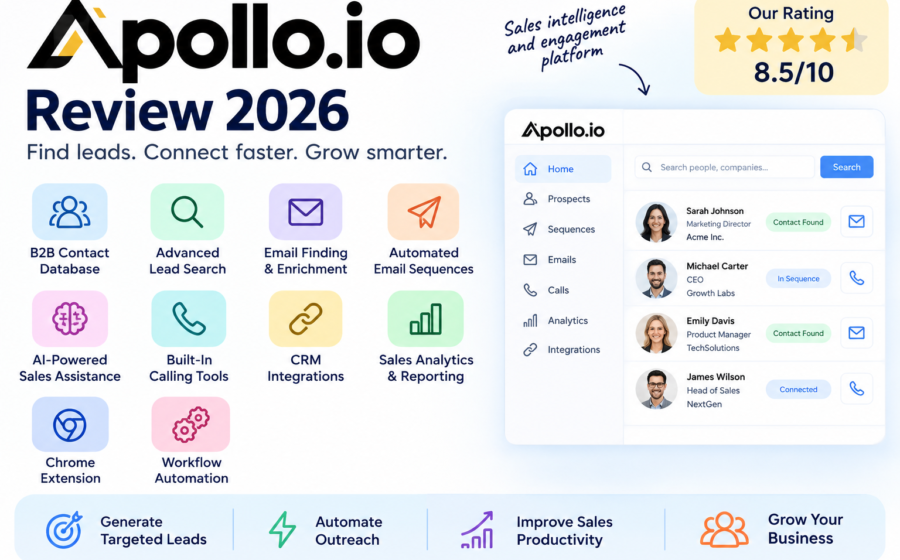
Apollo.io Review 2026
Apollo.io is a sales intelligence and engagement platform designed to help businesses find potential customers, build targeted lead lists, automate email outreach, and improve their sales processes. It combines a business-to-business (B2B) contact database with prospecting tools, email sequences, data enrichment, and sales engagement features in one platform.
Unlike traditional lead-generation tools that focus primarily on collecting contact information, Apollo.io helps businesses move from prospect research to customer outreach within a connected workflow. Sales representatives can search for decision-makers, identify companies that match their ideal customer profile, organize leads, and follow up with prospects through automated email sequences.
Apollo.io also offers AI-powered capabilities that can help users research prospects, prepare personalized messages, and streamline repetitive sales activities. Its integrations with customer relationship management (CRM) systems make it easier for sales teams to connect prospecting activities with their existing business workflows.
However, Apollo.io is not perfect for every business. Contact information may be outdated or incomplete, credit limits can affect how much prospecting users can do, and email outreach requires careful management to protect deliverability and follow applicable marketing regulations.
So, what does Apollo.io offer in 2026? How much does it cost? What are its biggest advantages and disadvantages? And is it worth using for your business?
Let’s take a closer look in this Apollo.io review.
Table of Contents
Our Rating
| Category | Our Rating |
|---|---|
| Lead Generation | 9/10 |
| Contact Database | 8.5/10 |
| Email Outreach | 8.5/10 |
| AI Features | 8/10 |
| CRM Integration | 8.5/10 |
| Ease of Use | 8/10 |
| Pricing and Affordability | 8.5/10 |
| Overall | 8.5/10 |
Editorial assessment based on Apollo.io’s publicly documented capabilities, pricing structure, and intended use cases. These are not results from an independent hands-on benchmark. Contact accuracy, deliverability, and value will vary depending on the market, data requirements, and how the platform is used.
About Apollo.io
Apollo.io is a B2B sales intelligence and engagement platform that helps businesses identify potential customers and manage outbound sales activities.
The platform is designed for people who need to find business contacts, research companies, and communicate with decision-makers. Instead of purchasing a contact database and a separate email outreach tool, users can access several sales-related capabilities through one platform.
For example, imagine you run a software company that sells accounting software to small businesses. You want to contact finance managers, business owners, and accounting professionals who might benefit from your product.
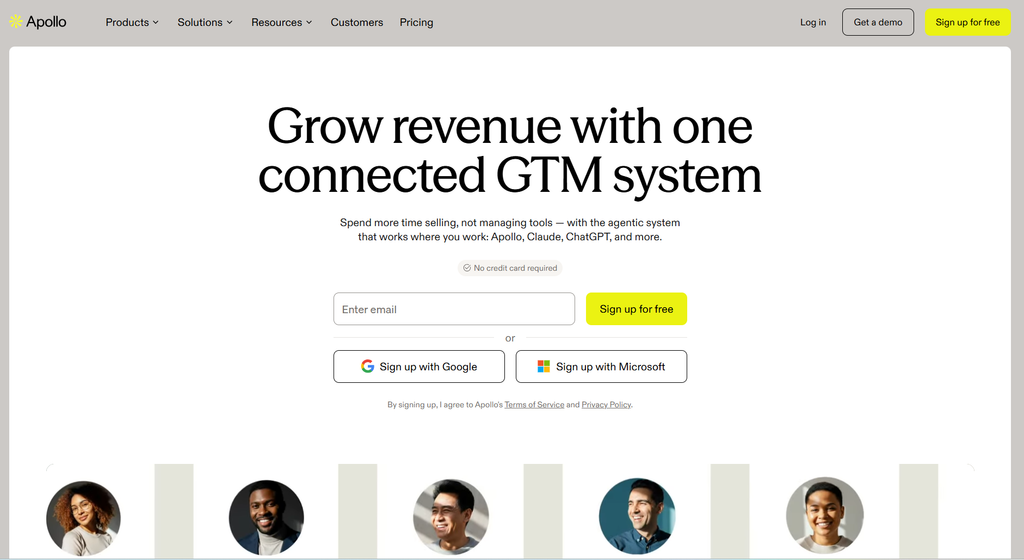
Using Apollo.io, you can search for companies that match your target market, filter contacts by job title or industry, find available business contact information, and organize relevant prospects into lists. You can then use email sequences to plan follow-up messages and track selected engagement activities.
Apollo.io is useful for several types of businesses, including:
- B2B software companies
- Marketing and lead-generation agencies
- Startups and small businesses
- Sales development teams
- Business consultants
- Recruiting and staffing companies
- Enterprise sales departments
One of Apollo.io’s main advantages is that it combines prospecting and engagement. Users can research potential customers and then take action without constantly switching between different applications.
However, Apollo.io should not be treated as a guarantee of accurate contact information or successful sales. Businesses still need to verify important details, write relevant messages, and build appropriate relationships with prospects.
You can explore the official platform at Apollo.io.
How We Evaluated Apollo.io
This review examines Apollo.io’s publicly documented features, pricing, practical applications, and potential limitations. It is an editorial review rather than a claim of independent, controlled product testing.
We considered the following factors:
- Contact database and lead discovery
- Search filters and prospect targeting
- Email finding and data enrichment
- Email sequences and outreach automation
- AI-powered sales assistance
- Calling and engagement capabilities
- CRM integrations
- Sales reporting and analytics
- Ease of use
- Pricing and credit limitations
- Data accuracy and email deliverability considerations
- Suitability for small businesses and larger sales teams
We also considered how Apollo.io fits into everyday business activities, including prospect research, lead generation, customer outreach, and sales pipeline management.
The goal is to help readers understand whether Apollo.io is suitable for their organization and whether its features justify the cost.
Apollo.io Features
1. B2B Contact Database
One of Apollo.io’s core features is its searchable B2B contact database.
Businesses often struggle to identify the right people to contact. Finding a company is relatively easy, but locating a relevant decision-maker and obtaining usable business contact information can require considerable research.
Apollo.io helps simplify this process by allowing users to search for business contacts and companies using available database information.
Depending on the available records and subscription, users may find information such as:
- Contact names
- Job titles
- Company names
- Business email addresses
- Phone numbers
- Company websites
- Industry information
- Company size
- Professional and organizational details
For example, a marketing agency that specializes in helping software companies could use Apollo.io to identify marketing managers, founders, and other decision-makers at relevant businesses.
Instead of manually researching every company, the agency can build a list of potential customers based on its target audience.
Potential benefits include:
- Faster prospect research
- More organized contact lists
- Easier identification of decision-makers
- Reduced manual data collection
- More focused sales outreach
However, no contact database is perfectly accurate. People change jobs, companies update their contact information, and some records may be incomplete or outdated.
Businesses should verify important contact details before launching large campaigns, especially when accuracy is critical.
2. Advanced Lead Search and Filtering
Finding thousands of contacts is not necessarily useful if those contacts are unlikely to become customers. Effective prospecting requires businesses to identify people and organizations that match their target market.
Apollo.io offers search filters that help users narrow down potential prospects.
Depending on the available plan and search options, users can filter contacts or companies by criteria such as:
- Job title and seniority
- Industry
- Company size
- Geographic location
- Company name
- Technologies used
- Department
- Available contact information
- Other company and prospect attributes
For example, a company selling cybersecurity software might want to reach IT directors at medium-sized businesses in the United States.
Instead of creating a broad list of unrelated contacts, its sales team can use relevant filters to focus on people who are more likely to need the product.
Advanced filtering can help businesses:
- Create targeted prospect lists
- Reduce irrelevant outreach
- Identify decision-makers
- Segment prospects into different audiences
- Organize campaigns around specific industries
- Improve the efficiency of sales research
The quality of the results still depends on the accuracy of the underlying data and the filters selected.
If your targeting criteria are too broad, you may collect many irrelevant contacts. If your criteria are too restrictive, you might miss useful opportunities.
For the best results, define your ideal customer profile before building a list.
3. Email Finding and Data Enrichment
Sales teams often work with incomplete customer records. A spreadsheet might contain company names but no contact details, or a CRM might have outdated information about existing prospects.
Apollo.io provides contact discovery and data enrichment capabilities to help businesses find available information and update records.
Depending on the plan and feature used, users may be able to discover business emails, access phone information, and enrich existing contact or company records.
For example, a sales representative might have a spreadsheet containing the names of 200 companies but limited information about their decision-makers.
Apollo.io can help identify relevant contacts associated with those companies and provide available business details.
Data enrichment can be useful for:
- Completing incomplete prospect records
- Updating selected CRM information
- Identifying business contacts
- Preparing targeted outreach campaigns
- Reducing repetitive research
- Organizing sales databases
However, users should understand the platform’s credit system before enriching large lists. Certain actions consume credits, and the amount available depends on the subscription and the specific action.
Phone-number discovery, email access, exports, and other activities may have different usage rules.
Before purchasing a paid plan, estimate how many contacts you need to research each month and check the current credit requirements.
Also, remember that discovering an email address does not guarantee that the address is current, that the recipient wants marketing messages, or that an email will reach the inbox.
4. Automated Email Sequences
Apollo.io includes email sequencing capabilities that help sales teams organize and automate follow-up communication.
In traditional outbound sales, representatives often send an initial email and then manually remember to follow up several days later. When managing hundreds of prospects, this process becomes difficult to maintain.
Email sequences help organize this workflow by scheduling a series of messages according to configured timing and campaign rules.
For example, a simple sales sequence might include:
- An introductory email explaining a product.
- A follow-up message a few days later.
- A message addressing a common customer problem.
- A final follow-up inviting the prospect to respond or schedule a meeting.
The exact sequence, timing, and automation options depend on the features available in the user’s account.
Apollo.io can help sales teams:
- Plan consistent follow-ups
- Reduce repetitive manual work
- Organize outbound campaigns
- Track selected engagement metrics
- Manage prospect communication
- Maintain a more structured outreach process
One important advantage is that prospecting and email engagement can happen within the same platform.
However, automated outreach should not mean sending identical, irrelevant messages to everyone. Prospects are more likely to appreciate communication that addresses their actual needs.
Users should personalize messages, monitor replies and complaints, maintain clean contact lists, and follow applicable email marketing laws.
Email deliverability also depends on sending practices, mailbox reputation, authentication, message quality, and recipient engagement. Apollo.io cannot guarantee that every message will reach the inbox.
5. AI-Powered Sales Assistance
Apollo.io offers AI-related capabilities designed to support sales research, communication, and workflow efficiency.
AI can help sales professionals spend less time preparing repetitive messages and more time understanding potential customers.
Depending on the available feature and subscription, AI assistance may help with tasks such as:
- Preparing sales email drafts
- Personalizing outreach
- Supporting prospect research
- Summarizing relevant information
- Improving sales workflows
- Reducing repetitive administrative tasks
For example, a salesperson contacting a company that is hiring several new employees might want to explain how their product could help manage the company’s growth.
AI assistance can help prepare a relevant first draft based on the information available to the user. The salesperson can then review the message and make it more specific to the prospect.
Potential benefits include:
- Faster email preparation
- Less repetitive writing
- Support for personalization
- More efficient sales research
- Improved consistency across campaigns
However, AI-generated content is not always accurate or persuasive. It may produce generic language, misunderstand company information, or include assumptions that have not been verified.
Users should review AI-generated messages before sending them. Avoid inventing facts about prospects or using personal information in ways that violate privacy expectations.
AI is most useful when it supports informed human decisions rather than replacing thoughtful communication.
6. Built-In Calling Tools
Apollo.io also provides calling and sales engagement capabilities for eligible subscriptions.
Some sales processes require more than email. A representative might need to call a prospect to discuss a product, answer questions, or schedule a demonstration.
Built-in calling capabilities can help bring selected calling activities into the same environment used for prospecting and email outreach.
Depending on the plan and configuration, available capabilities may include:
- Calling selected prospects
- Managing calling activities
- Organizing follow-up tasks
- Recording or reviewing calls where supported
- Tracking selected sales engagement information
For example, a software sales team might identify a relevant business owner through Apollo.io, send an introductory email, and follow up with a phone call when appropriate.
Keeping these activities connected can make it easier to organize prospect interactions.
However, calling functionality and usage limits vary by subscription. Businesses should check which dialer features are included before choosing a plan.
They should also comply with applicable telemarketing rules, consent requirements, recording laws, and restrictions on unsolicited calls.
Calling tools can support the sales process, but successful conversations still depend on preparation, relevance, and professional communication.
7. CRM Integrations
Customer relationship management software helps businesses organize contacts, sales opportunities, customer histories, and pipeline activities.
Apollo.io offers integrations with CRM and sales tools so businesses can connect prospecting data with their existing systems.
Its integrations include supported connections with platforms such as Salesforce and HubSpot, with additional options depending on the integration and subscription.
CRM integration can help businesses:
- Transfer relevant prospect information
- Enrich existing contact records
- Keep selected sales information synchronized
- Reduce duplicate data entry
- Connect prospecting with pipeline management
- Coordinate work across sales teams
For example, a company might use Apollo.io to find potential customers and Salesforce to manage sales opportunities.
A supported integration can help connect these activities, reducing the need to manually copy information between systems.
However, integrations may require configuration, appropriate permissions, and careful field mapping.
Businesses should also establish rules for handling duplicate records and deciding which system is the source of truth for important customer information.
Before enabling synchronization, test the integration with a small set of records and review how updates are handled.
8. Sales Analytics and Reporting
Sales teams need to understand whether their prospecting and outreach activities are producing useful results.
Apollo.io offers reporting and analytics capabilities that help users monitor selected sales activities and campaign performance.
Depending on the plan and feature, reports may provide insight into areas such as email engagement, sequence activity, prospecting workflows, and sales performance.
These insights can help businesses investigate questions such as:
- Which campaigns are generating replies?
- Are prospects engaging with outreach messages?
- Which sequences need improvement?
- Are sales representatives following up consistently?
- Which activities deserve further attention?
For example, a company running two different email campaigns might compare their reply rates and meeting outcomes to understand which message is more relevant to its audience.
The team can then adjust its targeting, messaging, or follow-up schedule.
Reporting can support better decision-making, but individual metrics should be interpreted carefully.
An email open does not necessarily mean that a prospect is interested. Open tracking can also be affected by privacy features and automated email systems.
Reply quality, qualified meetings, conversion rates, and revenue are often more useful measures of business impact.
Teams should select metrics that match their actual sales goals rather than focusing only on activity volume.
9. Chrome Extension
Apollo.io provides a Chrome extension that can help users access supported prospecting features while browsing compatible websites and professional profiles.
This can be convenient for sales professionals who research companies and potential customers throughout the day.
Instead of switching between multiple tabs for every task, users may be able to access relevant Apollo information directly through supported browsing workflows.
Depending on the current extension and available permissions, this can help users:
- Find available business contact information
- Research companies and prospects
- Access relevant contact records
- Add or organize selected prospects
- Support sales research while browsing
For example, a salesperson researching a software company may use the extension to investigate available business contact information and decide whether the company matches their target market.
This can reduce friction during prospect research.
However, extension capabilities and access may change over time. Users should check the current Chrome Web Store listing and Apollo documentation for supported features and permissions.
As with any browser extension, review its permissions and use it in accordance with company policies and applicable privacy requirements.
10. Workflow Automation
Apollo.io helps businesses connect prospecting and sales engagement activities through configured workflows.
Sales teams often repeat the same tasks: finding prospects, organizing contacts, assigning follow-ups, sending messages, and reviewing responses.
When these processes are managed entirely by hand, representatives may spend too much time on administrative work.
Supported automation features can help reduce some of this repetitive effort.
Possible applications include:
- Organizing prospect lists
- Managing email sequences
- Coordinating follow-up activities
- Supporting contact enrichment
- Connecting prospecting with CRM workflows
- Helping sales teams maintain consistent processes
For example, a sales team might create a workflow for new prospects that includes researching the contact, checking the available business details, assigning the prospect to the appropriate representative, and enrolling eligible contacts in a relevant sequence.
The actual automation options depend on the selected plan, integrations, and configuration.
Automation should be designed carefully. Poorly configured workflows can send irrelevant messages, create duplicate records, or contact people who should not receive further communication.
Businesses should begin with a small, clearly defined process, test the results, and introduce safeguards before scaling up.
Quick Summary
| Feature | Best For |
|---|---|
| B2B Contact Database | Finding potential business customers |
| Advanced Search | Identifying relevant prospects |
| Data Enrichment | Completing selected contact records |
| Email Sequences | Organizing follow-up campaigns |
| AI Sales Assistance | Drafting and personalizing sales messages |
| Calling Tools | Supporting phone-based sales outreach |
| CRM Integrations | Connecting prospecting with customer records |
| Sales Analytics | Monitoring outreach performance |
| Chrome Extension | Supporting research while browsing |
| Workflow Automation | Reducing repetitive sales tasks |
Apollo.io Pricing
Apollo.io offers multiple subscription levels, including a free plan and paid plans for users who need more advanced sales capabilities.
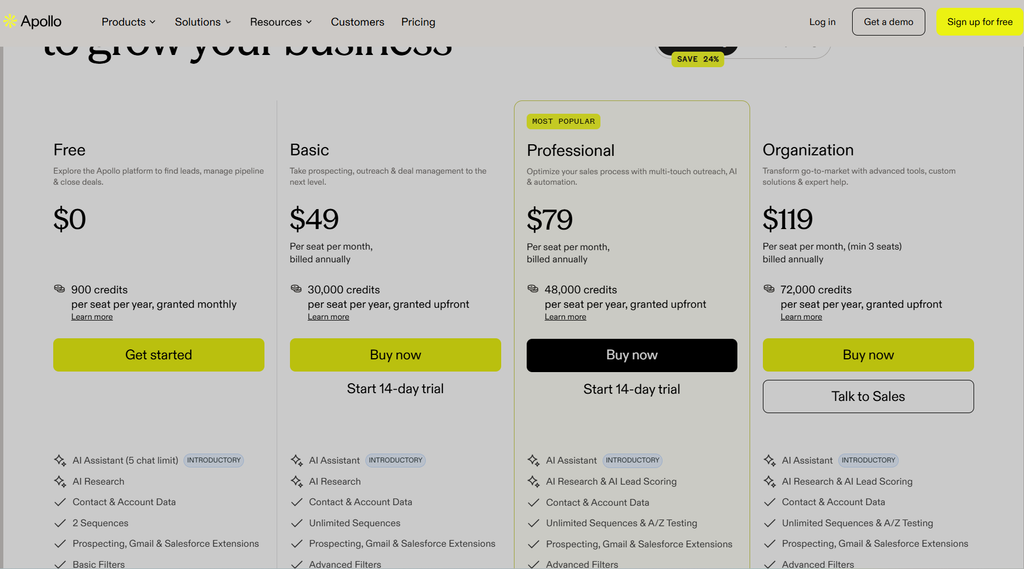
The amount you pay depends on the selected plan, billing schedule, number of users, included credits, and any additional services or usage requirements.
Apollo’s official pricing page lists the following plan structure:
| Plan | Pricing | Best For |
|---|---|---|
| Free | $0 | Individuals exploring Apollo and users with limited prospecting needs |
| Basic | $49 | Individual salespeople and regular outbound prospecting |
| Professional | $75 | Sales representatives needing more credits and advanced engagement features |
| Custom | $119 | Organizations requiring tailored volumes, security, or support |
Apollo’s official pricing page describes the main differences between these plans, but feature availability and exact prices should be checked directly before purchasing.
Pricing Updated: 09/10/2026
Visit the official Apollo.io pricing page for current rates and plan details.
What Does the Free Plan Include?
Apollo.io offers a free option for users who want to explore the platform before paying.
The free plan can be useful for learning how to search for prospects, understand the interface, and evaluate whether Apollo fits your sales process.
However, free access is limited. The available credits, number of permitted activities, integrations, and other features may differ from those included in paid subscriptions.
A free account is a sensible starting point for freelancers, founders, and small teams that want to test the platform before committing to a subscription.
Before relying on the free plan for regular prospecting, check its current limits and the credit cost of the actions you expect to perform.
What About Paid Plans?
Apollo.io’s paid plans are designed for users who need more consistent prospecting and outreach capabilities.
Depending on the plan, paid subscriptions can provide higher credit allowances, more advanced filters, additional email engagement features, expanded integrations, and other sales tools.
A paid plan may be worthwhile if Apollo.io becomes a regular part of your sales process.
However, the advertised subscription price is not the only cost to consider.
Evaluate the following before upgrading:
- Number of users who need access
- Monthly or annual billing requirements
- Available contact and phone-number credits
- Email sequencing requirements
- CRM integration needs
- Additional credits or add-ons
- Features available only on higher tiers
Apollo uses credits for certain activities, and credit allowances vary by subscription. Unused credits may not carry over into the next billing cycle, so check the current terms.
Is Apollo.io Worth the Price?
Apollo.io can offer good value for businesses that need both prospecting data and outreach tools.
A business that would otherwise pay for separate lead databases, email sequencing software, and contact enrichment services may appreciate having several capabilities in one platform.
However, the value depends on how much of the platform you actually use.
A freelancer who needs only a small number of contacts may find the free plan sufficient. A growing B2B sales team with regular outreach requirements may benefit from a paid subscription.
An organization that requires extensive international phone data, large export volumes, or advanced enterprise controls should compare the total cost with competing solutions.
The best approach is to start with a clearly defined prospecting goal, test the available features, and measure how much time and money the platform saves before upgrading.
Also Read: HubSpot Review 2026: Features, Pricing, Pros, Cons & Alternatives
Apollo.io Pros and Cons
| Pros ✅ | Cons ❌ |
|---|---|
| Large B2B contact database for prospect research. | Contact details may be outdated, incomplete, or inaccurate. |
| Combines prospecting and outreach in one platform. | Credit limits can restrict contact discovery and enrichment. |
| Free plan available for initial exploration. | Free access does not include every feature or unlimited usage. |
| Advanced filters help target relevant businesses and decision-makers. | Search results depend on data quality and targeting criteria. |
| Email sequences help organize follow-up activities. | Poorly managed outreach can damage sender reputation. |
| AI assistance can reduce repetitive writing and research tasks. | AI-generated messages require review and personalization. |
| Integrations connect Apollo with supported CRM systems. | Some integrations and capabilities may require higher-tier plans or configuration. |
| Reporting helps teams monitor selected engagement metrics. | Engagement metrics do not guarantee qualified leads or sales. |
| Useful for startups and growing B2B sales teams. | Advanced requirements can increase the overall cost. |
| Multiple sales functions are available through one platform. | The range of features can create a learning curve for beginners. |
Who Should Use Apollo.io?
Apollo.io is best suited to businesses that rely on outbound B2B prospecting and want a connected way to research potential customers and manage outreach.
1. B2B Sales Teams
Sales representatives can use Apollo.io to identify decision-makers, build prospect lists, organize follow-ups, and support their outreach activities.
It can be particularly useful for teams that need to contact many businesses regularly.
2. Startups and Small Businesses
Startups often have limited budgets and small sales teams. Apollo.io can help them research potential customers without immediately purchasing several separate sales tools.
The free plan also gives smaller businesses an opportunity to explore the platform before investing in a subscription.
However, startups should evaluate the cost of paid features against their actual prospecting needs.
3. Marketing Agencies
Marketing agencies that provide lead generation, advertising, or business growth services may use Apollo.io to identify potential clients and organize outreach.
For example, an agency specializing in SEO services could search for businesses in relevant industries and build a list of companies to research further.
Agencies must still ensure that their prospecting practices comply with applicable privacy, marketing, and client requirements.
4. B2B Software Companies
Software companies often need to reach specific professionals, such as IT managers, operations directors, founders, and department heads.
Apollo.io’s search and filtering capabilities can help sales teams identify businesses that match their target customer profile.
Email sequences can then help organize initial outreach and follow-up communication.
5. Freelancers and Consultants
Freelancers and consultants who sell services to businesses may find Apollo.io useful for researching potential clients.
A consultant specializing in automation, for example, could search for businesses that match a defined industry or company-size profile.
The free plan may be sufficient for initial research, while a paid subscription may make sense if prospecting becomes a regular source of new business.
6. Recruiting and Staffing Companies
Recruiters and staffing agencies may use business contact databases to research companies and identify relevant hiring contacts.
Apollo.io can support some business-contact research workflows, although it should not automatically be treated as a complete replacement for specialist recruiting databases.
Recruiters should evaluate whether its available data, search options, and permitted uses match their requirements.
Who Might Want to Avoid It?
Apollo.io may be less suitable for:
- Individuals who rarely need business contact information
- Businesses that depend mainly on inbound leads
- Users who need only a basic email marketing platform
- Organizations requiring consistently verified phone numbers across every international market
- Companies that need a specialist recruiting database
- Teams unwilling to manage contact quality and email deliverability
- Businesses that require capabilities unavailable in their selected plan
These users may benefit from a simpler or more specialized tool.
Apollo.io Use Cases
1. Lead Generation and Sales Prospecting
Lead generation is one of Apollo.io’s main applications.
Businesses can define their target market, search for relevant companies and contacts, and organize prospects into lists for further research.
For example, a company selling website development services might target small businesses that are likely to need website improvements.
A structured prospecting process helps the company spend less time searching randomly and more time evaluating relevant opportunities.
However, identifying a prospect does not mean the prospect is automatically interested in purchasing a service. Outreach should be relevant and respectful.
2. Cold Email Outreach
Apollo.io can help sales teams organize cold email campaigns using supported sequencing features.
A business might create a short introduction, schedule a follow-up, and prepare a final message for prospects who have not responded.
The objective is to maintain a consistent process without requiring representatives to manage every follow-up manually.
Effective cold outreach should focus on a specific business problem rather than sending generic promotional messages.
Users should also maintain appropriate consent and suppression practices, honor opt-out requests, and follow the marketing laws that apply to their recipients.
3. Building Targeted B2B Contact Lists
Companies can use Apollo.io’s search filters to identify businesses and professionals who fit a defined customer profile.
For example, an agency offering cybersecurity services could search for relevant companies and job roles instead of contacting every business in a geographic region.
Targeted lists can make campaigns more organized and help teams measure performance across different customer segments.
The most useful lists are based on a clear reason the prospect might benefit from the product or service.
4. Contact Data Enrichment
Businesses with existing customer spreadsheets or CRM records may use Apollo.io to find additional business information.
This can help sales representatives research accounts, identify relevant contacts, and prepare for conversations.
Before enriching large lists, teams should check credit requirements and review the platform’s terms governing data use.
They should also avoid assuming that every newly discovered detail is accurate.
Also Read: Leonardo AI Review 2026: Features, Pricing, Pros, Cons & Alternatives
5. Sales Follow-Up Management
Following up consistently is an important part of many B2B sales processes.
Apollo.io’s sequencing and engagement features can help representatives organize communications and manage selected activities.
For example, a sales representative might contact a potential customer after a product demonstration and schedule a reminder to follow up if the prospect does not respond.
The goal is to make follow-up more reliable without overwhelming prospects with excessive messages.
6. Agency Client Acquisition
Digital marketing agencies, software consultants, and other service providers can use Apollo.io to research potential business clients.
An agency might identify companies in its preferred industry, review their public business information, and prepare personalized outreach explaining how its services could address a specific need.
The platform can help organize research, but agencies should verify their assumptions before contacting prospects.
Personalized, relevant communication is generally more useful than simply increasing the number of messages sent.
7. CRM Data Management
Businesses that use supported CRM systems may connect Apollo.io with their existing contact-management workflows.
This can help teams enrich selected records and coordinate prospecting with their sales pipeline.
For example, a sales operations team could establish a process for reviewing new contacts, checking for duplicates, and synchronizing approved information.
A well-designed process can reduce manual work and improve consistency.
However, integration settings should be tested carefully to avoid overwriting valuable customer information or creating duplicate records.
Apollo.io Alternatives
Apollo.io is not the only platform available for prospecting, sales engagement, and business contact research.
The best alternative depends on your budget, preferred workflow, data requirements, and the tools your business already uses.
| Alternative | Best For | Main Difference |
|---|---|---|
| ZoomInfo | Organizations needing extensive B2B sales intelligence | Focuses on business data and sales intelligence, with pricing and access suited to different enterprise requirements. |
| Cognism | B2B prospecting, particularly for teams with international data needs | Emphasizes business contact data and compliance-oriented prospecting capabilities. |
| Hunter.io | Finding and verifying professional email addresses | More focused on email discovery and verification than an all-in-one sales platform. |
| Lusha | Finding business contact information | Provides prospecting and contact data tools for sales and recruitment workflows. |
| HubSpot | CRM, marketing, and sales management | Offers a broader customer platform with CRM and sales tools; contact-data capabilities differ from Apollo. |
1. ZoomInfo
ZoomInfo is a B2B intelligence platform used by organizations that need business contact information, company insights, and sales prospecting capabilities.
It may be worth considering for companies with more demanding sales intelligence requirements.
However, pricing, access, and contract terms should be compared directly with Apollo.io. It may not be the best fit for businesses seeking a simple, low-cost starting point.
2. Cognism
Cognism provides B2B sales intelligence and contact data capabilities, including tools aimed at sales teams conducting business prospecting across markets.
It is worth evaluating if international contact coverage and compliance-related requirements are major priorities.
As with any data provider, assess coverage in your target countries and verify the data quality you can expect for your specific audience.
3. Hunter.io
Hunter.io focuses on finding and verifying professional email addresses.
It can be a good alternative for users whose main requirement is email discovery rather than a broad platform for prospecting, sequences, and calling.
If you already have a separate sales engagement tool, a specialized email-finding service may be sufficient.
4. Lusha
Lusha offers business contact data and prospecting capabilities that can support sales and recruitment workflows.
It may suit users who prioritize discovering contact information and researching potential customers.
Compare its available data, credits, integrations, and subscription terms with Apollo.io before making a decision.
5. HubSpot
HubSpot offers CRM, sales, marketing, and customer-management tools.
It may be a stronger option for businesses that want to organize their customer relationships and manage sales activities through a broader CRM environment.
Apollo.io, by comparison, places a strong emphasis on prospect discovery and outbound sales engagement. The better choice depends on whether your main challenge is finding new contacts or managing the full customer lifecycle.
Also Read: Stable Diffusion Review 2026: Features, Pricing & Pros and Cons
Apollo.io Review Conclusion
Apollo.io is a useful sales intelligence and engagement platform for businesses that need to find B2B prospects, organize contact information, and manage outbound outreach.
Its main strength is the combination of a searchable contact database with email sequences, data enrichment, AI assistance, calling capabilities, and supported CRM integrations.
For startups, freelancers, agencies, and growing sales teams, this combination can simplify prospect research and reduce the need to switch between multiple tools.
However, Apollo.io has limitations. Contact data is not always accurate, credit allowances can restrict prospecting activities, and effective email outreach requires careful attention to deliverability and applicable marketing regulations.
The cost can also increase when businesses need higher usage limits, additional features, or more user seats.
Our final verdict: Apollo.io deserves an editorial rating of 8.5/10 for businesses that need an integrated B2B prospecting and outreach workflow.
It is particularly worth exploring if your business regularly identifies new prospects and conducts outbound sales. Start with the free plan, test its contact data and workflow against your target market, and upgrade only when the benefits justify the cost.
You can learn more or create an account at Apollo.io.
Frequently Asked Questions
What is Apollo.io used for?
Apollo.io is used for B2B lead generation, contact discovery, sales prospecting, email outreach, data enrichment, and sales engagement. It helps businesses find potential customers and organize outreach activities through one platform.
Is Apollo.io free?
Yes. Apollo.io offers a free plan with limited usage. The available credits, features, and usage limits depend on its current plan terms. Paid subscriptions are available for users who need additional capabilities.
How much does Apollo.io cost in 2026?
Apollo.io offers a free plan and paid subscriptions, including Basic and Professional, as well as options for organizations with customized requirements. Prices and billing terms can change, so consult the official pricing page for current information.
Is Apollo.io good for small businesses?
Apollo.io can be useful for small businesses that sell products or services to other businesses. Its contact database and outreach features can help them research potential clients and organize sales activities.
Small businesses should still evaluate credit limits and paid-plan costs against their actual needs.
Does Apollo.io use artificial intelligence?
Yes. Apollo.io offers AI-related features that support sales research, communication, and productivity. The available capabilities depend on the current product and subscription. Users should review AI-generated information and messages before relying on them.
Can Apollo.io automate cold emails?
Apollo.io supports email sequences that can help organize and automate parts of outbound email communication. Available functionality depends on the user’s plan and configuration.
Users must still follow applicable marketing laws, honor opt-out requests, and use responsible sending practices.
Is Apollo.io good for lead generation?
Apollo.io can be a strong option for B2B lead generation because it combines contact discovery, search filters, and outreach tools.
Its effectiveness depends on the accuracy of available data, the relevance of your targeting, and the quality of your sales communication.
Does Apollo.io integrate with Salesforce?
Apollo.io offers a supported Salesforce integration, allowing businesses to connect relevant prospecting information with their CRM workflows. Exact capabilities and setup requirements may depend on the subscription and integration configuration.
What are the best Apollo.io alternatives?
Popular alternatives include ZoomInfo, Cognism, Hunter.io, Lusha, and HubSpot. ZoomInfo and Cognism may suit some business intelligence needs, Hunter.io focuses on email discovery, Lusha offers contact data tools, and HubSpot provides a broader CRM and sales platform.
The best alternative depends on your budget and required features.
Is Apollo.io worth it in 2026?
Apollo.io may be worth it for businesses that regularly conduct B2B prospecting and want contact research and outreach tools in one place.
It may be less valuable for users who need only a few contacts or primarily rely on inbound marketing. Testing the free plan before upgrading is a practical way to determine whether it fits your workflow.
Is Apollo.io suitable for beginners?
Yes, beginners can start with Apollo.io’s free plan and learn its basic search and prospecting functions. However, advanced filters, email sequences, integrations, and credit management may take time to understand.
Starting with a small prospect list and a simple workflow can make the learning process easier.
Does Apollo.io guarantee accurate email addresses?
No. Apollo.io provides access to business contact data, but no database can guarantee that every email address is accurate and current. Users should verify important information and monitor bounce rates before scaling outreach campaigns.
1.
2.
3.
4.
5.
6.
7.
8.
9.
10.
11.