

MailMesh Review
Email infrastructure plays an important role in modern business communication. Whether you run a small business, manage a SaaS application, operate an online store, or send emails to customers, reliable email delivery is essential for keeping your audience informed and maintaining trust.
MailMesh is an email infrastructure platform that appears to focus on helping businesses manage their email delivery systems. Its website presents it as a service for managing email infrastructure, making it relevant to companies that depend on email for operational and customer communications.
Unlike traditional email marketing platforms that concentrate on newsletters, campaign templates, and subscriber management, an email infrastructure service generally focuses on the technical systems that help emails reach their intended recipients.
For businesses, this distinction matters. Marketing emails are used to promote products, share updates, and nurture leads, while transactional emails deliver important information such as account verification messages, password resets, order confirmations, and application notifications.
In this MailMesh review, we examine its apparent purpose, potential features, benefits, limitations, pricing considerations, use cases, and alternatives. Our goal is to help businesses understand whether MailMesh deserves consideration for their email infrastructure needs.
Important: This review is based on the publicly available information that could be verified. MailMesh’s detailed feature documentation, current pricing, and performance claims could not be independently confirmed. The feature descriptions below distinguish general email infrastructure capabilities from features that would need to be verified directly with MailMesh.
Our Rating
The following is a provisional editorial assessment, not a rating based on hands-on testing or verified performance benchmarks.
| Category | Provisional Assessment |
|---|---|
| Ease of Use | Not independently verified |
| Email Infrastructure | Appears to be the main focus |
| Deliverability | Performance not independently verified |
| Integrations | Not independently verified |
| Pricing | Current pricing not confirmed |
| Customer Support | Not independently verified |
| Overall | Insufficient evidence for a reliable numerical rating |
We believe an honest review should not assign a high overall score without verified information about the platform’s capabilities, reliability, and pricing.
Table of Contents
About MailMesh
MailMesh is an email infrastructure service with a website at MailMesh.co.uk. Its publicly accessible website presents an account sign-in experience for managing email infrastructure.
The platform appears intended for users who need to manage the systems behind business email delivery rather than simply compose and send individual messages.
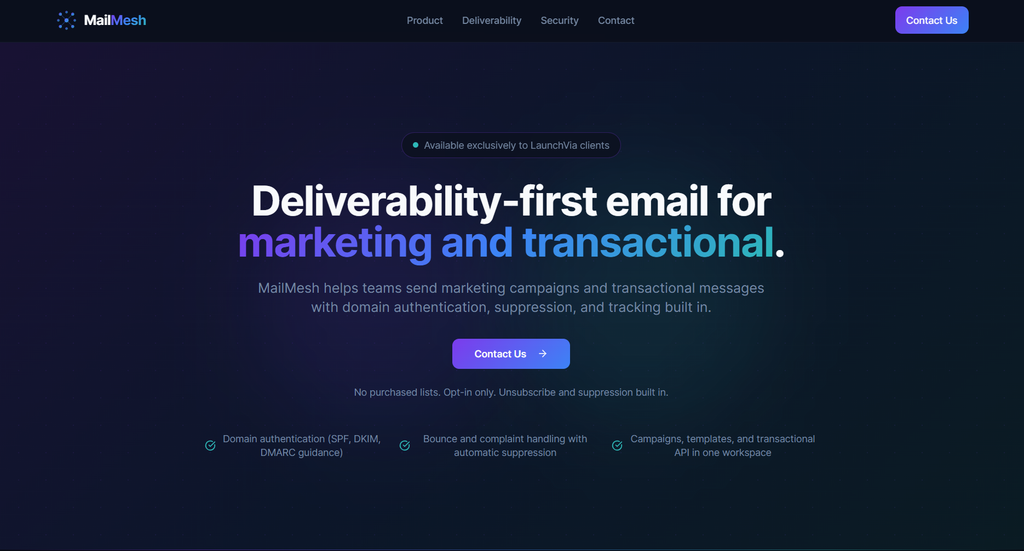
Email infrastructure can include several technical components, such as email-sending services, domain authentication, sending reputation management, delivery monitoring, and the systems responsible for processing outgoing messages.
For example, a software company might need to send thousands of automated notifications every day. These could include account activation emails, security alerts, billing notifications, and product updates. A dedicated email infrastructure platform can help businesses manage this type of communication when the necessary features are available.
However, the precise scope of MailMesh’s offering should be confirmed before choosing it for a production environment. The available public information does not establish which specific infrastructure tools, integrations, or service guarantees are included.
Official website: Mailmesh
How We Evaluated MailMesh
This review considers MailMesh’s publicly visible website and the general requirements businesses should evaluate when choosing an email infrastructure provider.
We considered the following factors:
- Platform purpose and target audience
- Email delivery capabilities
- Domain authentication support
- Deliverability monitoring
- Bounce and complaint handling
- API and developer integration options
- Security and account management
- Pricing transparency
- Scalability for business use
- Customer support and documentation
These factors are important when evaluating any email infrastructure platform. They should not be interpreted as confirmation that MailMesh currently provides every capability listed.
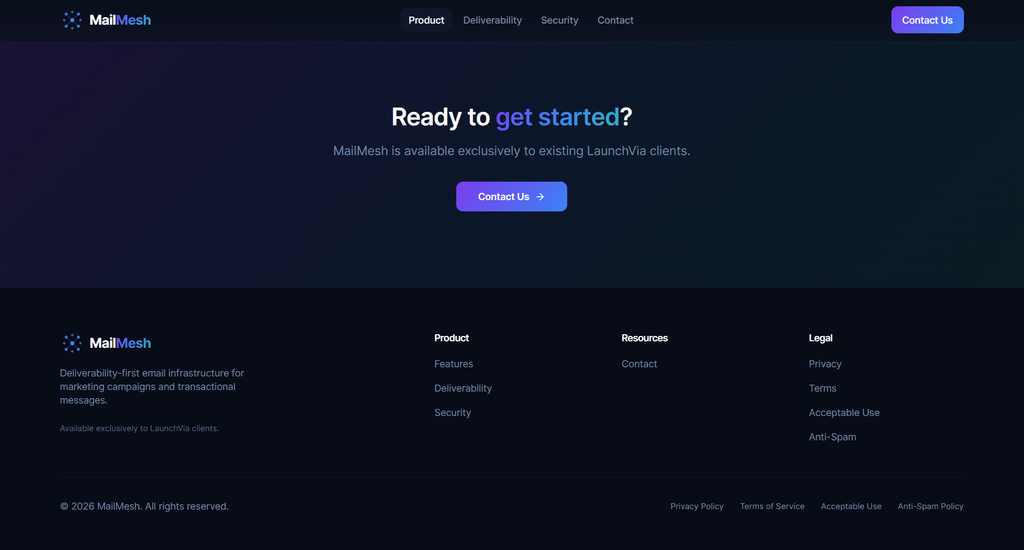
A comprehensive hands-on assessment would require access to a working account, technical documentation, published service terms, and a controlled email delivery test.
MailMesh Features
1. Email Infrastructure Management
MailMesh’s stated focus is email infrastructure management.
Email infrastructure refers to the technical systems and configurations that allow applications and businesses to send emails reliably. Depending on the provider, these systems may include sending servers, domain configuration tools, delivery monitoring, and account-level management features.
For businesses that send a high volume of emails, managing these systems independently can become complicated. A dedicated platform may help centralize parts of the process.
For example, an online service might need to send account verification emails whenever a new user registers. An email infrastructure service can potentially support that workflow by providing a managed system for sending those messages.
The important question is which infrastructure functions MailMesh actually includes. Businesses should confirm whether the platform supports their particular sending requirements before committing to it.
2. Business Email Delivery
Email delivery is one of the most important considerations for any infrastructure provider.
A business can create an accurate, useful email, but it still needs the message to reach the recipient’s inbox. Delivery can be affected by sender reputation, domain authentication, recipient engagement, message quality, and the receiving email provider’s filtering policies.
Email infrastructure platforms commonly provide mechanisms for sending messages through configured systems. Some also offer delivery reports and troubleshooting tools.
For MailMesh, prospective customers should confirm which delivery features are available, whether delivery statistics are provided, and how the service handles failed messages.
It is also important to understand the difference between a message being accepted by a receiving mail server and appearing in the recipient’s primary inbox. No responsible provider should be assumed to guarantee inbox placement for every email.
3. Domain Authentication
Domain authentication helps receiving email providers determine whether messages are authorized to be sent using a particular domain.
Three widely used email authentication technologies are:
- SPF: Specifies which servers are authorized to send email for a domain.
- DKIM: Uses a digital signature to help verify that a message is associated with an authorized sending domain and has not been altered in transit.
- DMARC: Allows domain owners to publish a policy for handling messages that fail authentication checks and receive reporting information.
Correct configuration of these records can improve email security and help protect a domain against spoofing.
When evaluating MailMesh, businesses should ask whether it assists with SPF, DKIM, and DMARC configuration, provides setup instructions, and identifies authentication problems.
These are essential questions for any business planning to send customer-facing emails through a new provider.
4. Email Deliverability Monitoring
Deliverability monitoring helps businesses understand what happens after they send email.
Depending on the platform, monitoring tools may provide information about accepted messages, rejected messages, temporary failures, bounces, spam complaints, and other delivery events.
This information can help technical teams identify problems before they affect a large number of recipients.
For example, a sudden increase in rejected messages might indicate a domain configuration issue, a recipient-list problem, or a reputation concern. Monitoring can help businesses investigate the cause.
MailMesh’s exact monitoring features could not be confirmed from the publicly accessible information reviewed. Before subscribing, users should ask whether it provides a dashboard, downloadable reports, delivery-event logs, or alerts for unusual activity.
5. Bounce and Error Handling
A bounce occurs when an email cannot be delivered to its intended recipient. Some failures are permanent, such as an invalid address, while others are temporary, such as a full mailbox or a receiving server that is temporarily unavailable.
Email infrastructure services may provide bounce notifications, event logs, retry mechanisms, and suppression lists.
These features can help businesses avoid repeatedly sending messages to invalid addresses and reduce unnecessary delivery attempts.
For example, an e-commerce website sending order notifications needs to identify failed messages so its support team can investigate problems and communicate with customers through an appropriate alternative channel.
Businesses should confirm whether MailMesh supports automated bounce processing, suppression management, and configurable retry policies.
6. API and Developer Integration
An application programming interface, or API, allows one software system to communicate with another.
Email APIs are commonly used to connect email infrastructure to websites, mobile applications, online stores, customer relationship management systems, and other business software.
A developer might use an email API to trigger an account verification message whenever someone signs up for a service. Another application could send receipts or password-reset instructions automatically.
API-based sending can reduce manual work and help businesses integrate email into their existing workflows.
However, MailMesh’s specific API availability, supported programming languages, authentication methods, request limits, and documentation could not be verified.
Developers should review the official documentation and confirm that the service supports their required integration before making a decision.
7. Account and Infrastructure Management
MailMesh presents a sign-in interface for managing email infrastructure, indicating that its service is designed around an account-based management experience.
For infrastructure products, a management dashboard can potentially help users review configuration settings, access account information, and administer sending resources.
The usefulness of such a dashboard depends on the tools available inside it.
Before selecting MailMesh, users should determine whether its dashboard supports the operations they need, such as managing sending domains, reviewing delivery activity, changing account settings, or configuring integrations.
The exact dashboard capabilities could not be independently inspected during this review.
8. Scalability for Growing Businesses
As businesses grow, their email requirements often become more demanding.
A small website might send only a few hundred transactional messages each day, while a larger application may need to send thousands or millions of messages over time.
A scalable infrastructure service should be able to accommodate the customer’s expected sending volume within its technical limits and acceptable usage policies.
Important considerations include sending quotas, rate limits, concurrent requests, available IP options, account verification requirements, and procedures for increasing sending capacity.
MailMesh’s specific sending limits and scalability provisions have not been verified. Businesses with high-volume requirements should obtain written confirmation of these details before migrating their email operations.
9. Email Security
Security is particularly important when email systems handle account credentials, customer information, invoices, or sensitive business notifications.
A business evaluating an email infrastructure provider should investigate how the service protects accounts and credentials, manages access, secures data in transit, and responds to potential security incidents.
Other relevant questions include whether multi-factor authentication is available, how API keys are managed, whether audit logs are provided, and what data retention policies apply.
These are general evaluation criteria rather than verified MailMesh features.
Organizations with compliance obligations should also examine the provider’s privacy policy, data processing terms, hosting arrangements, and any applicable security certifications.
10. Email Infrastructure Administration
Managing email infrastructure involves more than sending messages. Businesses may need to monitor sending activity, maintain domain configurations, troubleshoot failed deliveries, and respond to changes in their email requirements.
A centralized administration experience can make these tasks easier if the provider includes the relevant controls.
For MailMesh, the extent of its administrative functionality remains unclear based on the public information available.
Before purchasing, users should request a demonstration or trial that shows the actual workflow for configuring a domain, sending a test email, reviewing delivery results, and investigating a failed message.
Quick Summary
| Area | What to Know |
|---|---|
| Main Purpose | Email infrastructure management |
| Potential Audience | Businesses, developers, and application operators |
| Email Sending | Confirm supported sending methods |
| Authentication | Ask about SPF, DKIM, and DMARC support |
| Analytics | Verify available delivery logs and reports |
| API | Confirm documentation and integration support |
| Scalability | Check sending quotas and rate limits |
| Security | Review authentication, privacy, and data protection |
| Pricing | Current public pricing not confirmed |
| Best Next Step | Review the documentation and request a demonstration |
MailMesh Pricing
MailMesh’s current pricing could not be independently verified during the preparation of this review. Therefore, we cannot responsibly provide specific subscription prices, usage allowances, or a free-plan claim.
Email infrastructure providers use several pricing models. Understanding these models can help businesses evaluate MailMesh when requesting a quote or reviewing its official pricing information.
Common Email Infrastructure Pricing Models
| Pricing Model | How It Works | Best For |
|---|---|---|
| Pay per email | Charges are based on the number of messages sent | Businesses with predictable or variable sending volumes |
| Monthly subscription | Charges a recurring fee for a defined package | Businesses that prefer predictable monthly costs |
| Usage tiers | Pricing increases as sending volume grows | Growing applications and online businesses |
| Dedicated infrastructure | Additional resources may carry separate fees | Businesses with specialized requirements |
| Custom enterprise pricing | Costs are negotiated according to business needs | Large organizations and high-volume senders |
These are common industry pricing structures, not confirmed MailMesh plans.
What to Check Before Paying
Before purchasing a MailMesh subscription, confirm the following:
- Whether a free trial or free plan is available.
- How monthly charges are calculated.
- Whether sending limits apply.
- Whether additional messages incur extra fees.
- Whether dedicated IP addresses cost extra.
- Whether there are charges for setup, onboarding, or support.
- Whether unused credits or sending allowances expire.
- Whether cancellation and refunds are covered by clear terms.
Our pricing recommendation: Do not choose an email infrastructure provider based on its advertised monthly fee alone. Compare the total cost at your expected sending volume and confirm which essential features are included.
MailMesh Pros and Cons
Because independent testing and detailed product documentation were unavailable, the following table separates the potential benefits of the platform’s stated focus from information that still needs confirmation.
| Pros | Cons |
|---|---|
| Focuses on email infrastructure management | Detailed product capabilities are not publicly verified |
| May be relevant to businesses that rely on automated email | Current pricing could not be confirmed |
| Could suit technical teams seeking an infrastructure-focused service | API availability and documentation need verification |
| Has a website with an account sign-in experience | Independent deliverability benchmarks are unavailable |
| May be worth investigating for business email workflows | Security features and service guarantees require confirmation |
| Email infrastructure can support automated business communications | Suitability for specific sending volumes remains unclear |
Potential Advantages
MailMesh’s infrastructure-focused positioning may make it worth investigating for organizations that need more than a conventional email composition interface.
Businesses that depend on automated emails often need to consider reliability, domain authentication, delivery events, and integration with their existing software.
A service designed around infrastructure management could be relevant if it provides the necessary capabilities and documentation.
However, these potential advantages should be confirmed through a product demonstration and a review of the service’s actual features.
Potential Disadvantages
The main limitation during our evaluation was the lack of independently verifiable information about MailMesh’s detailed capabilities and pricing.
Without technical documentation or access to a working account, it is difficult to assess its ease of use, delivery performance, integration options, scalability, and value for money.
This does not establish that MailMesh lacks these features. It means prospective customers should verify them before depending on the service for important business communications.
Who Should Use MailMesh?
MailMesh may be worth investigating for several types of users if its actual capabilities match their requirements.
1. Software Developers
Developers who build websites, mobile applications, and SaaS products often need to send automated messages when users perform specific actions.
These messages may include verification links, password-reset instructions, security alerts, and account notifications.
An email infrastructure provider can support such workflows when it offers suitable APIs, authentication methods, and delivery-event handling.
Developers should confirm MailMesh’s API documentation and technical requirements before integrating it into a production application.
2. SaaS Businesses
Software-as-a-service companies frequently depend on email for onboarding, billing, account security, and product notifications.
For these businesses, a failed email can create confusion or interrupt the customer experience.
A suitable infrastructure provider should support reliable sending, clear error reporting, and the ability to investigate delivery issues.
SaaS companies considering MailMesh should first verify its uptime commitments, delivery reporting, and capacity limits.
3. E-commerce Businesses
Online stores use email to send order confirmations, shipping updates, receipts, and other transactional communications.
These messages are closely connected to the purchasing experience, so reliable delivery is important.
An appropriate infrastructure service can help automate such messages and provide information about unsuccessful delivery attempts.
Before using MailMesh for e-commerce notifications, businesses should check its integration options and confirm that its policies permit their intended email traffic.
4. Small and Medium-Sized Businesses
Smaller companies may want to reduce the technical work involved in operating their own email-sending infrastructure.
A managed provider can potentially reduce that burden, depending on its setup process and support options.
However, small businesses should avoid paying for advanced infrastructure features they do not need. A simpler email service may be more appropriate if their requirements are limited to occasional newsletters or basic customer communication.
5. Technical and Operations Teams
Operations teams may be responsible for monitoring automated emails, investigating failures, and maintaining sending-domain configurations.
An infrastructure platform can be useful when it provides clear monitoring, administrative controls, and practical troubleshooting tools.
Teams considering MailMesh should request a demonstration of its monitoring and diagnostic workflows rather than relying solely on marketing claims.
MailMesh Use Cases
1. Account Verification Emails
Websites and applications often send verification messages when a new user registers.
The message usually contains a link or code that helps confirm control of the email address.
A suitable email infrastructure service can help applications deliver these messages automatically after registration.
2. Password-Reset Notifications
Password-reset emails are a common part of account security.
When a user requests a password reset, an application needs to send a secure, time-sensitive message.
Businesses should choose an infrastructure provider that supports reliable sending and allows them to investigate delivery problems without exposing sensitive credentials.
3. E-commerce Order Updates
Online stores need to keep customers informed about purchases, payments, and shipping.
Automated email can reduce manual communication and give customers a convenient record of their transactions.
An infrastructure service may support this workflow if it integrates with the store’s software or provides a suitable API.
4. SaaS Product Notifications
Software platforms may send notifications about account activity, billing changes, scheduled maintenance, and other important events.
These messages help users understand what is happening within a service.
A suitable provider should accommodate the application’s sending volume and provide enough delivery information for the team to diagnose failures.
5. Business Workflow Automation
Businesses frequently connect email to forms, internal systems, customer databases, and other applications.
For example, a completed website form might trigger a notification to a sales team, while a payment event could trigger a receipt.
Email infrastructure can serve as part of these automated workflows when the required integrations and sending methods are supported.
6. High-Volume Application Email
Some organizations send large quantities of automated email every day.
They need to understand throughput, rate limits, bounce processing, reputation management, and the provider’s policies on acceptable traffic.
MailMesh’s suitability for high-volume applications should be established through its documented limits and, where possible, a controlled trial.
Also Read: Pictory Review 2026: Features, Pricing, Pros, Cons & Alternatives
MailMesh Alternatives
If MailMesh does not meet your requirements, several established email infrastructure and transactional email providers are worth comparing.
The alternatives below serve related needs, but they differ in their pricing models, developer tools, marketing capabilities, and integration options. Check their official websites for current plan details.
| Alternative | Best For | Pricing Approach |
|---|---|---|
| Amazon SES | Cost-conscious transactional email infrastructure | Usage-based |
| SendGrid | Application email and developer integrations | Free and paid options may be available |
| Mailgun | Transactional email and developer workflows | Paid plans and usage-dependent options |
| Postmark | Transactional email and delivery visibility | Paid plans |
| Brevo | Businesses needing email marketing and transactional email | Free and paid options |
| MailerLite | Newsletters and email marketing campaigns | Free and paid options |
1. Amazon SES
Amazon Simple Email Service (Amazon SES) is an email service from Amazon Web Services.
It is commonly considered by developers and businesses that want to send transactional or marketing email through a cloud-based infrastructure service.
Its usage-based model can be attractive to organizations that want to pay according to their sending requirements.
However, configuration and integration may require technical knowledge, particularly when working with other AWS services.
Amazon SES is worth comparing with MailMesh if your priority is infrastructure flexibility and cost-conscious application email.
Official website: https://aws.amazon.com/ses/
2. SendGrid
SendGrid provides email services for applications and business communications.
Developers can evaluate it for automated messages, while businesses can investigate its available tools for email delivery and related workflows.
Its suitability depends on the particular features, sending limits, support options, and plan requirements needed by your organization.
SendGrid may be worth comparing with MailMesh if you need an established service with developer-oriented email capabilities.
Official website: https://sendgrid.com/
3. Mailgun
Mailgun is an email service with developer-focused sending capabilities.
It is relevant to applications that need to send transactional messages and integrate email into existing software.
When evaluating Mailgun, examine API documentation, domain authentication requirements, delivery-event information, sending limits, and pricing at your expected volume.
Mailgun may be a useful comparison for teams that prioritize technical integration and automated email workflows.
Official website: https://www.mailgun.com/
4. Postmark
Postmark focuses on transactional email, making it relevant to applications that send account notifications, password resets, receipts, and similar messages.
Transactional email has different requirements from bulk promotional marketing. Important considerations include reliable delivery, clear diagnostics, and the separation of operational messages from marketing campaigns.
Postmark is worth evaluating if your main requirement is sending important application emails rather than managing a large newsletter audience.
Official website: https://postmarkapp.com/
5. Brevo
Brevo provides email marketing and customer communication tools, including transactional email capabilities.
It may be more suitable for businesses that want to combine promotional campaigns with automated customer messages in one service.
Its marketing-focused features may be useful for teams that need contact management and campaign workflows alongside transactional email.
Before choosing Brevo, compare its current sending allowances and feature restrictions with your business requirements.
Official website: https://www.brevo.com/
6. MailerLite
MailerLite is primarily associated with email marketing and newsletter creation.
It is worth considering if your goal is to build a subscriber list, send newsletters, create marketing campaigns, and manage audience communications through a relatively accessible interface.
It is not a direct substitute for every specialized infrastructure service. Businesses with demanding application-email requirements should verify whether its capabilities match their intended workflow.
Official website: https://www.mailerlite.com/
MailMesh vs. Traditional Email Marketing Tools
MailMesh’s apparent infrastructure focus makes it important to distinguish it from a traditional email marketing platform.
| Requirement | Email Infrastructure Service | Email Marketing Platform |
|---|---|---|
| Transactional messages | Often a core use case | May be supported |
| Developer APIs | Commonly important | Availability varies |
| Newsletters | Depends on the service | Usually a core use case |
| Subscriber management | Depends on the service | Usually included |
| Campaign templates | Not necessarily included | Commonly included |
| Marketing automation | Depends on the service | Often available |
| Delivery diagnostics | Important for infrastructure | Available to varying degrees |
| Visual campaign editor | Not necessarily included | Commonly included |
The best option depends on the work you need to accomplish.
If you want to send password-reset messages from an application, an infrastructure-oriented provider may be appropriate. If you want to design newsletters, manage subscribers, and run promotional campaigns, a marketing platform may be a better starting point.
Some services offer both categories of functionality, so examine the actual feature list rather than relying on the product category alone.
Also Read: Apollo.io Review 2026: Features, Pricing, Pros & Cons, Alternatives
Is MailMesh Worth It in 2026?
Whether MailMesh is worth considering depends on its verified capabilities, pricing, technical documentation, and reliability.
Its stated focus on email infrastructure suggests that it is intended for people who need to manage business email systems. That positioning may be relevant to developers, software companies, and organizations that depend on automated messages.
However, the available public information was insufficient to confirm its detailed functionality, service limits, pricing, or independent delivery performance.
Before making a purchase, we recommend completing the following checks:
- Review the official product documentation.
- Confirm the supported sending methods and integrations.
- Verify domain authentication and delivery-monitoring features.
- Request the current pricing and sending limits.
- Review security, privacy, and data-retention terms.
- Test the service with non-critical messages before migrating production email.
- Confirm the support process and any uptime or service-level commitments.
Our verdict: MailMesh is a platform to investigate if you need email infrastructure management, but there is not enough independently verified information to recommend it over established alternatives at this stage. A trial, technical demonstration, or detailed documentation review would help establish whether it is a good fit.
Conclusion
MailMesh is an email infrastructure platform that may be relevant to businesses looking for a way to manage the systems behind their email communications.
Email infrastructure can support essential workflows such as account verification, password resets, order notifications, and automated application messages. For businesses that depend on these communications, the right provider can make email operations easier to integrate and monitor.
However, MailMesh’s detailed feature set, current pricing, and independent performance could not be verified sufficiently to provide a definitive recommendation.
Before choosing it, compare its actual capabilities with established alternatives such as Amazon SES, SendGrid, Mailgun, and Postmark. If your primary goal is newsletter creation or marketing automation, also consider platforms such as Brevo and MailerLite.
Ultimately, the best email service is the one that meets your technical requirements, provides transparent pricing, protects your data, and offers sufficient visibility into delivery problems.
Final verdict: MailMesh may be worth investigating for email infrastructure management, but businesses should verify its features, pricing, and reliability before relying on it for important communications.
Frequently Asked Questions (FAQ)
What is MailMesh?
MailMesh is an online service whose publicly visible website presents it as a platform for managing email infrastructure. Its exact feature set requires further verification.
Is MailMesh an email marketing tool?
MailMesh appears to focus on email infrastructure rather than a conventional newsletter and campaign-building interface. Confirm its current capabilities directly before choosing it for marketing campaigns.
How much does MailMesh cost?
MailMesh’s current pricing could not be independently verified for this review. Visit its official website or contact the provider to request current plan details and usage limits.
Does MailMesh offer a free plan?
A free plan or trial could not be confirmed from the publicly accessible information reviewed. Check the official website for current trial and subscription terms.
Is MailMesh suitable for developers?
It may be relevant to developers because its stated focus is email infrastructure management. However, its API availability, documentation, integration methods, and technical limits should be verified before use.
Can MailMesh send transactional emails?
The service’s precise transactional-email capabilities could not be confirmed. Ask the provider whether it supports messages such as account verification, password resets, receipts, and application notifications.
Does MailMesh improve email deliverability?
An email infrastructure provider may offer tools that help businesses configure authentication and monitor delivery. However, no independent benchmark was available to establish MailMesh’s delivery performance or prove that it improves inbox placement.
What are the best MailMesh alternatives?
Amazon SES, SendGrid, Mailgun, and Postmark are worth comparing for infrastructure and transactional email. Brevo and MailerLite may be more appropriate for businesses focused on newsletters and marketing campaigns.
Is MailMesh suitable for small businesses?
Potentially, depending on the features, price, technical requirements, and volume limits it offers. Small businesses should compare the total cost and setup effort with simpler alternatives before subscribing.
Should I use MailMesh for business-critical emails?
Not until you have confirmed its reliability, security practices, support arrangements, and delivery capabilities. Start with a controlled test and avoid migrating critical workflows before the service meets your requirements.



2 Comments