

Best Enterprise AI Server Zanus
Artificial intelligence is becoming an important part of modern business operations. Companies use AI to analyze documents, automate repetitive tasks, assist employees, improve customer service, and manage large amounts of information. However, using cloud-based AI services can raise concerns about data privacy, recurring usage costs, and control over sensitive business information.
This is why private AI servers are attracting attention from businesses that want to run AI models on their own infrastructure.
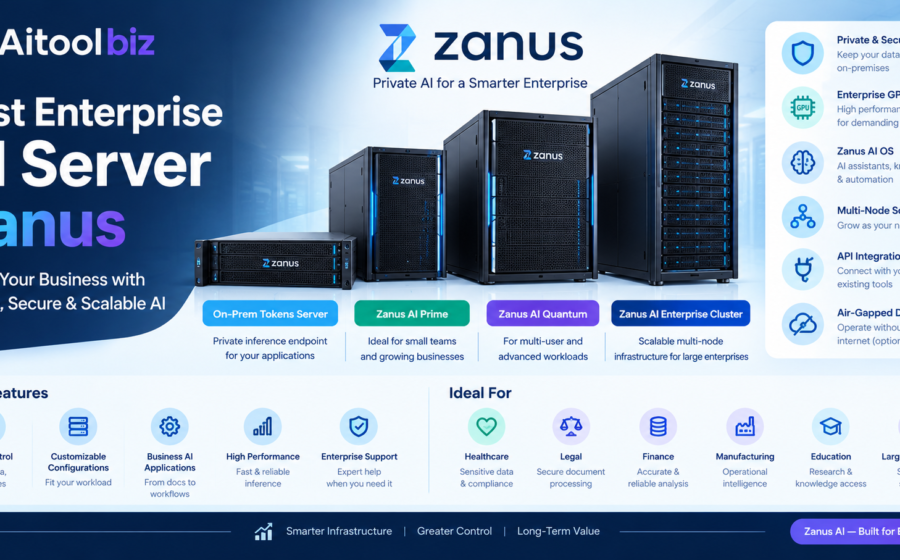
Zanus AI is a company specializing in private AI servers and business AI software. Its product lineup includes the Zanus AI Prime, Zanus AI Quantum, and Zanus AI Enterprise Cluster, designed for different workloads and organizational sizes. The company also offers an On-Prem Tokens Server for organizations that primarily need a private AI inference endpoint.
These systems combine server hardware with AI software designed to help organizations use their own business information and automate selected workflows. Depending on the configuration, they can support private document processing, internal knowledge retrieval, AI assistants, and business applications.
But is Zanus the best enterprise AI server for your organization? What features does it offer, how much does it cost, and how does it compare with other AI infrastructure options?
In this review, we will explore Zanus AI servers, their main features, possible business applications, pricing considerations, advantages, disadvantages, and alternatives to help you make an informed decision.
What Is Zanus AI?
Zanus AI is a technology company that develops private artificial intelligence infrastructure and business AI software. Its server products are designed to run AI workloads on hardware deployed within an organization’s premises rather than relying exclusively on external AI services.
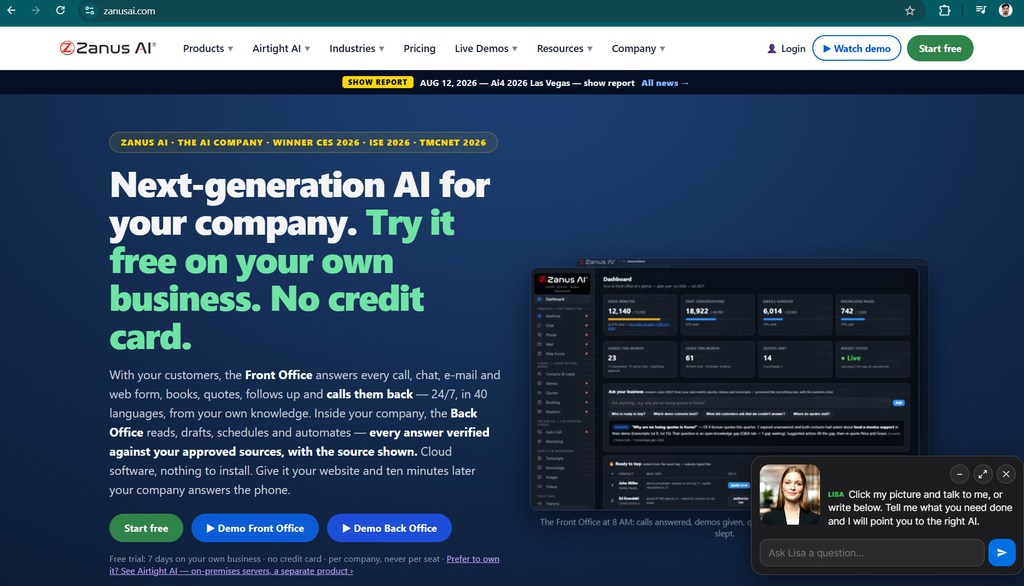
The company’s approach combines three major elements:
- AI server hardware: Enterprise-oriented computing infrastructure with integrated GPUs for running AI models.
- Zanus AI OS: Software designed to support AI assistants, business knowledge, and automation workflows.
- Industry-specific applications: Optional or configured software capabilities for particular business requirements.
According to its official website, Zanus offers different server configurations based on the size of the organization, its AI workload, and its expected usage.
One of its main selling points is ownership. Instead of paying for every AI interaction through an external provider, a company can purchase its own server and run supported models locally. The economics depend on the initial purchase price, electricity, maintenance, software arrangements, and workload.
Zanus also describes air-gapped deployment options, which allow appropriately configured systems to operate without an internet connection.
You can learn more on the official Zanus AI server website.
Also Read: AI Smart Review (2026): Features, Pricing, Pros, Cons & Alternatives
Why Are Businesses Looking for Enterprise AI Servers?
Before examining Zanus AI, it is helpful to understand why organizations might invest in private AI infrastructure.
1. Greater Control Over Business Data
Cloud AI services generally process requests using infrastructure operated by a third party. This may be suitable for many businesses, but some organizations have stricter requirements for confidential information.
A private AI server can allow supported models to process data within the company’s own environment. This may be useful for legal documents, financial reports, internal policies, engineering files, and proprietary business information.
However, local hosting alone does not guarantee security. Organizations still need appropriate access controls, encryption, monitoring, backups, and security updates.
2. More Predictable AI Usage Costs
Some cloud AI providers charge according to the amount of text processed or the number of requests made.
For companies with heavy AI workloads, those costs can grow as usage increases.
Owning a private AI server changes the cost structure. Instead of paying a provider for every token, a business pays for the infrastructure and its ongoing operating expenses.
This can be attractive for high-volume workloads, but the initial hardware investment and maintenance must be included in any financial comparison.
3. Independence From External AI Services
Organizations may want to reduce their dependence on external APIs, internet connectivity, or third-party service availability.
A properly configured on-premises AI system can continue operating without an internet connection when its required models, software, and supporting resources are installed locally.
This can be valuable in environments where connectivity is restricted or where business continuity is particularly important.
4. Using Internal Business Knowledge
Many organizations have valuable information spread across documents, spreadsheets, databases, and internal procedures.
A private AI system can help employees search this information, summarize documents, and obtain answers based on approved company resources.
This is especially useful when the information is difficult to locate manually or when employees need to consult multiple documents to complete a task.
Zanus AI Server Models Explained
Zanus offers multiple configurations intended for different levels of AI usage. The following comparison summarizes the company’s currently described server tiers.
<PRIVATE_PERSON> AI model names and configurations should be confirmed with the vendor before purchase, particularly if you are comparing hardware specifications or planning a large deployment.
1. Zanus AI Prime
Zanus AI Prime is positioned as an entry-level private AI server for smaller teams and organizations with relatively modest AI workloads.
It is intended for businesses that want to begin using private AI without immediately investing in a large multi-node infrastructure.
Key capabilities described by Zanus include:
- Private, on-premises AI deployment.
- AI assistant functionality.
- Document and business knowledge workflows.
- Automation capabilities.
- API and integration options.
Prime may be worth considering for a small company that wants employees to search internal documents, generate summaries, and use AI for routine administrative work.
Best for: Small businesses, individual departments, and organizations beginning their private AI journey.
Before selecting this model, confirm the available GPU memory, supported models, storage capacity, user limits, and expected throughput.
2. Zanus AI Quantum
Zanus AI Quantum is positioned as a more capable system for organizations that need to support multiple users and more demanding AI workloads.
The company describes Quantum as suitable for multi-user retrieval-augmented generation (RAG), complex reasoning, larger knowledge libraries, and longer-context tasks.
Its potential applications include:
- Internal AI assistants for multiple employees.
- Searching and analyzing large document collections.
- AI-assisted operational workflows.
- More demanding inference workloads.
- Connecting AI capabilities to compatible applications.
Quantum may be a better fit for businesses where AI is becoming part of everyday operations rather than an occasional productivity tool.
Best for: Growing companies, multiple departments, and organizations with heavier daily AI usage.
The actual number of concurrent users and achievable response speed will depend on the hardware configuration, model size, context length, and workload.
3. Zanus AI Enterprise Cluster
Zanus AI Enterprise Cluster is designed for organizations that require more capacity than a single server can provide.
According to Zanus, the Enterprise Cluster combines multiple server nodes into a unified private AI infrastructure. The company’s described capabilities include multi-node scaling, shared business knowledge, multi-location deployments, and load balancing.
Potential applications include:
- Supporting AI services across multiple departments.
- Serving larger numbers of concurrent users.
- Deploying AI infrastructure across multiple sites.
- Managing large organizational knowledge bases.
- Running more demanding enterprise AI workloads.
An enterprise cluster may offer more room for growth, but it also introduces additional infrastructure and administration requirements.
Best for: Large organizations, enterprises with multiple locations, and businesses expecting substantial AI demand.
Before purchasing, request a detailed architecture proposal covering node count, GPU configuration, networking, storage, redundancy, backup procedures, and performance targets.
4. Zanus On-Prem Tokens Server
Zanus also offers an On-Prem Tokens Server, described as a private generative AI endpoint running on Zanus hardware and software.
Unlike the complete Private On-Premises AI package, this option is aimed primarily at organizations that want to generate AI output locally and connect compatible applications to their own inference infrastructure.
The company describes an OpenAI-compatible API, which may simplify integration with applications that support compatible endpoints. Compatibility should still be verified for each model, API feature, and application.
Potential uses include:
- Running supported open-weight language models locally.
- Providing a private endpoint for internal applications.
- Connecting development tools and AI agents.
- Reducing dependence on external token-based AI services.
Best for: Technical teams that already have AI applications and want to bring supported inference workloads onto their own infrastructure.
Learn more through the official Zanus AI server page.
Key Features of Zanus AI Enterprise Servers
1. Private, On-Premises AI Processing
One of Zanus AI’s central features is the ability to run supported AI models on hardware installed at the customer’s premises.
This allows businesses to maintain greater control over their AI environment and can reduce the need to send prompts and documents to external AI inference services.
For organizations working with confidential information, this can be an important advantage.
However, the complete data path should be reviewed. External integrations, telemetry, update mechanisms, backups, and connected applications may have separate data-handling requirements.
2. Enterprise GPU Hardware
AI workloads can require significant computing resources, particularly when running larger language models or serving many users simultaneously.
Zanus describes its servers as including integrated enterprise GPUs selected for the intended workload.
GPU memory is particularly important because it affects which models can run and how much context and concurrency a server can support.
When evaluating a configuration, ask the vendor about:
- GPU model and total VRAM.
- System RAM and storage capacity.
- Supported model sizes and quantization formats.
- Expected tokens per second.
- Concurrent-user performance.
- Power consumption and cooling requirements.
These details matter more than a general claim that a server is designed for enterprise AI.
3. Zanus AI Operating System
The company’s server offerings include Zanus AI OS, a software environment designed to provide business AI functionality alongside the hardware.
The company describes capabilities such as AI assistants, knowledge management, workflow automation, scheduling, and business-oriented modules.
The main benefit of this integrated approach is that organizations may not need to assemble every component separately.
However, the included software modules and their availability can vary by product. Request a written list of features, licenses, integrations, and update entitlements before signing a contract.
4. Private Business Knowledge and RAG
Retrieval-augmented generation, or RAG, allows an AI system to retrieve relevant information from a knowledge base before generating an answer.
For example, an employee could ask a question about a company procedure. The system can search relevant documents and use the retrieved information to help prepare a response.
Zanus describes a precision vector store and business knowledge capabilities as part of its private AI ecosystem.
These functions can help employees work with internal information without manually searching through every file.
Nevertheless, RAG systems can still retrieve the wrong document, miss relevant information, or produce inaccurate answers. Businesses should evaluate retrieval quality, source citations, permissions, and document-update procedures using their own data.
5. AI Workflow Automation
An enterprise AI server can do more than answer questions. When connected to suitable software and configured workflows, it can also help automate business processes.
Potential examples include:
- Summarizing incoming documents.
- Preparing reports from approved information.
- Classifying support requests.
- Drafting customer communications.
- Organizing internal tasks.
- Assisting with recurring administrative processes.
Zanus’s software ecosystem includes workflow and business automation capabilities.
The exact actions that can be performed depend on the selected product, available integrations, permissions, and configuration.
6. Air-Gapped Deployment Options
An air-gapped system is isolated from external networks, including the public internet.
Zanus states that its private AI servers can support air-gapped operation when configured appropriately.
This can be relevant to organizations that handle sensitive information or operate in environments with restricted connectivity.
An air-gapped deployment still needs a plan for software updates, security patches, backups, model updates, and controlled data transfer. Those processes should be agreed upon before deployment.
7. API and Application Integration
Businesses often need to connect AI infrastructure to existing software rather than ask employees to use an entirely separate interface.
Zanus describes API connectivity and an OpenAI-compatible endpoint for its On-Prem Tokens Server.
This can help technical teams connect compatible applications to locally hosted AI models.
Before implementation, test authentication, supported API operations, structured output requirements, tool calling, streaming, and model-specific limitations.
API compatibility does not guarantee that every application or feature will work without modification.
8. Multi-Node Scalability
Organizations with growing workloads may eventually outgrow a single server.
Zanus AI Enterprise Cluster is designed to combine multiple nodes into a larger private AI environment.
A multi-node architecture can provide additional compute capacity and support broader deployments, but performance depends on the cluster design and workload distribution.
Ask the vendor how scaling affects latency, throughput, availability, data synchronization, and operating costs.
9. Business Software in One Package
Another aspect of Zanus is its combined hardware-and-software model.
Rather than purchasing a server and independently assembling every AI component, businesses can choose a configured system with the company’s AI operating environment and selected business functionality.
This may simplify procurement and initial deployment.
The trade-off is that buyers should understand software licensing, vendor dependency, customization options, maintenance, and the process for migrating data if they later switch platforms.
Best Use Cases for Zanus Enterprise AI Servers
Zanus private AI servers may be useful in several industries, depending on the selected configuration and software package.
Healthcare and Medical Organizations
Healthcare organizations handle sensitive patient information, internal policies, medical documentation, and administrative records.
A private AI environment may help with document summarization, internal knowledge retrieval, and selected administrative workflows.
However, medical use requires strict controls. Any deployment should be assessed for applicable privacy requirements, clinical safety, access permissions, and data retention.
AI-generated clinical content must not be treated as a substitute for qualified medical judgment.
Law Firms and Legal Departments
Legal teams work with contracts, case documents, internal research, correspondence, and confidential client information.
A private AI server could help search approved document collections, summarize lengthy materials, and prepare draft content for lawyer review.
This may reduce the time spent on repetitive information gathering.
Confidentiality, document-level permissions, citation quality, and legal accuracy should be tested before using the system in client work.
Finance and Accounting
Finance teams process reports, invoices, spreadsheets, internal policies, and other sensitive business information.
Private AI infrastructure may assist with document classification, internal knowledge retrieval, and report preparation.
For financial analysis, the system should be tested for calculation accuracy, traceability, and integration with authoritative financial records.
AI-generated results should be reviewed before they are used for reporting, payments, or compliance decisions.
Manufacturing and Industrial Operations
Manufacturers may use private AI to search technical documentation, summarize maintenance records, organize procedures, and assist with quality documentation.
A local deployment can be particularly attractive where connectivity is limited or industrial information is commercially sensitive.
Any connection to operational technology or production-control systems requires additional safety and security analysis.
Education and Research
Educational institutions and research organizations may need to work with internal documents, course materials, research papers, and institutional policies.
A private AI server can provide a controlled environment for searching and summarizing this information.
For research, users should verify citations and original sources rather than assume generated answers are accurate.
Large Enterprises
Large organizations often have multiple departments, locations, and different data-access requirements.
A multi-node private AI cluster may support shared infrastructure while allowing the organization to design appropriate permissions and deployment boundaries.
The main considerations are scalability, governance, operational reliability, and integration with existing enterprise systems.
Zanus AI Server Pricing: How Much Does It Cost?
Zanus AI server pricing depends on the product and configuration.
The company’s current server materials describe quote-based pricing, with system selection based on requirements such as model size, context needs, expected AI usage, users, storage, and included software.
The company also describes three principal configurations: Prime, Quantum, and Enterprise Cluster.
Rather than assuming one fixed price applies to every organization, request a quote for your intended workload.
Visit the official Zanus AI server website to review the available options and request pricing.
What Determines the Cost?
Hardware configuration: GPU capacity, memory, storage, and server design affect the purchase price.
AI workload: Larger models, longer context windows, and higher throughput requirements may require more powerful hardware.
Software package: The included AI OS, business modules, integrations, and licensing terms affect the total package.
Enterprise scale: A multi-node cluster generally requires a different budget and implementation plan from a single-server deployment.
Support and maintenance: Warranty coverage, software updates, technical assistance, and extended support should be included in the cost comparison.
Power and facilities: Electricity, networking, cooling, physical security, and backup infrastructure contribute to ongoing expenses.
Does Zanus AI Have Recurring Fees?
Zanus markets its private AI server ownership model as an alternative to ongoing per-token AI charges. Its website describes ownership-based options with no recurring token fees, although the precise software, support, and maintenance terms depend on the product and contract.
Do not assume that every possible expense disappears after the hardware purchase.
Request written confirmation of software license terms, optional maintenance costs, upgrade fees, warranty coverage, and any recurring services.
Is a Private AI Server Cheaper Than Cloud AI?
It depends on the workload.
A company that processes a small number of AI requests may find cloud services more economical because there is little upfront investment.
A business that processes large volumes of information every day may benefit from owning its infrastructure, particularly if its workloads are consistent and suitable models run efficiently on the selected hardware.
A useful comparison should consider the total cost of ownership over three to five years, including:
- Initial purchase and installation.
- Electricity and cooling.
- Hardware maintenance.
- Software and support.
- Staff time and administration.
- Expected AI usage.
- Hardware replacement or upgrades.
Compare the results using your actual workload rather than relying solely on the vendor’s projected savings.
Pros and Cons of Zanus AI Enterprise Servers
| Pros | Cons |
|---|---|
| Supports private, on-premises AI deployment. | Initial hardware investment can be substantial. |
| Offers multiple configurations for different workloads. | Exact pricing requires a configuration-specific quote. |
| Combines hardware with business AI software. | Buyers should evaluate the included modules carefully. |
| Can reduce dependence on external AI inference APIs. | Local hardware still requires electricity, maintenance, and support. |
| Air-gapped deployment options are described. | Air-gapped systems require controlled update and backup processes. |
| Provides business knowledge and workflow capabilities. | AI accuracy and retrieval quality must be tested. |
| Offers an enterprise cluster option. | Multi-node deployments can increase infrastructure complexity. |
| Describes API integration capabilities. | Application compatibility must be verified individually. |
Zanus AI vs. Cloud AI Services
Private AI servers and cloud AI services solve related but different problems.
Cloud AI is usually easier to start using because businesses can access models without purchasing dedicated hardware. Private servers offer more direct control over the underlying infrastructure and can be attractive for predictable, high-volume workloads.
| Factor | Zanus Private AI Server | Cloud AI Service |
|---|---|---|
| Infrastructure | Owned and operated on-premises | Operated by a cloud provider |
| Initial investment | Higher hardware investment | Often lower initial cost |
| Usage charges | Depends on the ownership and license terms | May be based on tokens, requests, or subscriptions |
| Data handling | Can keep supported processing local | Depends on provider, configuration, and contract |
| Internet dependency | Can support offline operation when configured for it | Usually requires connectivity |
| Maintenance | Customer responsibilities depend on the support agreement | Provider manages the underlying infrastructure |
| Scaling | May require hardware expansion | Often easier to scale through cloud capacity |
| Customization | Depends on the software and supported models | Depends on provider APIs and service limitations |
Neither approach is automatically better for every business.
A cloud service may be ideal for experimentation, variable workloads, or rapid scaling. A private server may be more appropriate when data control, offline operation, or sustained AI usage is a priority.
Some organizations may benefit from a hybrid model that combines local AI inference with selected cloud services.
Best Alternatives to Zanus AI Enterprise Servers
Zanus is one option in the broader enterprise AI infrastructure market. Other vendors and platforms may be better suited to different budgets, technical requirements, and deployment strategies.
1. NVIDIA DGX Systems
NVIDIA offers specialized AI computing systems and infrastructure for organizations developing or operating demanding AI workloads.
These systems can be relevant to businesses and research teams that need high-performance GPU computing and an established AI software ecosystem.
Best for: Organizations with demanding AI compute requirements and the technical resources to manage enterprise infrastructure.
Compare GPU specifications, software support, networking, and total system cost against the Zanus configuration you are considering.
2. Dell AI Infrastructure
Dell Technologies offers enterprise server and infrastructure products that can be configured for AI workloads.
Businesses may use suitable systems to build their own AI platforms with selected GPUs, storage, networking, and software.
Best for: Enterprises that want to build or integrate AI infrastructure within an established IT environment.
The final capabilities depend on the selected hardware, software stack, and support arrangement.
3. HPE AI Infrastructure
Hewlett Packard Enterprise offers computing and infrastructure solutions for enterprise workloads, including AI.
Organizations may evaluate HPE when they need broader infrastructure integration, enterprise support, or custom AI deployments.
Best for: Enterprises with existing HPE environments or requirements for larger infrastructure projects.
Compare the complete solution rather than the server hardware alone, including deployment services and ongoing support.
4. Lenovo ThinkSystem
Lenovo offers enterprise server platforms that can be configured for a variety of computing workloads, including suitable AI applications.
A configurable server approach may appeal to organizations that want more control over hardware selection and the software stack.
Best for: IT teams that want configurable enterprise hardware for their own AI deployment.
The performance of an AI system depends heavily on the GPU configuration, memory, supported models, and software optimization.
5. Supermicro AI Servers
Supermicro provides server systems designed for demanding computing and AI workloads.
Its range of configurations may be relevant to organizations building GPU servers or larger AI infrastructure.
Best for: Technical teams that want flexibility in AI server hardware and infrastructure design.
Compared with an integrated product, a configurable system may require more work to select, install, and maintain the AI software stack.
Which Enterprise AI Server Should You Choose?
Consider Zanus if you prefer an integrated private AI server and business software package rather than assembling every component yourself.
Consider NVIDIA, Dell, HPE, Lenovo, or Supermicro if your organization has specific hardware requirements, existing infrastructure standards, or an IT team that wants greater control over the architecture.
The best choice depends on model requirements, GPU memory, concurrency, data governance, support, and total cost of ownership.
Is Zanus AI Enterprise Secure?
Security is one of the main reasons businesses consider private AI infrastructure.
Zanus describes its servers as supporting on-premises deployment and, for appropriately configured systems, air-gapped operation. These characteristics can help organizations maintain greater control over data processing.
However, no server should be considered secure simply because it is installed inside an office or data center.
Before purchasing, ask the vendor about the following areas.
Access control: Can administrators manage permissions for individual users, teams, documents, and applications?
Encryption: How are data at rest, network traffic, credentials, and backups protected?
Logging: Can the organization review access, AI requests, administrative changes, and workflow executions?
Updates: How are security patches and software upgrades delivered, particularly for offline installations?
Backups and recovery: What happens if hardware fails or the knowledge base becomes corrupted?
Model security: How are prompt injection, unsafe outputs, and attempts to retrieve unauthorized information handled?
Compliance: Which certifications or independent audit reports are available, and which parts of the system do they cover?
Support: Who can access the system during troubleshooting, and under what conditions?
Organizations in regulated industries should conduct a formal security assessment and review relevant contractual commitments before using the system with sensitive data.
Is Zanus AI Easy to Set Up?
Zanus positions its server products as integrated solutions that arrive configured for their intended use.
The company describes deployment as a process of installing the system, connecting it to the local network, and accessing the AI environment.
This can potentially reduce the amount of work required compared with building an AI platform from separate hardware and software components.
However, deployment time depends on the customer’s network, security policies, data migration requirements, integrations, and user setup.
Before buying, confirm:
- Delivery and installation timelines.
- Whether on-site setup is included.
- How existing documents and knowledge bases are imported.
- Whether staff training is provided.
- How integrations are configured.
- What support is available after deployment.
A short demonstration using your own representative documents can help establish whether the system fits your organization’s workflow.
Who Should Buy Zanus AI Enterprise Servers?
Zanus may be worth evaluating for organizations that need a private environment for AI processing and business knowledge.
Small businesses: Prime may be worth considering when a small team wants to use internal AI without building an infrastructure stack from scratch.
Growing companies: Quantum may be relevant when more employees need access to AI assistants, document retrieval, and everyday workflows.
Large enterprises: Enterprise Cluster may be appropriate when the organization needs multi-node infrastructure, more concurrent capacity, or multi-location deployment.
Regulated organizations: Private deployment may help address certain data-control requirements, subject to a complete security and compliance assessment.
Technical teams: The On-Prem Tokens Server may suit teams that want to connect compatible applications to local inference infrastructure.
On the other hand, organizations with limited AI usage, highly variable workloads, or little interest in managing physical infrastructure may prefer a cloud service.
Final Verdict: Is Zanus the Best Enterprise AI Server in 2026?
Zanus AI is a noteworthy option for organizations exploring private AI infrastructure that combines server hardware with business-oriented AI software.
Its product range covers smaller deployments through to multi-node enterprise configurations. The company also offers an On-Prem Tokens Server for businesses that want a local AI inference endpoint without the complete industry-specific software package.
The most compelling reasons to evaluate Zanus are its integrated approach, local processing options, business knowledge capabilities, and potential to reduce dependence on external token-based AI services.
However, whether it is the best enterprise AI server depends on your specific requirements. Hardware specifications, software licensing, model performance, security controls, support arrangements, and total cost must all be assessed before making a decision.
Our recommendation: Request a demonstration and a configuration-specific quote from Zanus AI. Test the system with representative business documents, measure response speed and accuracy, and compare the three-to-five-year ownership cost with suitable cloud services and alternative server platforms.
A private AI server can be a valuable investment, but the right solution is the one that meets your organization’s technical and business needs—not simply the one with the most impressive feature list.
Frequently Asked Questions (FAQs)
1. What is the best enterprise AI server from Zanus?
The best option depends on the workload. Zanus AI Prime is positioned for smaller teams, Quantum for more demanding multi-user workloads, and Enterprise Cluster for larger deployments requiring multiple nodes. The On-Prem Tokens Server is aimed at local AI inference.
2. What is Zanus AI Enterprise Cluster?
Zanus AI Enterprise Cluster is a multi-node private AI infrastructure offering designed to combine server nodes into a larger AI environment. It is intended for organizations that require greater capacity or multi-location deployment.
3. How much does a Zanus AI server cost?
Pricing depends on the server model, hardware configuration, software package, and intended workload. Zanus provides quote-based pricing for its current server offerings. Contact the company for an accurate quote.
4. Can Zanus AI servers run without the internet?
Zanus states that its private AI servers can operate in air-gapped environments when configured appropriately. Confirm the requirements for offline operation, updates, and any external dependencies with the vendor.
5. Does Zanus AI charge per token?
Zanus markets its private server ownership model as an alternative to recurring per-token charges. However, software licenses, maintenance, support, and other expenses may depend on the selected package and contract.
6. Is Zanus AI suitable for small businesses?
Yes, it may be suitable for smaller businesses that need private AI capabilities and can justify the infrastructure investment. The Prime configuration is positioned for smaller teams and document libraries.
7. What is the difference between Zanus Prime and Quantum?
Prime is positioned as an entry-level system for smaller teams and workloads. Quantum is designed for more demanding multi-user AI, larger knowledge libraries, and complex reasoning tasks. Confirm exact specifications before comparing the models.
8. Is Zanus AI better than cloud AI?
Neither is universally better. Zanus may suit organizations that prioritize local data processing and ownership, while cloud AI may be more convenient for variable workloads, rapid scaling, or lower initial investment.
9. Can Zanus AI integrate with existing business software?
Zanus describes API and integration capabilities, including an OpenAI-compatible endpoint for its On-Prem Tokens Server. Compatibility should be verified for each application and required API feature.
10. Where can I buy or request a quote for Zanus AI?
Visit the official Zanus AI server website to explore the current product lineup, review deployment options, and request a quote.

1 Comment