
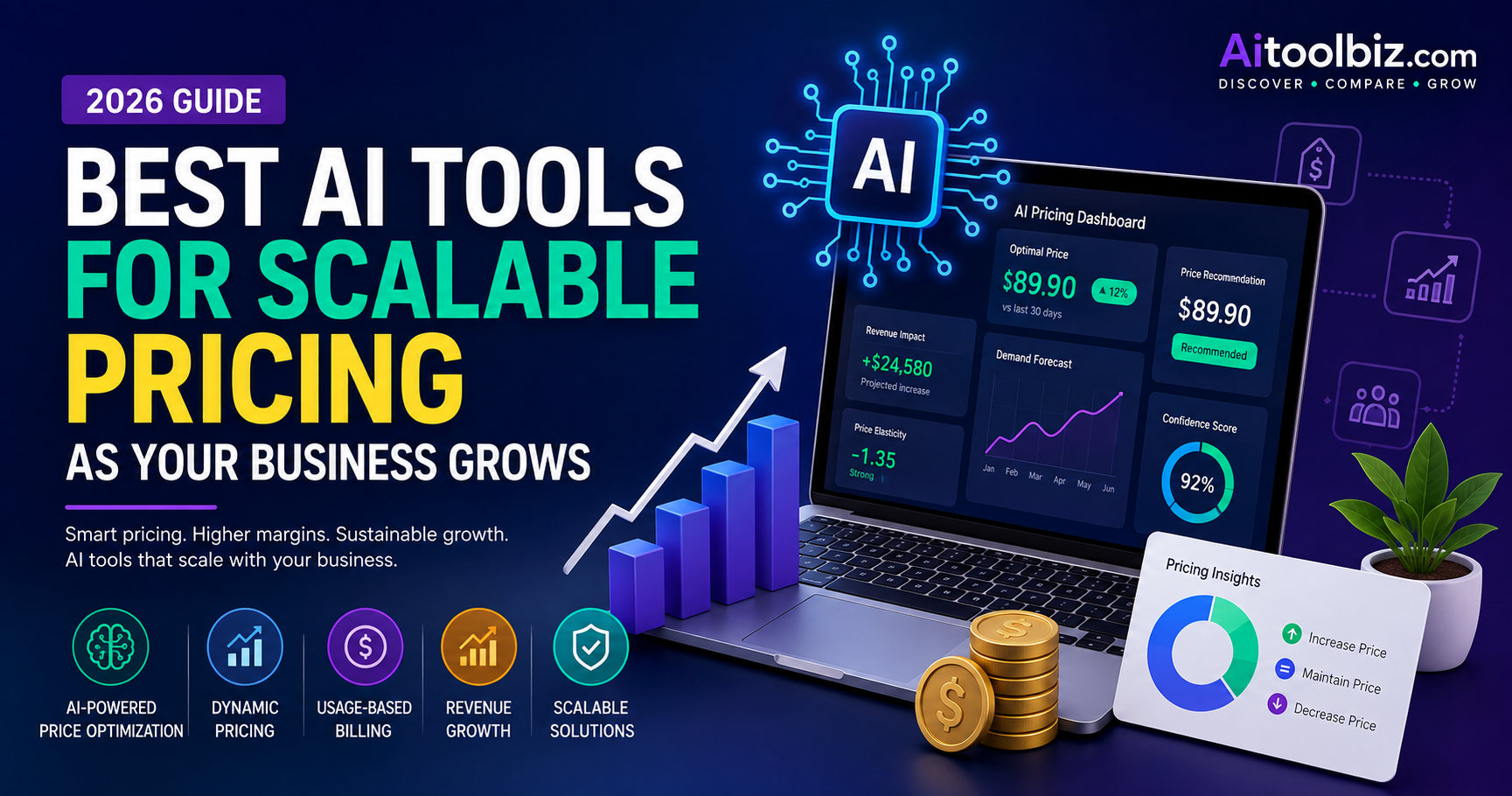
Best AI Tools for Scalable Pricing as Your Business Grows
As a business expands, pricing becomes more complex. When a business has thousands of clients, numerous marketplaces, hundreds of goods, or usage-based services, what works for a tiny startup with a few products and dozens of customers may become ineffective.
AI pricing tools can be very helpful in this situation.
In order to help businesses make better pricing decisions, modern AI-powered pricing tools can examine demand, consumer behavior, rival prices, transaction history, costs, inventory, discounts, and other business signals. While some systems concentrate on price optimization, others are more specialized in revenue management, usage-based pricing, dynamic pricing, subscription billing, or quotation and deal optimization.
A growing business can transition from spreadsheets and manual pricing decisions to a scalable pricing system with the proper technology.
The top AI tools for scalable pricing as your company expands are discussed in this guide, along with the advantages of each tool and how to pick the best option for your company.
Table of Contents
What Is Scalable Pricing?
Scalable pricing means designing a pricing system that can continue working effectively as your business becomes larger and more complex.
A small company might have:
- A few products
- One currency
- One customer segment
- Simple monthly or annual pricing
- Manual discounts
- Spreadsheet-based reporting
As the company grows, it may need to manage:
- Hundreds or thousands of products
- Multiple customer segments
- Different geographic markets
- Multiple currencies
- Enterprise contracts
- Personalized discounts
- Subscription upgrades and downgrades
- Usage-based billing
- Dynamic prices
- Competitor monitoring
- Complex revenue recognition
At that point, manually managing prices becomes difficult.
Businesses might find possibilities that people might overlook by using AI pricing tools to evaluate vast amounts of pricing and consumer data.
When recommending a price, for instance, a dynamic pricing system may take inventory, rival prices, demand, and other signals into account. According to Shopify’s 2026 overview, dynamic pricing software refers to systems that use signals like inventory, competition pricing, and demand to automate price changes.
Why Businesses Need AI Pricing Tools as They Grow
Revenue and profitability are directly impacted by pricing. Growing businesses, however, frequently have to strike a challenging balance.
The company may increase sales but lose profitability if pricing are too low.
Customers may switch to competitors if prices are too high.
AI can assist by analyzing pricing data on a scale that would be challenging to handle by hand.
1. More products mean more pricing decisions
A business that sells five items can manually check prices.
Employees cannot feasibly examine every price every day for a company that sells 5,000 SKUs.
Thousands of goods can be analyzed by AI pricing systems to find products that need attention, odd prices, and profit opportunities.
2. Customer segments become more complicated
Growing businesses frequently introduce different pricing for:
- Small businesses
- Mid-market customers
- Enterprises
- Wholesale buyers
- High-volume customers
- Geographic markets
AI can help identify customer and transaction patterns so businesses can create more appropriate pricing strategies.
3. Competition changes quickly
Competitor prices are subject to regular fluctuations, especially in e-commerce.
Automated pricing systems can keep an eye on the state of the market and enable companies to react faster.
4. Subscription businesses need flexible pricing
SaaS and AI companies increasingly use combinations of:
- Subscriptions
- Usage charges
- Seats
- Credits
- API consumption
- Overage fees
- One-time charges
Stripe’s documentation, for example, supports pay-as-you-go models based on measured customer usage.
As pricing models become more sophisticated, billing infrastructure becomes just as important as pricing strategy.
Best AI Tools for Scalable Pricing
1. Pricefx — Best for Enterprise B2B Pricing Optimization
One of the best choices for companies handling intricate B2B pricing, quoting, discounting, and margin management is Pricefx.
Its AI optimization features are intended to offer pricing suggestions while enabling pricing teams to adhere to business policies and guidelines.

Pricefx claims that their AI optimization technology can help teams understand how suggestions are made while offering advise for list prices and live sales.
Best Features
- AI-powered price recommendations
- Deal optimization
- Price management
- Discount optimization
- Margin analysis
- Pricing workflows
- B2B quoting support
- Pricing analytics
Best for
Manufacturers, wholesalers, and other sophisticated B2B companies with extensive product catalogs and intricate customer-specific pricing are most suited for Pricefx.
Why it Scales
Pricing complexity rises quickly as companies add goods, clients, sales methods, and markets. This kind of intricate business environment is the foundation of Pricefx’s design.
2. PROS — Best for Advanced Revenue and Price Optimization
PROS is a well-known software for managing price and revenue that has robust analytical features.
For businesses that require complex pricing recommendations and have a lot of past transaction data, it is especially intriguing.

Comparisons with other industries demonstrate PROS’s advantages in willingness-to-pay estimation and demand modeling.
Key Features
- Price optimization
- Demand modeling
- Revenue management
- Deal management
- AI-driven recommendations
- Customer segmentation
- Price elasticity analysis
Best for
Established businesses with substantial transaction data and specialized pricing or revenue teams are typically better suited for PROS.
Why it Scales
The software can assist businesses in transitioning from simple pricing guidelines to more complex data-driven pricing strategies.
However, this degree of expertise might not be required for a tiny firm.
3. Zilliant — Best for Complex B2B Pricing
Another excellent option for B2B businesses handling complicated product and client pricing is Zilliant.
When a business has a lot of combinations between clients, goods, areas, and contracts, it is especially helpful.
Zilliant’s ability to manage big SKU-by-customer price matrices is demonstrated by research on 2026 pricing software.
Key features
- Price optimization
- Price recommendations
- Deal guidance
- Customer-specific pricing
- Discount management
- Sales guidance
- Price analytics
Best for
Zilliant can be a good fit for:
- Manufacturers
- Distributors
- Industrial companies
- B2B organizations
- Large sales organizations
Why it Scales
Businesses can develop more uniform pricing by using data-driven recommendations rather than depending on sales reps to calculate discounts on an individual basis.
4. Shopify Dynamic Pricing Tools — Best for Growing Ecommerce Businesses
As the product catalog and competitive landscape expand, dynamic pricing may prove beneficial for online retailers.

According to Shopify’s 2026 guide, dynamic pricing solutions can automate or optimize price changes by utilizing demand, competitive pricing, and inventory data.
Useful Capabilities
Depending on the specific Shopify pricing application, businesses can access:
- Competitor price monitoring
- Automated price changes
- Inventory-based pricing
- Demand-based pricing
- Margin protection
- Pricing rules
- Product-level optimization
Best for
This approach is particularly useful for:
- Online retailers
- DTC brands
- Marketplace sellers
- Large product catalogs
- Competitive ecommerce categories
why it scales
Merchants can automate parts of the pricing process rather than manually adjusting prices for hundreds or thousands of products.
However, before allowing aggressive automated pricing, companies should set minimum margins and other protections.
5. Chargebee — Best for Subscription and Usage-Based Pricing
Chargebee is particularly helpful for SaaS and AI companies whose pricing requirements change as their business expands.
Chargebee concentrates on the infrastructure needed to sell, meter, bill, and oversee intricate pricing models rather than choosing the best retail price.
Flat-fee, tiered, volume, consumption, seat-based, and hybrid pricing models are all supported by its current platform.
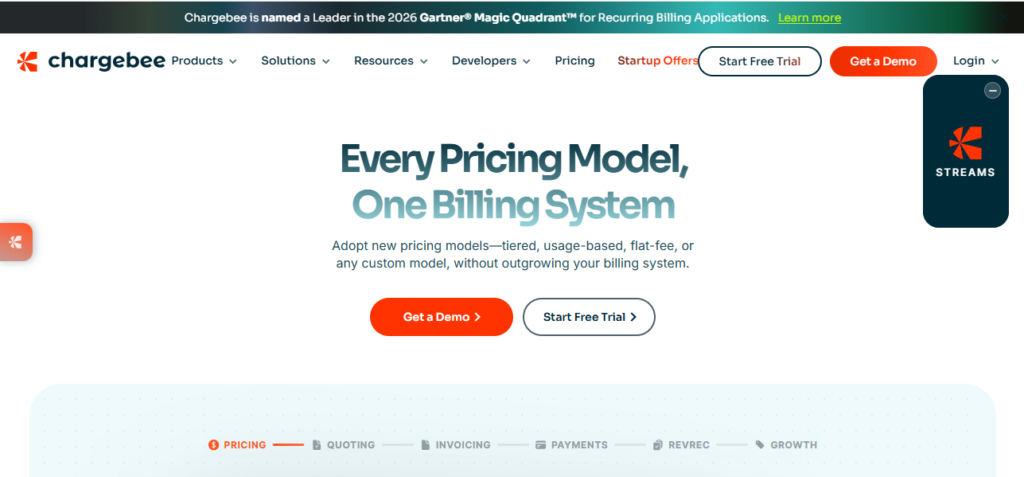
Additionally, Chargebee enables usage-based models for SaaS and AI businesses, such as hybrid pricing, use tiers, overages, and prepaid credits.
Key features
- Subscription management
- Usage-based billing
- Hybrid pricing
- Tiered pricing
- Usage metering
- Pricing experiments
- Revenue recognition
- Customer portals
- Multi-currency support
Best for
Chargebee is particularly relevant to:
- SaaS companies
- AI startups
- Subscription businesses
- API companies
- Usage-based businesses
Why it Scales
A startup might begin with $20-per-month subscriptions.
Later, it may introduce:
Base subscription + usage + overages + enterprise contracts.
A scalable billing platform can support that transition without requiring the company to rebuild its entire billing architecture.
6. Stripe Billing — Best for Flexible Usage-Based Billing
Another significant choice for companies in need of flexible subscription and usage-based pricing infrastructure is Stripe pricing.
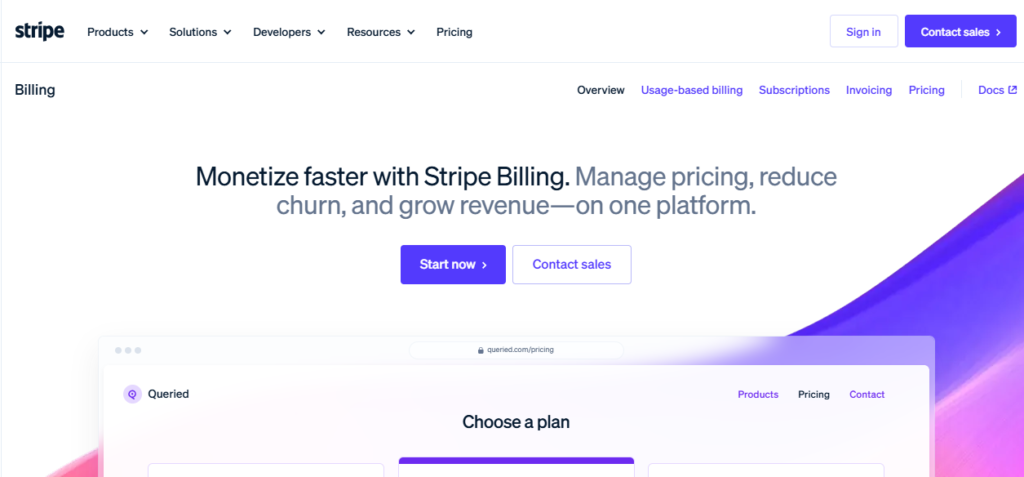
Stripe offers guidelines on how to use meters, items, prices, and use events to establish pay-as-you-go pricing.
Key Features
- Subscription billing
- Usage-based billing
- Metered billing
- Recurring payments
- Pricing tiers
- Invoicing
- Payment management
- Usage tracking
Best for
Stripe is particularly attractive for:
- SaaS startups
- Developers
- API businesses
- AI applications
- Digital services
- Internet businesses
Why it Scales
As their product develops, businesses can go from relatively basic subscription pricing to metered or usage-based pricing.
For companies who anticipate a more complex monetization plan, this makes it helpful.
7. Competera — Best for Retail Price Optimization
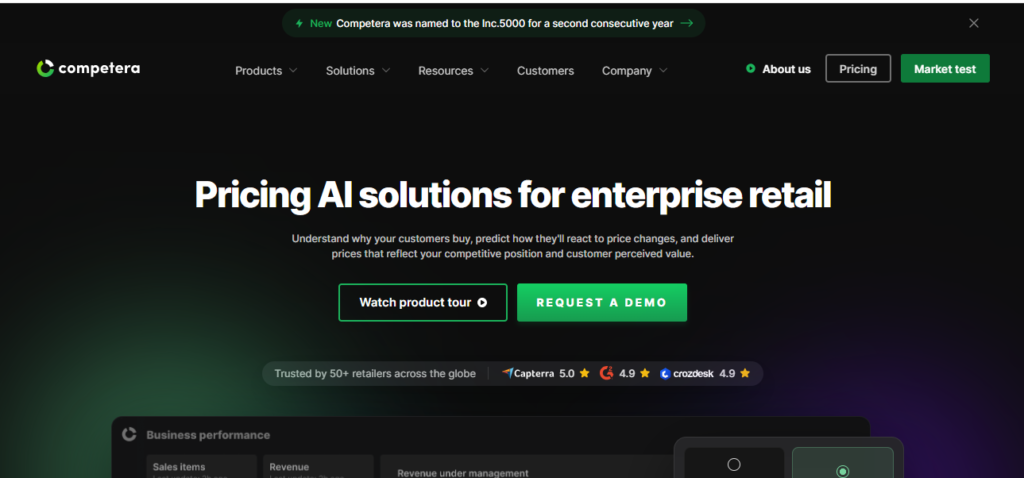
Competera focuses heavily on retail pricing and price optimization.
Retailers often need to consider:
- Demand
- Competition
- Product relationships
- Promotions
- Inventory
- Customer behavior
- Seasonality
AI can help process these signals and provide recommendations across large product catalogs.
Key Features
- Price optimization
- Demand forecasting
- Competitive intelligence
- Promotion optimization
- Retail analytics
- AI recommendations
Best for
Retailers with extensive catalogs and complex pricing needs should give Competera some thought.
8. Omnia Retail — Best for Ecommerce Competitive Pricing
Omnia Retail specializes in competition analysis and dynamic pricing for retail and e-commerce businesses.
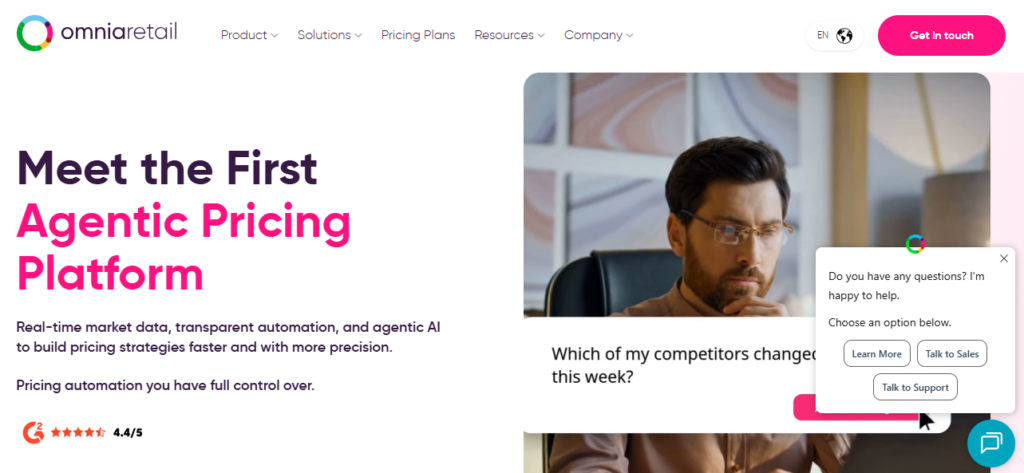
The basic premise is straightforward: companies may utilize pricing algorithms and market data to make more frequent price adjustments rather than setting prices once and then manually evaluating them.
Key features
Retailers that compete in markets where rival prices are constantly changing may find Omnia Retail helpful.
AI Pricing Tools vs Traditional Pricing
Traditional pricing usually relies on:
- Spreadsheets
- Historical averages
- Manual competitor research
- Fixed pricing rules
- Sales-team judgment
AI-powered pricing can introduce:
- Automated analysis
- Demand forecasting
- Price elasticity modeling
- Competitor monitoring
- Customer segmentation
- Dynamic recommendations
- Automated price changes
- Usage-based billing
The biggest advantage is not simply automation.
It is scale.
A human pricing manager may be able to analyze dozens of pricing decisions. AI systems can analyze thousands or millions of transactions and pricing signals.
Also Read
- 10 best AI Tools for Anomaly Detection in Business Data 2026
- 6 Free ai marketing tools for small business
- Why Use AI Search Optimization Tools for Your Business in 2026?
How to Choose the Right AI Pricing Tool
There is no single best AI pricing platform for every company.
Your choice should depend on your business model.
For ecommerce
Look for:
- Dynamic pricing
- Competitor monitoring
- Inventory-based pricing
- Automated repricing
- Margin controls
For SaaS
Look for:
- Subscription management
- Usage-based billing
- Tiered pricing
- Customer segmentation
- Pricing experimentation
For AI companies
Look for:
- Token or credit billing
- Usage metering
- Outcome-based pricing
- Usage alerts
- Hybrid subscriptions
- Flexible pricing models
Chargebee specifically highlights token, credit, usage, outcome, agentic, and hybrid pricing models for AI businesses.
For manufacturing and distribution
Prioritize:
- B2B price optimization
- Deal guidance
- Customer-specific pricing
- Discount management
- Margin optimization
- Large SKU support
Important Pricing Metrics to Track
AI pricing software is only useful if businesses measure the right outcomes.
Track:
Gross margin
How much money remains after direct costs?
Average selling price
Are customers paying more or less over time?
Conversion rate
Are price changes affecting purchasing behavior?
Customer lifetime value
Are pricing changes improving long-term customer value?
Revenue per customer
How much revenue does each customer generate?
Discount rate
How much revenue is being lost through discounts?
Price elasticity
How strongly does demand respond to price changes?
Churn
For subscription businesses, does a price increase lead to higher cancellation rates?
Net revenue retention
For SaaS companies, does pricing improve expansion revenue without creating excessive churn?
The Future of AI-Powered Pricing
The dynamic nature of pricing is growing.
Because customer service costs might vary based on consumption, AI businesses are spearheading this movement.
Rather than just charging:
$49 a month for each user
An AI product may eventually make use of:
Use costs, result fees, base subscription, and included credits.
As a result, price strategy and billing infrastructure become more intertwined.
For instance, Chargebee bases its platform on a variety of pricing models, including usage, outcome, credit, token, hybrid, and classic subscriptions.
Conventional companies are also implementing AI-driven price optimization at the same time.
While B2B businesses can examine transaction data, customer behavior, product relationships, and discount trends, retailers can use inventory and demand signals.
Adaptive pricing systems replace static pricing as a result.
Conclusion: What Is the Best AI Pricing Tool?
The best tool depends on the type and size of your business.
Pricefx is one of the strongest choices for complex B2B pricing and margin optimization.
PROS is suitable for organizations that need advanced revenue and demand modeling.
Zilliant is a strong option for companies managing large B2B product and customer pricing matrices.
Shopify-compatible dynamic pricing solutions are attractive for growing ecommerce companies.
Chargebee is particularly strong for SaaS and AI businesses that need flexible subscription, usage, and hybrid billing.
Stripe Billing is an excellent option for businesses looking for developer-friendly subscription and usage-based billing infrastructure.
The most important lesson is that scalable pricing is not simply about finding a more sophisticated algorithm.
It is about building a pricing system that can evolve with your business.
Start with reliable data, establish pricing rules and margin guardrails, test recommendations, and automate only when you understand the results.
As your business grows, the right AI pricing technology can turn pricing from a manual administrative task into a strategic growth engine.
Frequently Asked Questions
What are AI pricing tools?
AI pricing tools use artificial intelligence, machine learning, analytics, and automation to help businesses determine, optimize, monitor, or manage prices. Depending on the platform, they may analyze demand, competitors, customer behavior, costs, inventory, transaction data, or usage.
Which AI pricing tool is best for small businesses?
Small businesses generally do not need highly complex enterprise pricing software. Ecommerce businesses can start with dynamic pricing solutions integrated with their ecommerce platform, while SaaS companies may benefit from flexible billing platforms such as Stripe Billing or Chargebee.
Can AI automatically change product prices?
Yes. Some dynamic pricing systems can automatically adjust prices based on predefined rules and market signals. However, businesses should establish minimum margins, maximum price-change limits, and other safeguards before enabling full automation.
Is AI pricing suitable for SaaS companies?
Yes. AI pricing can be particularly useful for SaaS companies because they can analyze conversion rates, customer segments, usage, churn, expansion revenue, and willingness-to-pay. Billing platforms can also support subscription, tiered, and usage-based models.
What is usage-based pricing?
Usage-based pricing charges customers according to how much of a product or service they consume. Examples include API calls, AI tokens, storage, transactions, minutes, credits, or automated tasks.
Should startups use AI pricing software?
Startups can benefit from AI pricing tools, but they should avoid unnecessary complexity. Early-stage companies often benefit more from understanding customers, testing pricing manually, and collecting reliable data before adopting advanced automated pricing.
Is AI going to replace pricing managers?
Probably not completely. AI can automate data analysis and routine recommendations, but pricing strategy still requires business judgment. Human teams remain important for positioning, customer relationships, competitive strategy, and decisions involving unusual market conditions.