
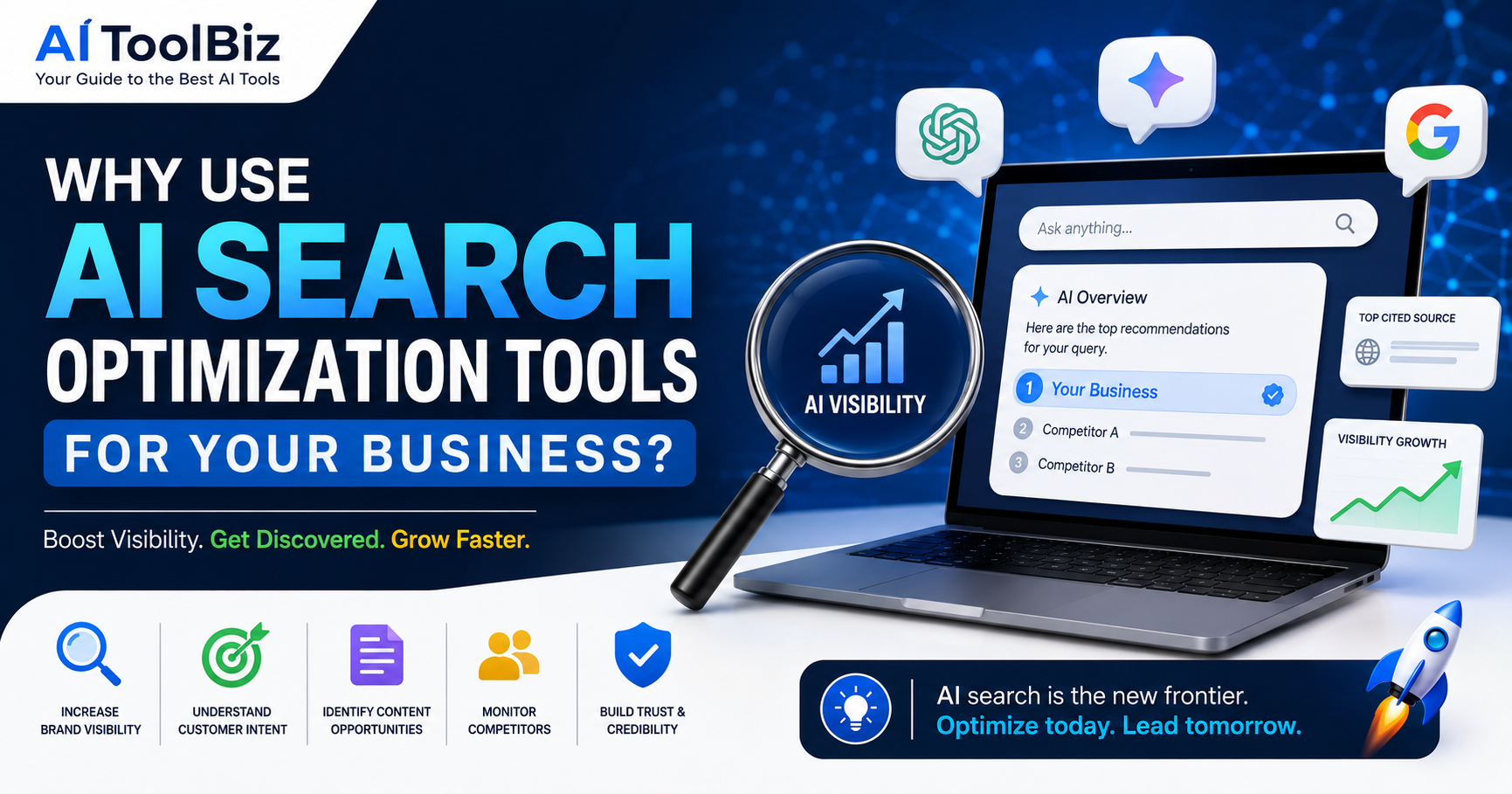
Why Use AI Search Optimization Tools for Your Business in 2026?,
Search is evolving more quickly than it has in a long time.
Businesses usedsites on Google and other conventional search engines. Keyword research, title tag optimization, backlink building, technical SEO enhancement, and content creation for the first page of search results were all done by marketers.
These principles are still important. Customers are, nevertheless, increasingly use AI-powered search experiences to obtain information, evaluate goods, investigate businesses, locate services, and decide what to buy.
Rather than limiting their search to terms like “best accounting software for small businesses,” a prospective client can now ask an AI search engine:
"What are the best accounting tools for a small business with five employees, and which one is easiest to use?"
Instead of 10 conventional blue links, the response can provide a brief list of suggested brands.
Businesses now face a new challenge: How can you showcase your brand when consumers are looking through AI-generated results?
AI search optimization technologies are useful in this situation.
Businesses may monitor and enhance how their brands and content appear across AI-powered search experiences with the aid of AI search optimization technologies, which are frequently linked to Answer Engine Optimization (AEO), Generative Engine Optimization (GEO), AI Search Optimization, or AI Visibility.
Here, Google’s existing guidelines are especially crucial: companies can feature in AI Overviews or AI Mode without having to meet an entirely other set of technological standards. Conventional SEO principles continue to be the cornerstone. AI search, however, opens up new avenues for understanding how content is found, condensed, cited, and displayed to users.
What makes using AI search optimization technologies beneficial for your company?
Let’s examine the main causes.
Table of Contents
What Are AI Search Optimization Tools?
Software platforms created to assist companies in comprehending and enhancing their visibility in AI-powered search and response experiences are known as AI search optimization tools.
Depending on the platform, these tools could keep an eye on:
- ChatGPT-style search experiences
- Google AI Overviews and AI Mode
- Microsoft Copilot and Bing AI experiences
- Perplexity
- Gemini
- Other emerging AI answer engines
- Brand mentions
- AI citations
- Competitor mentions
- Search prompts
- Content gaps
- Citation sources
- AI-generated recommendations
Conventional SEO tools mostly respond to queries like:
“Where does my website rank for this keyword?”
AI search optimization technologies are becoming more useful in addressing queries like:
“Does AI recommend my business when customers ask about my industry?”
This distinction is significant.
Even while a business ranks highly for a number of conventional keywords, it may not be as visible when users utilize AI to ask conversational inquiries.
Simultaneously, a brand may appear frequently in AI-generated responses because AI systems can learn valuable information from its website, reviews, publications, product details, and other online sources.
As a result, a significant class of software has emerged that measures AI search visibility.
1. AI Search Is Changing How Customers Discover Businesses
The client journey is evolving, which is the main justification for thinking about AI search optimization solutions.
Microsoft has added AI-generated responses to Bing and Copilot, while Google has enhanced AI capabilities like AI Overviews and AI Mode.
According to Google, AI search tools are made to make it easier for consumers to comprehend difficult subjects and find pertinent links faster.
This implies that the conventional search process may increasingly resemble:
Question → AI-generated answer → recommended brands → website/product/service
rather than:
Keyword → Google results → website → research → purchase
For businesses, this creates a new visibility layer.
If your company is absent from the AI-generated conversation, you may miss potential customers even when your traditional SEO performance is relatively strong.
AI search optimization tools can help you monitor this new environment.
2. Find Out Whether AI Mentions Your Brand
Monitoring brand exposure is one of the most useful features of AI search optimization software.
Assume you run a company that sells online project management software.
AI systems are questioned by potential clients:
- “What is the best project management software for startups?”
- “Which project management tools are affordable?”
- “What are alternatives to Asana?”
- “Which project management software is easiest for remote teams?”
It’s possible that your rivals will show up more frequently than your business.
This issue may not be readily apparent in traditional SEO reporting.
An AI visibility platform can track certain prompts and display whether your company is:
- Mentioned
- Recommended
- Cited
- Compared against competitors
- Associated with particular categories
- Missing from important queries
This gives marketers a different perspective on brand discovery.
Instead of asking only “Where do we rank?”, you can also ask:
“Where are we being recommended?”
Also Read: 10 top ai avatar tools for nonprofit fundraising videos
3. Track AI Citations and Sources
Being mentioned is helpful, but knowing why a company is cited can be much more beneficial.
Multiple sources of information may be used by AI search engines.
These may consist of:
- Company websites
- Industry publications
- Review websites
- News articles
- Product pages
- Documentation
- Business directories
- Research
- Forums
- Third-party comparisons
You may decide to create:
- Better comparison pages
- Original research
- Product documentation
- Expert guides
- Customer case studies
- Detailed FAQs
- Industry reports
Understanding grounding inquiries and related pages, enhancing subject depth, enhancing clarity and structure, bolstering claims with evidence, and maintaining accurate and up-to-date information are all particularly advised by Bing’s AI Performance guidance.
4. Discover Competitors You May Not See in Traditional SEO
Your traditional SEO competitors and AI-search competitors may not always be identical.
For example, your biggest competitor in Google rankings might be another large company.
But when customers ask AI:
“What are the best affordable alternatives?”
A smaller business could come out of nowhere.
Why?
Because instead of only providing a conventional ranking page, AI systems are able to analyze information across various sources and contexts.
Tools for AI search optimization can show:
- Which competitors appear most often
- Which competitors receive citations
- Which competitors are associated with specific topics
- Which brands appear for high-intent prompts
- Which companies are gaining visibility
This can assist companies in spotting new rivals sooner.
5. Understand What Customers Are Actually Asking
Keyword research has traditionally focused on short phrases.
For example:
“CRM software”
But AI search encourages more conversational and detailed queries.
Customers may ask:
“What CRM is best for a small consulting company with a limited budget?”
or:
“Compare CRM platforms that integrate with Gmail and don’t require technical knowledge.”
There is a lot more information regarding client intent in these queries.
Businesses may arrange and keep an eye on these conversational prompts with the aid of AI search optimization tools.
Because you can write content around real queries rather than just focusing on isolated keywords, this helps enhance content planning.
For instance, rather than writing:
“Best CRM Software”
you could create:
“Best CRM Software for Small Consulting Businesses: Features, Pricing, Integrations, and Use Cases.”
The second approach addresses a much more specific intent.
6. Improve Your Content Strategy
Content gaps can be found with the use of AI search optimization techniques.
Assume you keep an eye on 100 consumer inquiries about your sector.
You find that inquiries concerning: Your rivals are often brought up.
- Pricing
- Comparisons
- Integrations
- Alternatives
- Use cases
- Implementation
- Security
However, general product pages make up the majority of your website.
That’s a chance.
You could produce content that addresses those gaps.
Among the useful content formats are:
Comparison articles
Examples:
- Product A vs Product B
- Best alternatives to Product A
- Product A alternatives for small businesses
Educational guides
Examples:
- How to choose accounting software
- How to implement CRM software
- How to improve customer retention
FAQ pages
Answer common customer questions clearly and directly.
Case studies
Show how real customers use your products or services.
Original research
Publicize industry insights, standards, statistics, and surveys.
Producing content with the express purpose of influencing AI systems is not the aim.
The objective is to produce authoritative, helpful information that actually responds to consumer inquiries.
Google still prioritizes information that is useful, trustworthy, people-first, and has distinctive value above content that is largely produced to trick search engines.
7. Identify Content Gaps Between You and Competitors
Competitive gap analysis becomes especially useful with AI search.
Suppose an AI tool shows that:
Competitor A is frequently mentioned for cybersecurity.
Competitor B is frequently mentioned for affordability.
Competitor C is frequently mentioned for ease of use.
Your company may only appear for enterprise features.
This tells you something important about market positioning.
You can determine:
- Where competitors have authority
- Which topics they dominate
- Which questions they answer
- Which sources mention them
- Where your content is weak
- Where you have an opportunity to differentiate
This information can feed directly into your SEO and content marketing strategy.
8. Measure AI Search Visibility Over Time
AI search results are not static.
They can change as:
- AI models evolve
- Search engines update their systems
- New competitors publish content
- Customer questions change
- Websites gain or lose authority
- Information becomes outdated
Therefore, checking your AI visibility once is not enough.
You need ongoing monitoring.
AI search optimization tools can help create historical reports showing trends such as:
- Brand mentions
- Citation frequency
- Share of AI visibility
- Competitor visibility
- Prompt performance
- Source changes
- Content performance
Microsoft’s AI Performance feature, for example, provides visibility into how publisher content appears in AI-generated answers and allows site owners to examine citation activity over time.
9. Protect Your Brand Reputation
Being mentioned is just one aspect of AI search visibility.
It also concerns how your company is portrayed.
Let’s say someone queries:
“Is Company X a good choice for small businesses?”
Information from multiple sources may be summarized by an AI system.
The final response might not fairly represent your business if the internet contains out-of-date prices, inaccurate product descriptions, unfavorable reviews, or false information from third parties.
AI monitoring can assist companies in determining:
- Incorrect descriptions
- Outdated information
- Missing information
- Competitor claims
- Negative narratives
- Inconsistent company details
Once identified, these problems can be looked into and fixed at the proper location.
Because of this, monitoring AI visibility is partially an element of managing brand reputation.
10. Improve Local Business Visibility
AI search is also important for local businesses.
Consider a customer asking:
“What are the best digital marketing agencies near me?”
or:
“Which restaurants are good for a family dinner?”
AI-powered search may use information from:
- Business profiles
- Reviews
- Websites
- Local directories
- Maps
- Articles
- Other trusted sources
For local businesses, keeping information accurate across the web is therefore increasingly important.
Google specifically recommends keeping Business Profile and other relevant business information up to date as part of maintaining eligibility for search features.
AI search optimization tools can complement local SEO by helping businesses understand how they appear in conversational local queries.
11. Support Better SEO Decisions
Traditional SEO should not be replaced by AI search optimization.
Indeed, Google makes it clear that the principles of current SEO are still applicable to its generative AI search experiences.
Rather, AI search tools ought to enhance your current SEO stack.
Conventional SEO techniques can assist you in comprehending:
- Keyword rankings
- Organic traffic
- Backlinks
- Technical issues
- Search volume
- Site health
- On-page optimization
AI search tools can add information about:
- AI mentions
- AI citations
- Conversational prompts
- Competitor recommendations
- AI-generated answers
- Brand representation
Together, these provide a broader picture of search visibility.
12. Save Time on AI Search Research
It takes a lot of time to manually test hundreds of prompts across several AI systems.
For instance, a marketing team may choose to keep an eye on:
- 100 prompts
- 10 competitors
- 5 AI platforms
- Weekly changes
It can easily grow to thousands of separate observations.
A large portion of this monitoring is automated by AI search optimization solutions.
Depending on the instrument, you could be able to:
- Add your company.
- Add competitors.
- Define important customer prompts.
- Select AI engines.
- Run monitoring campaigns.
- Review mentions and citations.
- Identify content opportunities.
- Track changes over time.
Compared to manually reviewing AI search results, this is far more scalable.
13. Improve Your AEO and GEO Strategy
AEO and GEO are two words that you will often come across.
Answer Engine Optimization, or AEO
The goal of AEO is to increase the possibility that your material will be utilized or appear in answer-based search results.
Generative Engine Optimization, or GEO
Optimizing content and brand visibility for generative AI systems is commonly referred to as GEO.
Additionally, you can come across phrases like:
- AI Search Optimization AI SEO
- Optimization of LLM
- LLMO AI Visibility
- Optimization of Generative Search
The nomenclature is still changing.
Crucially, companies shouldn’t use these as SEO magic replacement tactics.
According to Google’s official guidelines, appearing in AI Overviews or AI Mode does not require any unique technological requirements or particular schema. Conventional technical SEO and quality considerations continue to be fundamental.
Therefore, the usefulness of AI search tools is more about monitoring visibility, identifying gaps, and comprehending how AI search reflects your brand than it is about discovering a secret ranking trick.
14. Make Your Content Easier to Understand
AI systems need to interpret information.
Humans do too.
This means many improvements that help AI search can also improve user experience.
For example:
- Clear headings
- Short paragraphs
- Descriptive titles
- Well-organized sections
- Tables
- Lists
- FAQs
- Definitions
- Supporting evidence
- Original examples
Bing’s current AI Performance guidance specifically highlights descriptive headings, concise sections, tables, FAQ-style content, evidence, freshness, and consistency as useful content practices.
These improvements can make your content easier for both humans and search systems to understand.
15. Build a More Data-Driven Content Strategy
AI optimization may turn into conjecture without measurement.
A company may assume that by publishing dozens of articles, they are increasing the visibility of AI.
Which pages, though, truly assist?
Which queries result in mentions?
Which rivals are making an appearance?
Which references are used?
Which subjects offer opportunities?
These questions can be addressed by AI search technologies.
As a result, AI optimization becomes a quantifiable procedure:
Track → Evaluate → Enhance → Release → Measure → Repeat
That is far more sustainable than creating articles at random using AI.
16. Avoid the Mistake of Publishing Low-Quality AI Content
This is a crucial caution.
It is not necessary to produce thousands of AI-generated pages in order to use AI search optimization techniques.
Google cautions that using AI to create a large number of pages without providing value may violate its spam policies regarding the abuse of scaled content.
In a same vein, Bing cautions against mass-produced material that lacks quality control, utility, accuracy, or originality.
Consequently, the optimal approach is not:
AI tools → generate everything → publish everything
Instead:
AI tools → research → identify opportunities → create valuable content → human review → publish → measure
Human knowledge is still crucial.
17. AI Search Optimization Can Help Small Businesses Compete
Big businesses are not the only ones who can benefit from AI search.
Focused expertise can become a competitive advantage for small businesses.
Let’s say a small cybersecurity consultant focuses on:
Dental clinic cybersecurity.
Rather of engaging in general competition for:
“cybersecurity services”
It can produce comprehensive resources related to:
- Cybersecurity in dental offices
- HIPAA-related security inquiries
- Dental offices’ security risks
- Checklists for cybersecurity
- Ransomware defense for dental clinics
- Comparisons of security software
Topical depth is produced as a result.
A corporation has increased chances of becoming connected with that niche if AI systems come across reliable, consistent, and helpful information about it and its area of expertise.
18. Improve Conversion Opportunities
The mere fact that your brand is referenced does not make AI visibility worthwhile.
Growth of the firm is the ultimate objective.
Customers may be influenced by AI-generated responses during:
- Product discovery
- Vendor research
- Comparisons
- Problem research
- Shortlisting
- Purchase decisions
The potential commercial value can be substantial if your brand shows up when a customer is actively considering solutions.
However, rather than viewing citations as direct income, companies should gage AI visibility in conjunction with significant commercial outcomes.
A citation does not imply that the user clicked or converted; rather, it shows that content was mentioned or displayed in an AI response. Bing makes a clear distinction between traffic and engagement and AI citations.
What Should You Look for in an AI Search Optimization Tool?
If you decide to invest in an AI search optimization platform, consider these features.
- AI Engine Coverage
Look for support for the AI platforms relevant to your customers.
- Prompt Tracking
The tool should let you monitor questions that reflect real customer intent.
- Brand Mention Tracking
You should be able to see whether your company appears in AI answers.
- Citation Tracking
Citation data can show which pages and external sources contribute to AI visibility.
- Competitor Monitoring
Compare your visibility against relevant competitors.
- Content Recommendations
The best platforms don’t only show problems; they help identify potential improvements.
- Historical Reporting
Look for trend tracking rather than one-time snapshots.
- SEO Integration
Ideally, AI visibility data should complement your existing SEO workflow.
- Clear Metrics
Avoid platforms that present complicated scores without explaining what they mean.
- Actionable Insights
The tool should help answer:
“What should we do next?”
rather than simply:
“Here is a score.”
AI Search Optimization Tools vs Traditional SEO Tools
| Feature | Traditional SEO Tools | AI Search Optimization Tools |
|---|
| Keyword rankings | Excellent | Sometimes |
| Backlink analysis | Excellent | Limited |
| Technical SEO | Excellent | Usually limited |
| AI brand mentions | Limited | Strong |
| AI citations | Limited | Strong |
| Conversational prompts | Limited | Strong |
| AI competitor visibility | Limited | Strong |
| Content gap analysis | Strong | Strong |
| AI answer monitoring | Limited | Strong |
| Traditional organic traffic | Strong | Usually limited |
| AI search trends | Limited | Strong |
Selecting one over the other isn’t always the best course of action.
Traditional SEO plus AI search visibility monitoring makes more sense for the majority of firms.
How to Start Using AI Search Optimization for Your Business
You don’t need to completely rebuild your marketing strategy.
Start with these steps.
Step 1: Identify Your Important Customer Questions
Make a list of 25 to 100 questions that consumers might have while looking into your goods or services.
Step 2: Identify Your Competitors
Include both traditional competitors and businesses appearing in AI-generated recommendations.
Step 3: Establish a Baseline
Check how often your brand appears today.
Step 4: Analyze the Sources
Find out which websites and pages are being referenced.
Step 5: Improve Your Content
Create useful, original content addressing missing questions.
Step 6: Strengthen Your Website
Improve internal linking, technical SEO, page experience, structured information, and content organization.
Step 7: Keep Business Information Accurate
Make sure important company, product, pricing, location, and contact information is current.
Step 8: Monitor Continuously
Track visibility monthly or weekly depending on your business and competition.
Step 9: Compare Against Competitors
Look for areas where competitors consistently appear and your brand doesn’t.
Step 10: Connect Visibility to Business Goals
Monitor leads, conversions, branded searches, referral traffic, and sales alongside AI visibility metrics.
Common Mistakes to Avoid
Mistake 1: Thinking AI Search Replaces SEO
It doesn’t.
Google’s current documentation makes clear that foundational SEO remains important for its AI search experiences.
Mistake 2: Chasing AI Citations at Any Cost
Citations are useful, but they shouldn’t become the only KPI.
Mistake 3: Publishing Mass AI Content
Quantity without quality can damage your website rather than improve it.
Mistake 4: Ignoring Human Readers
Content should be useful to people first.
Mistake 5: Monitoring Only One AI Platform
Customer behavior is fragmented across multiple search and AI experiences.
Mistake 6: Ignoring Third-Party Sources
Your brand’s AI representation can depend on information beyond your own website.
Mistake 7: Expecting Instant Results
AI visibility is an evolving channel. Consistent content quality, authority, technical health, and accurate information matter over time.
Final Verdict: Should Your Business Use AI Search Optimization Tools?
Yes—if your clients are researching goods, services, businesses, or solutions utilizing AI-powered search.
Businesses may see how brands are portrayed in AI-generated responses thanks to AI search optimization solutions, something that traditional SEO reporting frequently cannot.
They can assist you in learning:
- Whether AI makes reference to your business
- Which rivals show up
- Which consumer inquiries are important
- Which pages are cited?
- Which sources affect AI responses?
- Where there are gaps in your content
- How your visibility varies over time
However, companies ought to have reasonable expectations.
There is no surefire way to make an AI system mention a specific business. Google stresses that current SEO and people-first content practices remain fundamental, while Bing clearly states that GEO does not guaranty anchoring or citations.
The smartest strategy is therefore not to abandon SEO and chase AI algorithms.
Instead, businesses should build a broader search visibility strategy.
That strategy combines:
Technical SEO + Helpful Content + Brand Authority + Structured Information + Customer Intent + AI Visibility Monitoring
The companies that adapt early can gain a valuable advantage: they will understand not only where they rank in traditional search, but also how AI systems discover, describe, compare, and recommend their businesses.
As AI search continues to develop, that distinction may become increasingly important.
Frequently Asked Questions
What are AI search optimization tools?
AI search optimization tools help businesses monitor and improve their visibility across AI-powered search and answer experiences. Depending on the platform, they can track brand mentions, citations, competitors, prompts, content opportunities, and AI-generated answers.
Is AI search optimization the same as SEO?
No. AI search optimization is closely related to SEO but focuses more specifically on visibility within AI-generated answers and conversational search. Traditional SEO remains foundational, particularly because Google says its AI search features use existing Search ranking and quality systems.
What is AEO?
AEO stands for Answer Engine Optimization. It generally refers to optimizing content so that it can be effectively discovered, understood, and potentially referenced in answer-oriented search experiences.
What is GEO?
GEO commonly means Generative Engine Optimization. It focuses on improving a brand’s visibility and representation in generative AI search experiences.
Do I need an AI search optimization tool if I already use an SEO tool?
The two can work well together, though not always. While AI visibility tools can offer more information on AI mentions, citations, prompts, and competitors, traditional SEO tools are great for keywords, backlinks, ranks, and technical SEO.
Can AI search optimization tools guarantee that my business will be mentioned?
No. No legitimate tool can guarantee that an AI system will recommend or cite your business. AI-generated results can change based on queries, sources, models, freshness, and other factors.
Does Google require special AI SEO markup?
Google currently says there are no additional technical requirements or special schema.org markup required specifically for AI Overviews or AI Mode. The same foundational SEO practices remain important.
Is AI-generated content good for AI search optimization?
AI can help with research, outlining, and content workflows, but publishing large quantities of low-value AI-generated content is risky. Google and Bing both emphasize quality, usefulness, originality, and appropriate editorial oversight.
How often should businesses monitor AI search visibility?
For competitive industries, monthly or even weekly monitoring can be useful. Smaller businesses can begin with monthly monitoring and increase frequency as AI search becomes more important to their customer acquisition strategy.
Is AI search optimization important for small businesses?
Yes. Small businesses can benefit particularly when they have strong expertise in a specific niche. Creating authoritative, useful content around specific customer problems can help establish topical relevance and improve overall search visibility.