

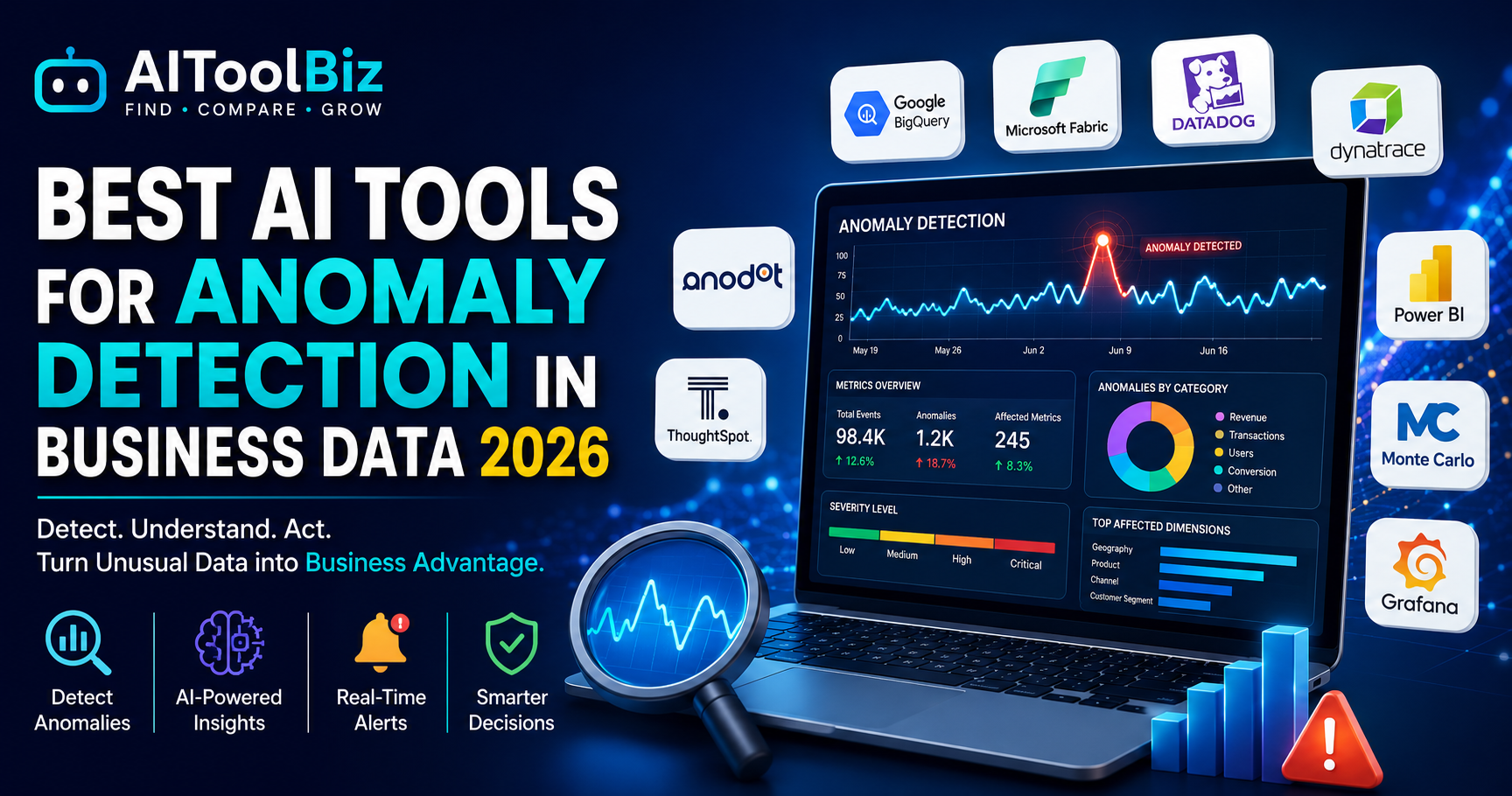
Best AI Tools for Anomaly Detection in Business Data 2026
Every day, businesses produce massive volumes of data. Millions of data points can be generated by sales transactions, internet traffic, customer behavior, inventory levels, financial records, marketing performance, operational indicators, and application logs.
Data collection is no longer the only difficulty. Finding what appears out of the ordinary and figuring out why it occurred are the true challenges.
Anything from a typical seasonal shift to a significant company issue can be indicated by an abrupt drop in sales, an unexpected rise in refunds, strange consumer behavior, anomalous inventory movement, increased cloud expenses, or an increase in website faults.
To find these patterns fast, traditional spreadsheets and manually set thresholds are frequently insufficient. AI-driven anomaly detection techniques are useful in this situation.
AI anomaly detection software establishes what “normal” looks like and finds significant deviations using machine learning, statistical analysis, time-series models, and increasingly AI agents.
In 2026, business intelligence, data warehouses, observability platforms, and analytics systems will all use anomaly detection more and more. For instance, Microsoft Fabric supports both time-series and multivariate anomaly-detection workflows, whereas Google BigQuery offers AI-based anomaly detection utilizing TimesFM for time-series data.
The top AI solutions for anomaly detection in corporate data in 2026 are examined in this guide, along with the advantages of each tool and how companies may select the best platform.
Table of Contents
What Is AI Anomaly Detection?
The process of identifying data points or patterns that substantially deviate from predicted behavior using machine learning, statistical models, or AI systems is known as AI anomaly detection.
Assume, for instance, that an online retailer typically receives 8,000 to 10,000 orders every day.
An anomaly detection system could automatically detect a change if orders abruptly drop to 4,500.
Sophisticated systems, however, go farther.
They may think about:
- Historical trends
- Seasonality
- Weekdays versus weekends
- Geographic differences
- Product categories
- Customer segments
- Marketing campaigns
- External factors
- Relationships between multiple variables
Because of this, AI-based detection is far more beneficial than a straightforward rule like “send an alert whenever sales fall below 7,000.”
Anomaly detection, according to Google, is a technique for spotting departures from a dataset’s typical behavior. The company provides instances, such as odd product return rates that might point to flaws or fraud.
Best AI Tools for Anomaly Detection in Business Data in 2026
1. Microsoft Fabric
One of the best choices for companies that already use the Microsoft data ecosystem is Microsoft Fabric.
Microsoft offers methods for training and utilizing multivariate anomaly-detection models, and its Real-Time Intelligence capabilities include anomaly detection for real-time data streams.

Businesses can train a multivariate anomaly model in a notebook, score new data using KQL, and visualize the abnormalities found using the Fabric approach described in Microsoft’s documentation.
It is best for Microsoft-centric businesses and organizations working with large-scale enterprise data
Key features
- Real-time anomaly detection
- Multivariate anomaly detection
- KQL integration
- Eventhouse integration
- Notebook-based machine learning
- Data visualization
- Microsoft ecosystem integration
- Support for real-time telemetry
Why businesses should consider it
Fabric is particularly attractive when anomaly detection is part of a larger data platform rather than an isolated application.
For example, a manufacturer could monitor:
- Production speed
- Temperature
- Machine vibration
- Energy consumption
- Defect rates
AI can analyze multiple variables together and identify unusual combinations.
Verdict: One of the best enterprise options for businesses already invested in Microsoft Fabric and Azure.
2. Google BigQuery
Another effective option is Google BigQuery, which allows companies to do anomaly detection without having to transfer their data to a different anomaly-monitoring platform.
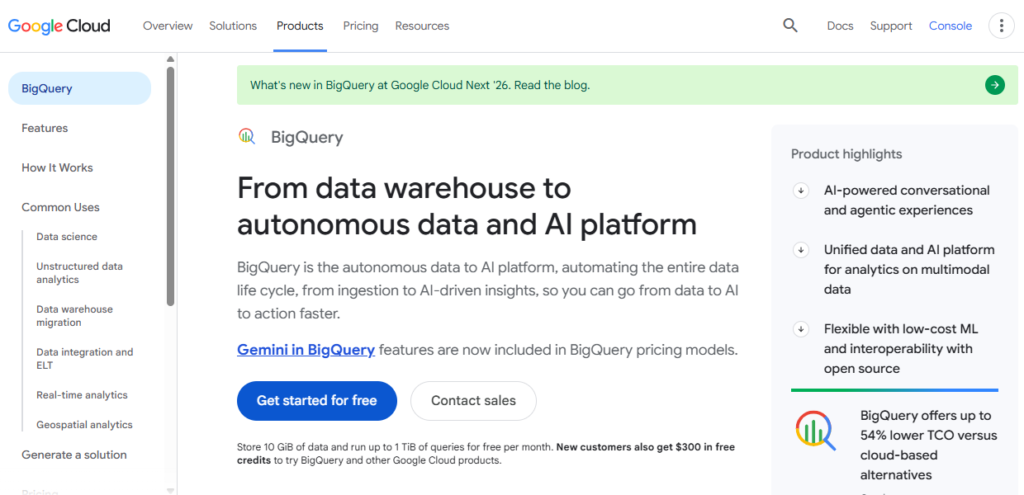
AI is currently covered in BigQuery’s documentation.DETECT_ANOMALIES, which detects time-series anomalies using the TimesFM model. Google also uses BigQuery ML to enable anomaly detection.
It is best for Data teams that want AI anomaly detection directly inside their cloud data warehouse.
Key Features
- AI-based time-series anomaly detection
- TimesFM integration
- BigQuery ML
- SQL-based workflows
- Large-scale data processing
- Cloud data warehouse integration
- Integration with Google Cloud analytics
Business Applications
BigQuery can be useful for detecting:
- Revenue abnormalities
- Traffic changes
- Product demand fluctuations
- Customer activity anomalies
- Return-rate changes
- Fraud indicators
- Marketing performance changes
One consideration is that Google’s current documentation says AI.DETECT_ANOMALIES evaluates the most recent 1,024 time points for anomalies, so businesses should understand the technical limitations for their particular workload.
Verdict: An excellent choice for organizations already storing business data in BigQuery.
Also Read: 6 Free ai marketing tools for small business
3. Datadog Watchdog
Although Datadog is primarily an observability platform, firms seeking automated anomaly detection can benefit from its AI-powered Watchdog features.
Datadog can detect anomalous behavior across monitored systems, saving teams from having to manually write rules for each statistic.
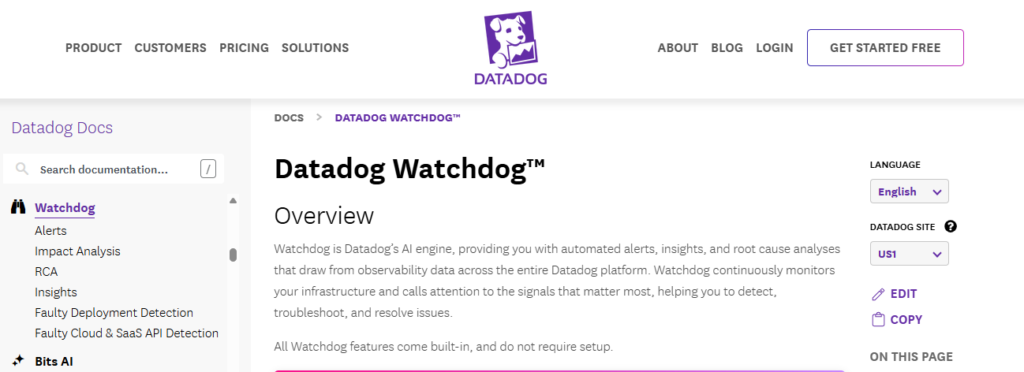
In 2026, industry comparisons frequently show Datadog Watchdog as an affordable option for businesses already utilizing Datadog’s monitoring environment.
It is use for Businesses that need anomaly detection across applications, infrastructure, and operational metrics.
Key Features
- Automated anomaly detection
- Infrastructure monitoring
- Application monitoring
- Log analysis
- APM
- AI-assisted investigations
- Automated alerts
- Correlation across monitoring data
Best business use cases
Businesses where “business data” and operational data overlap will find Datadog particularly helpful.
For instance:
An online store may notice a drop in completed orders and an abrupt rise in checkout mistakes.
Teams can now look into technological issues that have a direct impact on revenue.
Conclusion: Ideal for tech-driven companies that require both business impact monitoring and operational and application anomaly identification.
4. Dynatrace Davis AI
With its Davis AI capabilities, Dynatrace integrates automated analysis, AI, and observability.
Dynatrace’s emphasis on assisting teams in comprehending the connections between systems in addition to detecting aberrant activity is a significant benefit.
Because of this, it is especially helpful in complex enterprise setups with a large number of applications, services, infrastructure components, and dependencies.
It is best for Large enterprises requiring advanced observability and root-cause analysis.
Key Features
- AI-powered anomaly detection
- Root-cause analysis
- Infrastructure monitoring
- Application performance monitoring
- Distributed tracing
- Dependency analysis
- Automated problem detection
- Enterprise observability
Dynatrace is often positioned as a powerful option for complex business setups and full-stack cause analysis in current 2026 comparisons.
Conclusion: Great for big businesses because figuring out the root reason of an anomaly is just as crucial as finding it.
5. Anodot
Organizations looking to track business KPIs instead than just technical infrastructure will find Anodot very intriguing.
Thousands of indicators pertaining to revenue, conversions, customer activity, transactions, goods, and geographies may be present in a company.
It can be very challenging to manually monitor all of these.
The automatic monitoring of numerous business variables and the detection of anomalous changes is the foundation of Anodot’s architecture.
Anodot is frequently ranked as one of the best choices for business-metric monitoring and correlation in 2026 industry comparisons.
It is best for Revenue, customer, product, and business-metric anomaly detection.
Key Features
- Business metric monitoring
- Automated anomaly detection
- Large-scale metric correlation
- Alerting
- Revenue monitoring
- Customer behavior monitoring
- Root-cause investigation
Example
An e-commerce company could monitor:
Revenue → Country → Product → Customer segment → Payment method
If revenue unexpectedly declines only for customers using one payment processor in a particular region, the system can help narrow down the anomaly.
Verdict: One of the most compelling choices for organizations primarily interested in business KPI anomalies.
6. ThoughtSpot
ThoughtSpot integrates AI-powered analytics with business intelligence.
Its conversational analytics features let users to examine company data using natural language, and its SpotIQ capabilities can automatically highlight insights and anomalous developments.
Businesses where business users need to look into abnormalities without relying solely on data analysts will find this useful.
It is best for Self-service business intelligence and AI-powered data analysis.
Key Features
- AI-powered analytics
- Automated insights
- Anomaly identification
- Natural-language data exploration
- Interactive dashboards
- Business KPI monitoring
- Root-cause exploration
According to 2026 comparisons, ThoughtSpot is a powerful platform for automated insight finding and natural-language analytics.
Example Question
Instead of manually examining charts, a sales manager might ask:
“Why did sales decrease last week?”
The platform can help users investigate changes across dimensions such as region, product, customer segment, and sales channel.
Verdict: Excellent for businesses that want anomaly detection combined with self-service analytics.
7. Power BI
Since many businesses already use Microsoft Power BI for dashboards and reporting, it is still a sensible option.
Current Power BI anomaly-detection features can assist users look at contributing causes and spot odd shifts in time-series visualizations.
According to industry comparisons of 2026 BI platforms, Power BI is one of the main platforms providing automatic explanations and AI-assisted anomaly detection.
It is best for Businesses already using Microsoft business intelligence tools.
Key Features
- Business dashboards
- KPI monitoring
- Anomaly detection
- AI-assisted analysis
- Root-cause exploration
- Microsoft ecosystem integration
- Power Automate integration
Best use cases
Power BI can help detect:
- Sales drops
- Revenue spikes
- Customer churn changes
- Inventory abnormalities
- Marketing performance fluctuations
- Expense anomalies
Verdict: A strong choice for businesses that want anomaly detection inside an established BI environment rather than buying a dedicated anomaly platform.
8. New Relic
Logs, AI-assisted analysis, infrastructure monitoring, and application monitoring are all combined in New Relic.
Organizations might find unexpected changes in technical metrics with the aid of its anomaly detection skills.
In 2026, industry comparisons have emphasized New Relic’s accessibility and highlighted its AI/observability features as benefits for smaller teams.
It is best for Smaller technology businesses and teams looking for accessible observability.
Key features
- Application monitoring
- Infrastructure monitoring
- Log analysis
- AI-assisted insights
- Automated anomaly detection
- Alerts
- Performance monitoring
Conclusion: An excellent choice for IT teams and startups that want anomaly detection but don’t want to switch to a big corporate platform right away.
9. Monte Carlo
Not every anomaly occurs in the business itself.
Sometimes the anomaly is in the data.
For example:
When a data pipeline stops importing transactions, a company’s revenue suddenly seems to be 60% lower.
Executives may make decisions based on inaccurate information if they depend on that dashboard.
Organizations can find issues with data freshness, volume, schema, lineage, and quality by using Monte Carlo, which focuses on data observability.
Monte Carlo is often listed as one of the top solutions for data teams that must safeguard data pipelines and analytics dependability in industry comparisons.
Key features
- Data observability
- Data quality monitoring
- Pipeline monitoring
- Data freshness monitoring
- Lineage
- Automated alerts
- Data incident detection
Verdict: Best when the goal is detecting anomalies in the data infrastructure itself.
10. Grafana
Grafana is frequently used for time-series data visualization and metrics monitoring.
Additionally, machine learning-based methods for metric analysis and outlier detection are supported by Grafana’s ecosystem.
It may be more practicable for businesses who already use Grafana and Prometheus to add anomaly detection rather than completely replace the monitoring infrastructure.
It is best for Data quality and data pipeline anomaly detection.
Key features
- Time-series monitoring
- Dashboards
- Alerting
- Prometheus integration
- Machine-learning capabilities
- Cloud monitoring
- Open-source ecosystem
Conclusion: An excellent choice for technically competent teams seeking control and flexibility.
Quick Comparison of the Best AI Anomaly Detection Tools
| Tool | Best For | Main Strength |
|---|
| Microsoft Fabric | Enterprise data | Multivariate and real-time detection |
| Google BigQuery | Cloud data teams | AI anomaly detection inside the warehouse |
| Datadog | IT and applications | Automated operational anomaly detection |
| Dynatrace | Large enterprises | AI-powered root-cause analysis |
| Anodot | Business metrics | Revenue and KPI monitoring |
| ThoughtSpot | BI teams | AI insights and self-service analytics |
| Power BI | Microsoft businesses | BI + anomaly detection |
| New Relic | Tech teams | Accessible observability |
| Monte Carlo | Data teams | Data pipeline anomaly detection |
| Grafana | Technical teams | Flexible time-series monitoring |
Why Businesses Need AI Anomaly Detection in 2026
Faster problem detection
Manual reporting often identifies problems after they have already affected the business.
AI can monitor data continuously.
Reduced financial losses
A sudden payment failure, pricing problem, fraud event, or inventory issue can become expensive if it goes unnoticed.
Better customer experience
Businesses can identify unusual increases in complaints, cancellations, failed transactions, or service errors.
Less manual analysis
Data teams can spend less time reviewing thousands of dashboards and more time solving important problems.
More proactive decision-making
Instead of asking what happened after the end of the month, companies can investigate unusual behavior as it occurs.
How AI Anomaly Detection Works
Although implementations differ, most systems follow a similar process.
- Collect data
The platform connects to sources such as:
- Databases
- Data warehouses
- APIs
- SaaS applications
- Business intelligence systems
- Application logs
- IoT systems
- Financial systems
- Establish a baseline
The system analyzes historical behavior to understand what is normal.
For example, it may learn that sales typically increase on weekends.
- Detect deviations
When new data arrives, the system compares it with expected behavior.
- Calculate anomaly severity
Not every unusual event matters.
A sophisticated system attempts to distinguish between minor fluctuations and significant anomalies.
- Investigate the cause
Modern platforms increasingly help users identify the dimensions or systems responsible for the change.
- Alert the right people
Alerts can be delivered through channels such as:
- Slack
- Microsoft Teams
- Webhooks
- Mobile notifications
- Incident-management systems
Final Verdict: What Is the Best AI Anomaly Detection Tool in 2026?
There is no single winner for every business.
For business KPI and revenue monitoring, Anodot is one of the strongest specialized choices.
For enterprise data and real-time analytics, Microsoft Fabric is particularly compelling.
For companies that already store data in Google BigQuery, Google’s built-in AI anomaly detection capabilities can be a highly practical option.
For IT and application monitoring, Datadog and Dynatrace stand out.
For data quality and pipeline monitoring, Monte Carlo is a better fit.
For self-service business intelligence, Power BI and ThoughtSpot offer a combination of analytics and anomaly discovery.
The biggest trend in 2026 is that anomaly detection is moving beyond simple “something changed” alerts. Modern systems increasingly attempt to determine what changed, why it changed, how important it is, and what a business should investigate next.
For most organizations, the best strategy is therefore not to select the tool with the most impressive AI label. Instead, choose the platform that fits your existing data architecture, business metrics, technical capabilities, security requirements, and alerting workflow.
FAQ
What is the best AI tool for anomaly detection in business data?
There is no universal best tool. Anodot is particularly suited to business-metric monitoring, Microsoft Fabric and BigQuery are strong for data-platform-based detection, while Datadog and Dynatrace are better suited to operational and application monitoring.
Can AI detect anomalies in sales data?
Yes. AI anomaly detection can analyze sales history and identify unusual changes in revenue, orders, average order value, conversion rates, product performance, geographic sales, and other metrics.
Can anomaly detection predict business problems?
Anomaly detection primarily identifies unusual behavior rather than guaranteeing future events. However, detecting unusual patterns early can help businesses identify potential problems before they become more serious.
What is the difference between anomaly detection and forecasting?
Forecasting estimates what is likely to happen in the future. Anomaly detection determines whether observed or incoming data differs significantly from expected behavior. The two technologies can work together.
Is AI anomaly detection useful for small businesses?
Yes, although small businesses may not need an expensive enterprise platform. Businesses should first identify their most important metrics and choose a solution that integrates with their existing analytics or data infrastructure.



1 Comment