
Local LLM Zanus
Local large language models are becoming an important option for businesses that want to use artificial intelligence without sending sensitive information to external AI services. From analyzing company documents to assisting employees with daily tasks, locally hosted AI can give organizations greater control over their data and infrastructure.
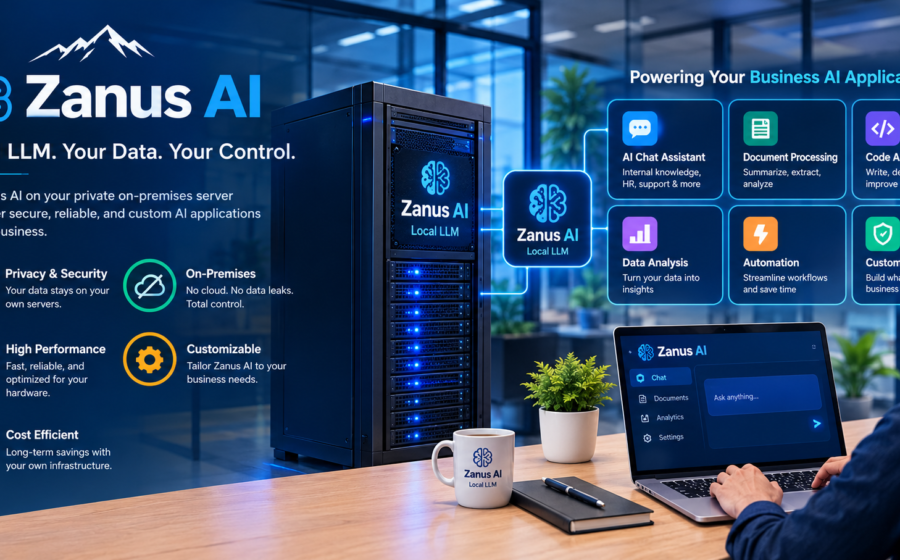
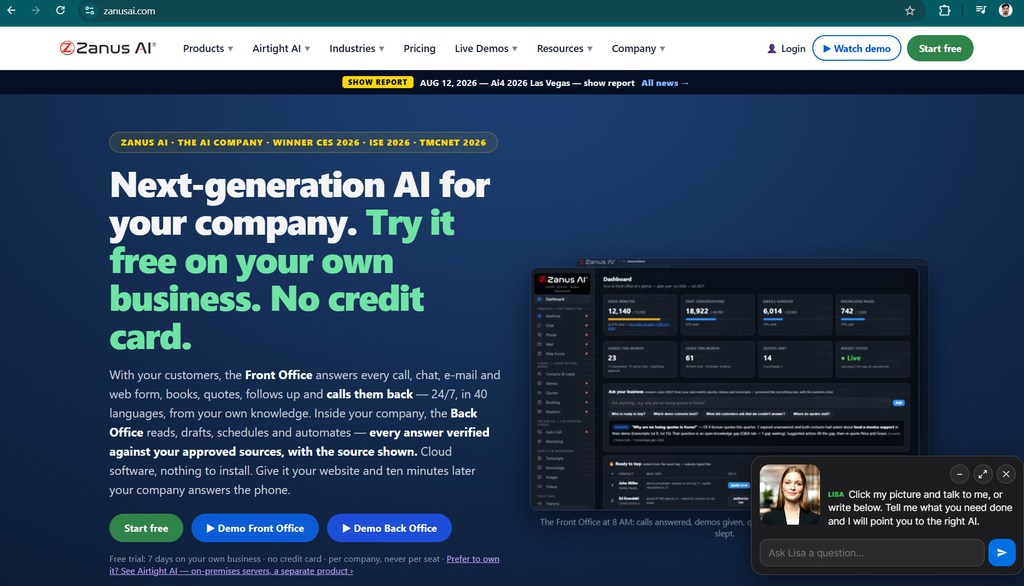
One platform exploring this approach is Zanus AI, which offers private, on-premises AI servers with preconfigured large language models (LLMs), business software, and integrated GPU hardware.
But what exactly is Local LLM Zanus, how does it work, and is it a good choice for businesses that want private AI?
In this article, we explore Zanus AI’s local LLM technology, key features, hardware, pricing considerations, advantages, disadvantages, business applications, and alternatives.
Table of Contents
What Is Local LLM Zanus?
Local LLM Zanus refers to the local large language model capabilities offered through Zanus AI’s private AI server products.
A large language model is an AI system trained to understand and generate text. Depending on the model, it can answer questions, summarize documents, analyze information, generate reports, and assist with software development.
Most popular AI services run their models in cloud infrastructure. Users submit prompts to a remote service, which processes the request and returns a response.
Zanus AI takes a different approach with its private, on-premises AI servers. According to its official website, these systems include enterprise GPU hardware and locally installed language models that can run within a company’s own environment.
The company also offers the Zanus AI Operating System, which includes business-oriented modules such as document management, AI assistants, client management, scheduling, and automation.
This combination is designed to let organizations use AI with their own information while keeping processing on local infrastructure.
Official website: https://zanusai.com/servers/index.html
What Is a Local LLM?
A local LLM is a large language model that runs on hardware controlled by the user or organization rather than relying entirely on a remote AI provider.
Depending on the hardware, model size, and software configuration, a local LLM may run on a workstation, an internal server, or a dedicated AI appliance.
For example, a company might install a local language model and allow authorized employees to ask questions about internal documents without sending those documents to an external AI API.
Local LLMs can support tasks such as:
- Summarizing company documents.
- Searching internal knowledge bases.
- Drafting emails and reports.
- Analyzing contracts.
- Answering questions about company procedures.
- Assisting with software development.
- Supporting internal research.
- Automating selected business workflows.
However, running a model locally does not automatically make every application private, secure, or accurate. The complete system’s data flows, permissions, integrations, and logging practices still matter.
How Does Zanus AI Local LLM Work?
Zanus AI describes a preconfigured on-premises system that combines hardware, locally running language models, and business software.
Its general workflow can be understood in several steps.
1. Local AI Hardware
The system uses integrated enterprise GPU hardware to run language models. GPUs are specialized processors that can accelerate the calculations required for AI inference.
The available hardware determines which models can run, how much information they can process at once, and how many requests the system can handle simultaneously.
Zanus offers different server configurations based on intended workloads.
2. Preinstalled Language Models
According to Zanus AI, its servers ship with language models installed and optimized by its engineering team.
The company describes using multiple open-weight model families selected according to customer requirements.
This approach is intended to reduce the work involved in finding models, configuring inference software, and setting up an AI server.
The exact model versions, licenses, supported context lengths, and performance specifications should be confirmed with the provider before purchase.
3. Connecting Company Information
A local LLM becomes more useful for business when it can access relevant internal information.
Zanus describes a process for connecting documents, databases, emails, CRM records, and other company information to its local AI environment.
Depending on the implementation, the system can index this information so that users can retrieve relevant material and ask questions about it.
Businesses should verify which data sources are supported natively, which require custom integration, and how changes to source information are synchronized.
4. Accessing the AI Through a Local Network
Zanus says users can access its private AI system through a web browser on computers connected to the local network.
This allows employees to interact with the system without needing a separate AI workstation for every user.
Network access should still be restricted using appropriate authentication, permissions, and security controls.
5. Using AI for Business Tasks
After configuration, employees can use the system for supported tasks such as document analysis, internal question answering, report generation, and business automation.
The Zanus AI Operating System adds business-oriented modules around the underlying AI models.
This is an important distinction: the product is positioned as more than a standalone language model. It combines AI infrastructure with software intended to support everyday operations.
Also Read:
- Is Zanus AI Good for Enterprise Operations? A Complete Review for 2026
- 4 Best Enterprise AI Server Zanus in 2026: Features, Pricing, Benefits & Review
- AI Voice Agent Zanus Review 2026: Features, Pricing, Benefits & Alternatives
- Zanus AI Automation Review 2026: Features, Pricing, Benefits & Alternatives
Key Features of Zanus AI Local LLM
1. On-Premises AI Processing
The central feature of Zanus AI’s private server offering is its on-premises deployment model.
Rather than sending every prompt to a cloud AI provider, the system is designed to process AI requests on hardware located within the organization’s environment.
This may be valuable for businesses that handle confidential documents, proprietary information, or sensitive customer data.
However, organizations should confirm that all relevant components, including backups, integrations, telemetry, and remote support, comply with their data-handling requirements.
2. Offline and Air-Gapped Operation
Zanus advertises that its local AI servers can operate without an internet connection and support air-gapped deployments.
An air-gapped environment is isolated from external networks, providing an additional layer of separation for certain high-security workloads.
This can be useful for organizations with strict network-isolation requirements.
There is an important practical consideration: an offline system still needs a process for receiving security patches, software updates, and new model versions. Businesses should ask how offline updates are delivered, verified, and installed.
3. Enterprise GPU Hardware
Running a language model locally requires suitable computing resources.
Zanus integrates enterprise GPU hardware into its server products to support AI inference.
The hardware configuration affects several factors:
- Which language models can run.
- How many requests can be processed simultaneously.
- How much context can be handled.
- Response speed.
- Power consumption.
- Total system cost.
Enterprises should request detailed specifications for GPU memory, system RAM, storage, networking, power requirements, and expected performance for their workloads.
The term enterprise GPU alone is not enough to determine whether a particular configuration will meet an organization’s needs.
4. Multiple Language Models
Zanus states that its servers can support multiple preinstalled and optimized LLMs.
This can give businesses flexibility when choosing models for different tasks, such as document summarization, question answering, coding, or more complex reasoning.
Different models have different strengths, licensing terms, hardware requirements, and accuracy characteristics.
Before selecting a configuration, ask the provider which exact models and versions are available, whether customers can change them, and how updates are handled.
5. Business Knowledge Retrieval
A local language model does not automatically know the latest details about a particular company’s operations.
To answer questions about internal documents, the system generally needs access to relevant company information through a retrieval or knowledge-management process.
Zanus describes a vector-store and knowledge-grounding approach intended to connect responses to company data.
For example, employees might ask questions about internal procedures, product documentation, or company policies.
The quality of the answer depends on the source material, retrieval process, model behavior, and any verification controls.
No LLM or retrieval system can guarantee that every answer will be correct. Important results should be checked against authoritative source documents.
6. Zanus AI Operating System
The company also offers the Zanus AI Operating System, a business software layer designed to work with its local AI infrastructure.
The official website describes modules covering areas such as:
- AI chat and assistants.
- Client and contact management.
- Documents and records.
- Scheduling.
- Task automation.
- Marketing tools.
- Website chat.
- User management and permissions.
The aim is to provide an integrated business environment rather than requiring organizations to assemble every component independently.
Businesses should confirm which modules are included in their chosen server package and whether additional industry-specific software carries separate costs.
7. Multiple Industry Applications
Zanus markets its private AI systems for several industries, including healthcare, legal services, finance, education, government, manufacturing, and professional services.
Potential applications include summarizing documents, searching internal knowledge, preparing reports, and supporting administrative work.
The suitability of the system depends on the organization’s regulatory requirements and the accuracy needed for each task.
For high-stakes applications, such as clinical decisions, legal advice, or financial approvals, human review and appropriate governance remain essential.
8. Local API Access
Zanus describes an OpenAI-compatible API for its On-Prem Tokens Server.
API compatibility can make integration easier for developers whose applications already support a compatible interface.
However, compatibility does not guarantee that every OpenAI feature, parameter, tool call, or model-specific function is supported.
Developers should test their applications against the exact endpoint and model configuration before planning a full migration.
9. Ownership-Based Deployment
Zanus positions its private AI servers as an alternative to recurring cloud AI usage charges.
The customer purchases the hardware and software package rather than relying entirely on per-token cloud billing.
This can be attractive for organizations with sustained workloads, although the system still has operating costs, including electricity, maintenance, hardware replacement, and staff time.
The financial benefits depend on usage volume and the total cost of owning the system.
Local LLM Zanus Pricing in 2026
Zanus AI uses a quote-based pricing model for its private AI server products.
Unlike many online AI tools with a simple monthly subscription, the price of a local LLM system depends on the hardware configuration, intended workload, software package, and deployment requirements.
The official website describes different server options, including the On-Prem Tokens Server and Private On-Premises AI.
| Product | Main purpose | Pricing approach |
|---|---|---|
| On-Prem Tokens Server | Local LLM inference through a compatible API | Request a quote |
| Private On-Premises AI | Local AI server, operating system, and industry-specific software | Request a quote |
| Enterprise Cluster | Larger-scale infrastructure for demanding workloads | Confirm configuration and pricing with the vendor |
Source: Official Zanus AI server information.
On-Prem Tokens Server
The On-Prem Tokens Server is designed for organizations that want a local AI inference endpoint without necessarily purchasing the full industry-specific software package.
The company describes an OpenAI-compatible API that applications can use to send requests to the local models.
This may suit technical teams building their own applications or companies that want to reduce reliance on external token-based AI services.
Pricing is quote-based and depends on the selected hardware and workload.
Private On-Premises AI
The Private On-Premises AI package combines the server, Zanus AI Operating System, and an industry-specific software package.
It is aimed at businesses that want a more complete system for internal AI use rather than only an inference endpoint.
The company describes permanent licensing and no recurring per-token or per-seat fees for the included system. Buyers should confirm the license terms, software maintenance arrangements, upgrades, support, and any optional services in writing.
Is Zanus AI Local LLM Free?
No. Zanus’s private server offering is a commercial hardware and software product, not a free local LLM download.
The advantage is the potential to own the infrastructure and avoid recurring cloud token charges for supported local workloads.
However, the initial purchase can be substantial. Businesses should compare the full cost of ownership with the cost of using cloud AI services.
Benefits of Using Zanus AI Local LLM
1. Greater Control Over Sensitive Data
Local processing may reduce the need to transmit confidential information to external AI providers.
This can be useful for companies working with proprietary research, customer records, internal policies, contracts, or financial documents.
However, privacy depends on the entire implementation. External integrations, remote support, backups, and network configuration must also be considered.
2. Reduced Dependence on Cloud AI Services
A local LLM can continue to operate even when internet connectivity is unavailable, provided its hardware and internal network remain operational.
This can be important for isolated facilities and organizations that require predictable access to internal AI tools.
3. Potentially Predictable Usage Costs
Cloud AI services often charge according to usage, subscription tier, or API consumption.
A purchased local system changes that cost structure. After the initial investment, usage-related costs may primarily involve electricity and maintenance rather than per-token fees.
The actual savings depend on how frequently the system is used and the costs of operating and maintaining it.
4. Customization for Business Workflows
Local AI infrastructure can support custom applications, internal data sources, and organization-specific workflows.
Zanus’s software layer is intended to make this more accessible by including business-oriented modules.
The degree of customization available should be verified for the specific package.
5. More Direct Control Over Deployment
Businesses can manage their own infrastructure, network access, user permissions, and update procedures.
This may help organizations align AI deployment with internal IT policies.
Owning the server also means the organization is responsible for maintaining its security and operational reliability.
6. Potentially Better Integration With Internal Knowledge
When properly configured, a local LLM can work with company-specific information without requiring that every document be uploaded to an external AI service.
This may support internal research, document search, and business knowledge management.
The quality of results still depends on retrieval accuracy, model capability, and data quality.
Disadvantages of Local LLM Zanus
Although local AI has potential advantages, there are several limitations to consider.
1. High Initial Investment
Dedicated AI hardware and integrated software can require a substantial upfront purchase.
For small businesses with occasional AI needs, a cloud subscription or a lower-cost local setup may be more economical.
Request a detailed quotation and compare it with alternative approaches before making a decision.
2. Hardware Limitations
Local models depend on the memory, processing capacity, and storage available in the server.
Larger models may require more GPU memory and system resources. Higher concurrent usage can also affect performance.
Enterprises should test their intended workloads rather than assuming that every model or task will run at the required speed.
3. Ongoing Maintenance
Even when the AI software is purchased outright, the system still requires maintenance.
This may include security updates, hardware monitoring, backup management, model updates, and troubleshooting.
Ask the vendor what support is included and which maintenance responsibilities remain with the customer.
4. Model Quality Varies
A local model may perform differently from a leading hosted AI model, depending on the task and model version.
Some tasks may work very well locally, while others may require more capable models, specialized tools, or human review.
Businesses should evaluate accuracy on real examples from their own work.
5. Limited Elastic Scalability
Cloud services can often add computing capacity without requiring the customer to purchase new hardware.
A local server has finite resources. If demand increases significantly, the business may need a larger configuration or additional machines.
The costs and complexity of scaling should be included in the purchasing decision.
6. Integration Work May Still Be Required
A preconfigured platform can reduce setup effort, but it does not guarantee seamless compatibility with every internal application.
CRM systems, ERP software, identity providers, document repositories, and custom databases may require additional configuration or development.
Confirm the exact integrations needed for your business before buying.
7. Ownership Does Not Eliminate Security Risks
Keeping AI processing on-premises can reduce certain external data exposures, but it does not automatically protect a server from compromised accounts, malicious insiders, ransomware, or software vulnerabilities.
Strong access controls, patching, network segmentation, backups, and monitoring remain necessary.
Local LLM Zanus vs. Cloud AI
One of the most important decisions is whether to run AI locally or use a cloud-based service.
| Feature | Zanus local LLM | Cloud AI service |
|---|---|---|
| Data processing | Designed to run on local infrastructure | Processed by a remote provider |
| Internet dependency | Can support offline operation | Usually requires internet access |
| Initial cost | Higher hardware and setup investment | Often lower initial cost |
| Usage charges | No per-token charges for the included local workload, according to the vendor | Often subscription- or usage-based |
| Maintenance | Customer and vendor responsibilities depend on the contract | Much of the infrastructure is managed by the provider |
| Model selection | Depends on supported local models and hardware | Depends on the provider’s available models |
| Scaling | May require additional hardware | Often easier to scale through service plans |
| Data governance | More direct control over local infrastructure | Depends on provider policies and configuration |
| Performance | Depends on hardware, model, and concurrency | Depends on model, network, provider capacity, and plan |
Neither approach is universally better.
Local AI may be more attractive when data control, offline access, and sustained usage are important. Cloud AI may be more practical when an organization needs minimal infrastructure management, easy scaling, or access to particular hosted models.
A hybrid approach is also possible: use local models for sensitive internal workloads and cloud AI for tasks that benefit from specific hosted capabilities.
Local LLM Zanus vs. Other Local AI Options
Businesses interested in local LLMs have several options beyond purchasing a dedicated appliance.
1. Ollama
Ollama provides tools for running supported language models locally on compatible hardware.
It can be a useful starting point for individuals and technical teams who want to experiment with local AI without purchasing an integrated enterprise appliance.
Official website: Ollama
2. LM Studio
LM Studio provides a desktop application for downloading, running, and experimenting with local language models.
It may be suitable for users who prefer a graphical interface and want to explore local AI before investing in dedicated infrastructure.
Official website: LM Studio
3. llama.cpp
llama.cpp is an open-source project focused on efficient local inference for supported models across a range of hardware.
It may suit technical users who want more control over model execution and system configuration.
Official repository: llama
4. vLLM
vLLM is an inference and serving framework designed for high-throughput language model deployments.
It may be relevant to technical teams building local or self-hosted AI services that need to handle multiple requests.
Official website: vLLM
Which Local AI Option Is Best?
The right choice depends on your budget, technical skills, and business requirements.
- Zanus AI: Worth evaluating if you want an integrated hardware-and-software package with business modules and vendor support.
- Ollama: Worth considering for straightforward local model experimentation.
- LM Studio: Worth considering for a desktop-based local AI experience.
- llama.cpp: Worth considering for flexible, efficient local inference.
- vLLM: Worth considering for higher-throughput serving and technical deployments.
These products are not direct equivalents. Zanus is positioned as a broader private AI system, while the other options primarily provide tools or frameworks for running models.
Who Should Use Zanus AI Local LLM?
Businesses Handling Confidential Documents
Organizations that process proprietary contracts, internal reports, customer information, or research may benefit from a local deployment model.
They should still verify the complete system’s security controls and data flows.
Law Firms
Legal teams may explore local AI for document summarization, internal research, and searching case-related materials.
Any use involving legal analysis should include appropriate professional review and confidentiality safeguards.
Healthcare Organizations
Healthcare organizations may investigate local AI for administrative documentation, internal knowledge retrieval, and selected operational tasks.
Patient data and clinical workflows require careful privacy, security, and regulatory review. AI-generated clinical content should not replace qualified medical judgment.
Financial and Professional Services
Financial organizations may use local models to support document analysis, internal policy searches, and report preparation.
Sensitive financial decisions require accurate data, appropriate authorization, and human oversight.
Enterprises With High AI Usage
Organizations with sustained AI workloads may benefit from comparing a one-time infrastructure investment with recurring cloud usage charges.
The decision should be based on realistic estimates of usage, model performance, hardware requirements, and ongoing maintenance costs.
Government and Education
Organizations that need tighter control over information or operate in restricted network environments may find local AI worth evaluating.
Deployment requirements vary widely, so each organization should verify that the proposed system satisfies its security and governance standards.
How to Get Started With Zanus AI Local LLM
If you are considering Zanus AI for your business, the following steps can help you make an informed decision.
Step 1: Identify your main use case.
Decide whether you want to summarize documents, search internal knowledge, automate reports, develop applications, or support multiple departments.
Step 2: Estimate your workload.
Calculate how many users and requests you expect, how long your documents are, and how quickly responses need to be generated.
Step 3: Request hardware specifications.
Ask for details about GPU memory, RAM, storage, networking, supported models, context length, and expected concurrent usage.
Step 4: Confirm model availability.
Ask which language models and versions are included, how updates are delivered, and whether you can install or change models later.
Step 5: Review privacy and security.
Request documentation covering access controls, encryption, data retention, remote support, backups, and offline update procedures.
Step 6: Test with real business tasks.
Evaluate accuracy, response time, retrieval quality, and performance using representative documents and questions.
Step 7: Calculate total cost of ownership.
Include hardware, licensing, installation, electricity, maintenance, upgrades, support, and eventual replacement.
Step 8: Compare alternatives.
Consider whether a dedicated appliance, an existing workstation, an open-source local setup, or a cloud service is most appropriate.
Step 9: Request a quotation.
Visit the official Zanus AI website to discuss the configuration that matches your workload and business requirements.
Official website: https://zanusai.com/servers/index.html
Conclusion: Is Local LLM Zanus Worth It in 2026?
Zanus AI is worth evaluating for organizations that want to move beyond cloud-based AI and operate language models on infrastructure they control.
Its main selling points are the combination of local GPU hardware, preconfigured language models, business-oriented software, and support for offline or air-gapped deployments.
These capabilities may be valuable for organizations that process confidential information, need internal AI access without continuous internet connectivity, or expect sustained AI usage.
However, a local AI server is not automatically the best choice for every business. Hardware investment, maintenance, model quality, integration work, and scalability all affect its value.
Before purchasing, businesses should request detailed specifications, test the system on representative workloads, review security documentation, and compare the full cost of ownership with cloud and open-source alternatives.
Our verdict: Zanus AI is a promising option to evaluate for private, on-premises business AI, particularly when data control and an integrated deployment are priorities. Its suitability should be established through technical testing, security review, and a realistic financial comparison rather than marketing claims alone.
Frequently Asked Questions
What is Local LLM Zanus?
Local LLM Zanus refers to the local language model capabilities provided through Zanus AI’s private server products. These combine AI hardware, locally running models, and business software for organizations that want to operate AI within their own environment.
Does Zanus AI run without the internet?
Zanus states that its private AI servers support offline operation and air-gapped deployments. Confirm the exact configuration, update process, and any features that require external connectivity.
Does Zanus AI send data to ChatGPT?
The company describes its private server products as running local models without requiring external AI services such as ChatGPT. Buyers should verify the data flows of the exact deployment, including optional integrations, telemetry, and remote support.
How much does Zanus AI cost?
Zanus AI uses a quote-based pricing approach for its private server products. The final cost depends on hardware, software, workload, and deployment requirements. Contact the company for a current quotation.
Is Zanus AI better than Ollama?
They serve different purposes. Zanus offers an integrated private AI hardware-and-software system, while Ollama provides tools for running supported language models locally. The better choice depends on whether you need an integrated business platform or a more flexible DIY setup.
Can Zanus AI analyze company documents?
The company describes connecting internal documents and other business information to its AI system for knowledge retrieval and analysis. The results depend on supported sources, configuration, model capabilities, and document quality.
Does a local LLM guarantee privacy?
No. Local processing can reduce the need to transmit information to external AI services, but privacy also depends on access controls, software configuration, integrations, logging, backups, and operational security.
Is Zanus AI suitable for small businesses?
It may suit small businesses that need private AI and want an integrated solution. However, dedicated hardware can involve a substantial upfront cost. Smaller organizations should compare the quotation with less expensive local and cloud alternatives.