

Abraham Quiros Villalba AI Tool
Artificial intelligence is rapidly changing the way people research information, analyze markets, automate tasks, and make decisions. As AI becomes more closely connected with finance and investment research, new platforms and concepts are attracting attention online. One name that has recently generated considerable search interest is the Abraham Quiros Villalba AI Tool.
But what exactly is it? Is it a conventional AI application, an investment research platform, or an automated trading system? And perhaps most importantly, how much of what is being said about it can actually be verified?
Public information presents a somewhat complicated picture. A website associated with Abraham Quiros Villalba describes an AI-powered investment platform that is intended to analyze markets, cryptocurrency trends, and other financial information. It characterizes the project as a research assistant rather than a high-frequency trading bot and says that the platform is being developed and tested.
At the same time, several independent websites have noted that detailed technical documentation, independently audited performance figures, transparent pricing, and a widely accessible product interface are difficult to verify publicly.
This article takes a balanced look at the Abraham Quiros Villalba AI Tool, including what it is reportedly designed to do, how an AI investment research system could work, potential benefits, limitations, and important questions users should ask before relying on any financial AI platform.
Table of Contents
What Is the Abraham Quiros Villalba AI Tool?
The term Abraham Quiros Villalba AI Tool appears to refer primarily to an AI-powered investment research project associated with Abraham Quiros Villalba.
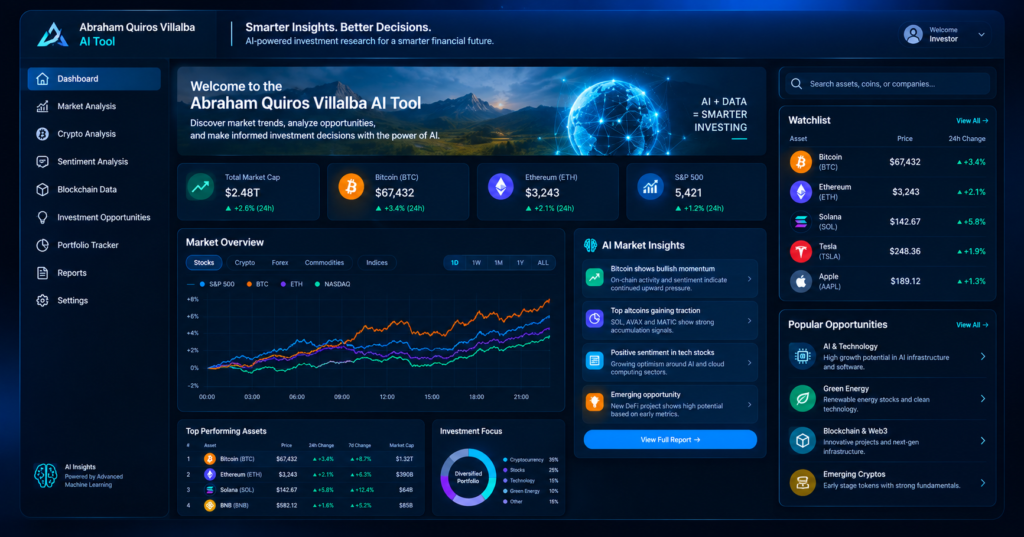
According to the project’s associated website, its broader vision involves using artificial intelligence, market information, cryptocurrency data, and analytics to help investors understand complex financial conditions. The website says the platform is intended to identify market patterns, examine investment opportunities, and provide information that can support longer-term investment decisions.
This is an important distinction.
The tool should not automatically be described as an autonomous trading robot. Its associated description specifically positions it as a research assistant, rather than a system designed primarily for high-frequency automated trading.
In practical terms, the concept is closer to an AI-powered research environment that could bring multiple sources of information together and help users interpret them.
Potential areas of analysis described across available sources include:
- Stock-market information
- Cryptocurrency markets
- Historical price patterns
- Market sentiment
- Blockchain or on-chain information
- Emerging cryptocurrency projects
- Startup and pre-IPO opportunities
- News and other alternative data
However, it is important to distinguish reported or proposed functionality from independently demonstrated functionality. Public technical information about the platform remains limited.
Who Is Abraham Quiros Villalba?
The online biography associated with Abraham Quiros Villalba presents him as an entrepreneur and investor with interests spanning renewable energy, cryptocurrency, and technology.
His own website describes a professional journey involving engineering, entrepreneurship, renewable energy, and investment. It also says that he became interested in Bitcoin early and later focused on solar energy and AI-driven investment technology.
Similar biographical data are repeated in other third-party articles, although there is little independent confirmation of all those claims. Because of this, readers should be able to discern between information from an individual’s own website and information verified by independent, institutional, or professional sources.
When assessing financial technologies, this distinction becomes more crucial. An AI system’s accuracy, profitability, regulation, or suitability for investing decisions cannot be determined only by a founder’s biography.
How Could the Abraham Quiros Villalba AI Tool Work?
The platform’s entire design is not explained in any public technical paper. Presenting a particular machine-learning architecture as a proven fact would therefore be improper.
However, the publicly available features give a plausible idea of what such a platform may try to achieve.
1. Market Data Collection
An investment AI system needs data before it can produce useful analysis.
Potential data sources could include:
- Historical prices
- Trading volume
- Market capitalization
- Cryptocurrency prices
- News
- Economic indicators
- Blockchain activity
- Social sentiment
- Company information
The purpose of collecting multiple data types is to create a broader view of market conditions instead of relying on a single indicator.
2. Historical Pattern Analysis
Machine-learning systems can process large historical datasets much faster than a person manually examining thousands of charts.
A financial AI model could potentially compare current market conditions with historical situations that have similar characteristics.
For example, a system might examine relationships between:
Price + volume + volatility + sentiment + market conditions
and compare those combinations with previous periods.
However, finding a historical pattern does not guarantee that the future will repeat it.
Financial markets are influenced by unpredictable events, including political decisions, economic shocks, company announcements, regulation, interest-rate changes, and investor behavior.
3. Sentiment Analysis
Another potentially important component is sentiment analysis.
AI can process large quantities of text from sources such as news articles, public commentary, and social platforms and attempt to classify the overall sentiment as positive, negative, or neutral.
For an investment research platform, this could help users identify changes in market perception.
For example, a sudden increase in negative discussion surrounding a company might become an additional research signal.
However, sentiment data has significant weaknesses. Online discussions can be inaccurate, manipulated, exaggerated, or dominated by a small group of users. Consequently, sentiment should be treated as one input rather than definitive evidence.
4. Cryptocurrency and Blockchain Analysis
Additionally, the initiative is related to blockchain and cryptocurrency research.
Blockchain networks produce vast amounts of data that are visible to the public. Analysts can examine wallet activity, token movements, transactions, and other on-chain indications, depending on the blockchain.
This data might be arranged by an AI system into patterns that would be challenging for a single investor to keep an eye on.
Because cryptocurrency markets are always active and subject to significant volatility, this could be very helpful.
Once more, though, on-chain activity does not always equate to a trustworthy forecast of future prices.
5. Startup and Pre-IPO Research
Another reported area of interest is identifying promising startups or potential pre-IPO opportunities.
An AI research system could potentially compare information such as:
- Funding activity
- Industry growth
- Market size
- Company traction
- Competitive environment
- Investor interest
- Business-model characteristics
Such analysis could help users create a research shortlist.
But private-market investing has additional challenges because information can be limited, difficult to verify, and unavailable to ordinary investors.
Key Features Associated With the Tool
The Abraham Quiros Villalba AI Tool is frequently linked to a number of capabilities, even though the precise final feature set is not completely published publicly.
AI-Powered Investment Research
The central idea is to use artificial intelligence to process financial information and help users conduct research more efficiently.
Market Pattern Recognition
The platform is described as being capable of examining historical and current market conditions to identify potentially relevant patterns.
Cryptocurrency Analysis
Crypto-market data and blockchain information are among the areas associated with the project.
Sentiment Analysis
News, online discussions, and other forms of market sentiment may be incorporated into analysis.
Opportunity Discovery
The project is also described as looking for emerging investment opportunities, including cryptocurrencies, stocks, and potentially early-stage companies.
Long-Term Investment Focus
Unlike platforms built primarily around rapid automated trading, the associated description emphasizes research, timing, and strategy for longer-term investors.
Is the Abraham Quiros Villalba AI Tool a Trading Bot?
It is best understood as an investing research tool than as a conventional trading bot based on the description that is currently available.
Typically, a trading bot connects to a cryptocurrency exchange or brokerage and automatically places trades based on algorithmic or predetermined criteria.
Instead, the Abraham Quiros Villalba AI Tool is characterized as a research assistant intended to assist users in comprehending market data and spotting chances.
This distinction is crucial since an automated system that manages a user’s finances is not the same as an AI that offers analysis.
Therefore, until such functionality can be verified by reliable documentation, users should be wary of websites or promotions that portray the program as a guaranteed-profit automated trading method.
Potential Benefits of an AI Investment Research Tool
If implemented effectively, an AI-powered financial research platform could offer several advantages.
Faster Information Processing
Investors can spend hours reading news, analyzing charts, and comparing different assets. AI can process large quantities of information rapidly.
Reduced Information Overload
Modern markets generate enormous amounts of data. An AI system could potentially organize that information into more manageable categories.
Pattern Discovery
Machine learning can identify statistical relationships that may be difficult to notice manually.
Broader Market Monitoring
Instead of monitoring a small number of assets, users could potentially screen a much larger universe of stocks, cryptocurrencies, and companies.
More Structured Research
A good research assistant could encourage users to compare multiple factors rather than making decisions based solely on headlines or emotions.
Important Limitations
AI can be powerful, but it does not eliminate investment risk.
AI Cannot Guarantee Profits
No legitimate AI system can guarantee that an investment will make money.
Markets are uncertain, and even highly sophisticated models can fail.
Historical Data Has Limitations
A model trained on historical patterns may perform poorly when market conditions change.
This is known as a form of model or regime risk.
Data Quality Matters
An AI system can only be as reliable as the information it receives.
Incorrect, delayed, manipulated, or incomplete data can produce misleading results.
Financial Markets Are Non-Stationary
Relationships that existed in the past can disappear.
For example, an indicator that worked during a low-interest-rate environment may behave differently during a period of high inflation or monetary tightening.
Human Judgment Remains Important
AI-generated analysis should be treated as an input into a decision-making process rather than an unquestionable answer.
Is the Abraham Quiros Villalba AI Tool Legitimate?
This is one of the most important questions surrounding the subject.
The safest answer is that there is not currently enough independent public evidence to make a definitive judgment about the platform’s legitimacy, performance, or investment value.
The associated website presents the platform as a developing AI investment project and says it is undergoing beta testing.
However, independent reviews have pointed out gaps such as limited technical documentation, a lack of independently audited performance results, unclear public pricing, and difficulty identifying a conventional public product interface.
This does not automatically prove that the project is fraudulent or nonexistent. It simply means that potential users should avoid treating online promotional descriptions as independently verified evidence.
Abraham Quiros Villalba AI Tool vs. Traditional Investment Research
Traditional investment research often requires users to gather information from multiple sources.
An investor might use:
- Financial statements
- Stock charts
- News websites
- Economic reports
- Analyst research
- Crypto analytics platforms
- Social sentiment
- Company announcements
An AI research assistant could potentially bring several of these information categories together.
The major advantage is therefore not necessarily that AI “knows” which investment will succeed. Instead, its value could come from speed, organization, screening, and pattern recognition.
This is a more realistic way to understand AI-assisted investing.
Also Read: Leonardo AI Review 2026: Features, Pricing, Pros, Cons & Alternatives
Conclusion
Based on the information that is currently available, the Abraham Quiros Villalba AI Tool is best defined as an upcoming AI-powered investment research concept connected to Abraham Quiros Villalba.
According to its publicly stated vision, it uses data analysis and artificial intelligence to look at things like equities, cryptocurrencies, sentiment, blockchain information, and possible investment opportunities. Instead of portraying the platform as a traditional automated trading bot, the related website presents it as a research helper.
Important details are still challenging to independently confirm, though. A long, independently audited performance history, thorough technical documentation, or an established public product ecosystem are not yet established by publicly accessible data.
As a result, the best course of action is not to reject the idea out of hand nor to believe every assertion made about it online.
Rather, prospective users ought to assess the platform according to the same criteria that they would apply to any financial technology: verifiable performance, transparency, independent proof, security, regulatory information, clear ownership, and realistic claims.
AI can speed up and improve the quality of investing research, but it cannot eliminate market uncertainty. The best application of an AI investment tool is probably as a research and decision-support system, with human judgment and suitable risk management still having the final say.
Frequently Asked Questions
What is the Abraham Quiros Villalba AI Tool?
The Abraham Quiros Villalba AI Tool refers to an AI-powered investment research platform associated with Abraham Quiros Villalba. Public descriptions say it is intended to analyze financial markets, cryptocurrency information, sentiment, and other data to support investment research.
Is the Abraham Quiros Villalba AI Tool a trading bot?
Not according to its associated description. It is presented primarily as an investment research assistant rather than a high-frequency automated trading bot.
Can the tool guarantee investment profits?
No. There is no credible basis for assuming that any AI system can guarantee investment profits. Financial markets remain unpredictable, and AI predictions can be wrong.
Does the Abraham Quiros Villalba AI Tool analyze cryptocurrency?
Cryptocurrency and blockchain analysis are among the areas publicly associated with the project. Descriptions mention crypto trends, blockchain information, sentiment, and emerging digital assets.
Is the Abraham Quiros Villalba AI Tool free?
A clearly established, independently verified public pricing structure is not readily available from the sources reviewed. Users should confirm pricing through an authentic official channel rather than relying on third-party articles.
Should I invest money because an AI tool recommends an asset?
No. An AI recommendation should never be treated as a guarantee. Investors should independently research an asset, understand the risks, verify information, and consider their own financial circumstances before making an investment decision.
What is the future of AI investment tools?
AI investment tools are likely to become increasingly sophisticated. They may combine real-time market data, natural-language processing, sentiment analysis, blockchain analytics, predictive models, and personalized research. Their greatest value may come from helping investors process information more efficiently rather than replacing human judgment.