

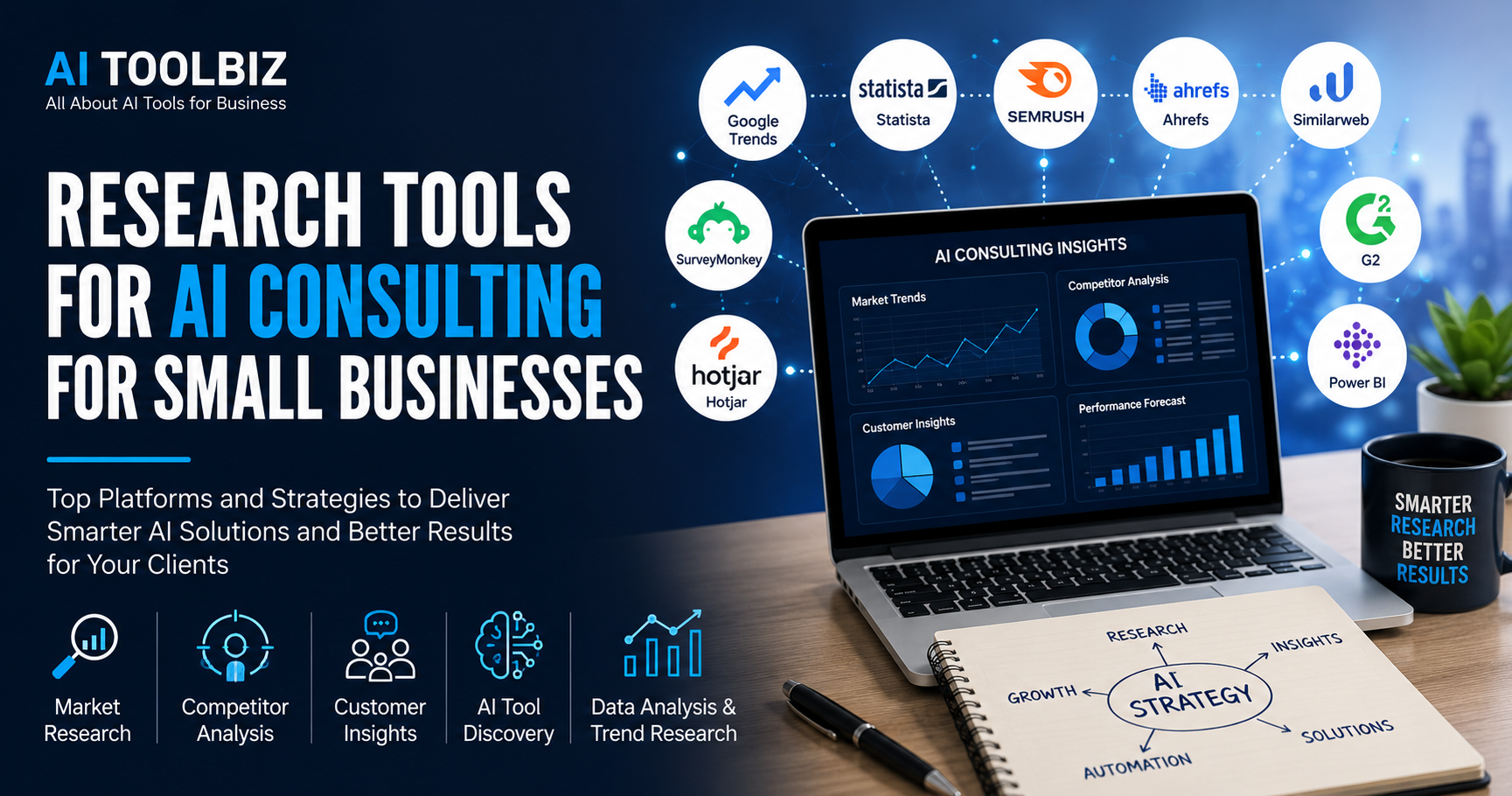
Research Tools for AI Consulting for Small Businesses
One of the digital economy’s fastest-growing service sectors is artificial intelligence (AI) consultancy. In order to increase productivity, cut expenses, automate processes, improve customer experiences, and obtain a competitive edge, small businesses are increasingly looking for advice on how to apply AI technologies.
However, suggesting solutions like ChatGPT, Claude, Gemini, or automation platforms is not the only way to provide effective AI advice. In order to comprehend industries, consumer behaviour, rivals, market opportunities, operational constraints, and upcoming technology, effective consultants extensively rely on research.
Research instruments become crucial in this situation.
Whether you work as a technology strategist for small enterprises, an independent AI consultant, or the owner of an AI firm, having the appropriate research toolkit can significantly enhance the calibre of your recommendations and raise client success rates.
The most useful research tools for AI consulting will be discussed in this book, along with how they help client projects and how small-business-focused consultants can develop a professional research methodology.
Table of Contents
Why Research Matters in AI Consulting
Many companies erroneously think that selecting a software platform is the first step in implementing AI.
Actually, research is the first step towards successful AI adoption.
Before offering a solution, consultants need to know the answers to questions like:
- What are the client’s biggest operational challenges?
- Which tasks consume the most employee time?
- What AI solutions are competitors already using?
- What customer pain points remain unsolved?
- What market trends are influencing the industry?
- Which AI tools deliver measurable ROI?
Consultants run the risk of endorsing solutions that don’t address real business issues if they don’t conduct adequate study.
Research enables consultants to:
- Identify opportunities for automation
- Validate AI use cases
- Analyze competitors
- Understand customer needs
- Evaluate technology vendors
- Estimate implementation costs
- Measure potential ROI
The right research tools make this process significantly faster and more accurate.
Categories of Research Tools for AI Consultants
Six main sorts of research tools are typically used by AI consultants:
- Market Research Tools
- Competitor Analysis Tools
- Customer Research Platforms
- AI Discovery and Evaluation Tools
- Data Analysis Platforms
- Industry Trend Research Tools
Let’s take a closer look at each category.
1. Market Research Tools
Consultants can better grasp industry conditions, growth prospects, consumer demand, and trends in technology adoption by doing market research.
Google Trend
One of the easiest-to-use tools for market research is still Google Trends.
Consultants are able to evaluate:
Look for the need for AI solutions
Trends unique to a given industry
Seasonal trends
Demand by geography
New technologies
An AI consultant employed by a nearby accounting business, for instance, can compare search interest in:
- AI bookkeeping
- Automated billing
- AI-powered financial automation and tax preparation
Prior to offering recommendations, this aids in identifying market potential.
Benefits
- Free to use
- Real-time trend data
- Industry validation
- Geographic insights
Statista
Statista offers comprehensive industry data, projections, and market research.
It is commonly used by consultants to collect:
- Adoption rates of AI
- Forecasts for industry growth
- Data on consumer behaviour
- Estimates of market size
These figures support strategic advice and consulting proposals.
Benefits
- Professional reports
- Reliable data sources
- Industry benchmarking
- Client presentation support
IBISWorld
IBISWorld provides industry-specific research studies that assist consultants in comprehending:
- Dynamics of the market
- Competitive environments
- Industry difficulties
- Patterns of technology adoption
These papers offer useful perspective for consultants working with specialised sectors.
2. Competitor Analysis Tools
Before making an AI investment, small firms frequently want to know what their rivals are doing.
Tools for competitor analysis aid in providing an answer to this query.
SEMrush
SEMrush is one of the most powerful competitor intelligence platforms available.
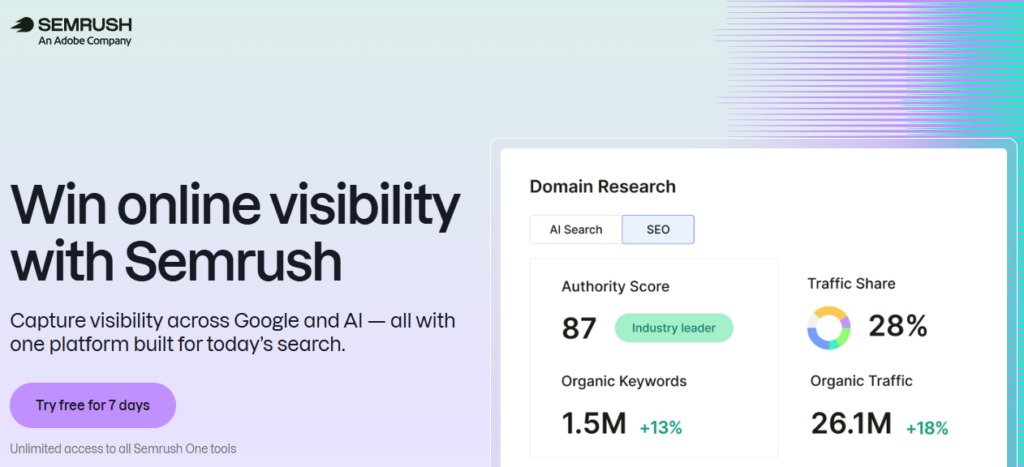
AI consultants use it to analyze:
- Website traffic
- SEO strategies
- Content performance
- Digital marketing activities
- Market positioning
For example, if a local law firm wants AI-driven lead generation, SEMrush can reveal how competing firms attract clients online.
Key Features
- Keyword analysis
- Competitor research
- Traffic estimation
- Content gap analysis
Ahrefs
Ahrefs provides similar competitor insights with a strong focus on search visibility.
Consultants can evaluate:
- Competitor authority
- Content strategies
- Backlink profiles
- Market leaders
Understanding competitor success often reveals opportunities where AI can improve a client’s performance.
Similarweb
Similarweb provides more comprehensive business intelligence information.
It aids consultants in looking at:
- Trends in website traffic
- sources of referrals
- Engagement of users and audience interests
Recommendations for AI-powered marketing and customer acquisition systems may be influenced by these insights.
3. Customer Research Platforms
The greatest AI solutions address actual customer issues.
Consultants can identify those issues with the aid of customer research methods.
SurveyMonkey
One of the easiest ways to get consumer input is still through surveys.
SurveyMonkey is used by consultants to determine:
- Consumer annoyances
- bottlenecks in services
- Gaps in communication
- Possibilities for automation
Customers that frequently complain about slow response times, for instance, would suggest that AI chatbots are necessary.
Advantages
- Easy deployment
- Fast feedback collection
- Quantifiable results
- Customer segmentation
Typeform
More interesting survey experiences are offered by Typeform.
It is perfect for customer discovery projects because of its conversational approach, which frequently results in better response rates.
Hotjar
Behavioural analytics are provided by Hotjar via:
- Heat maps
- Recordings of sessions
- Widgets for feedback
- User questionnaires
Consultants can watch how users interact with websites to find areas of friction that could benefit from AI-driven enhancements.
For instance:
- Inadequate navigation
- Perplexing checkout procedures
- High rates of abandonment
Automation recommendations can be guided by these findings.
AI Discovery and Evaluation Tools
The field of AI is changing quickly.
Consultants have to constantly assess new technology and tools.
AI Tool Directories
AI tool directories are now indispensable sources for study.
Well-known directories consist of:
- The Futurepedia
- An AI For That TopAI.tools AI Tool Hunt
These resources assist consultants in learning:
- New applications
- AI tools tailored to a certain industry
- Solutions for automation
- Software for productivity
Consultants can swiftly explore pertinent categories rather than painstakingly tracking thousands of businesses.
Product Hunt
Product Hunt is still a useful resource for finding recently released AI products.
Consultants are able to observe:
- Popular uses of AI
- User comments
- Reaction of the market
- Trends in innovation
Before being widely used, many innovative AI technologies first gain popularity on Product Hunt.
G2
G2 offers software comparisons and verified customer reviews.
G2 is commonly used by consultants to assess:
- Quality of AI software
- Client contentment
- Models of prices
- Comparisons of features
This lowers the possibility of suggesting untrustworthy fixes.
5. Data Analysis and Business Intelligence Tools
Stronger recommendations are the result of data-driven consulting.
These resources aid consultants in efficiently analysing client data.
Microsoft Power Bi
Power BI enables consultants to:
- Visualize business data
- Identify trends
- Track performance
- Measure AI impact
For small businesses, Power BI often provides affordable analytics capabilities.
Common use Case
- Sales analysis
- Customer segmentation
- Operational monitoring
- KPI tracking
Tableau
Tableau is known for advanced data visualization.
Consultants use it to transform complex datasets into actionable insights.
This is particularly valuable when presenting findings to business owners who may not have technical backgrounds.
Google Looker Studio
A free option for creating dashboards is Google Looker Studio.
Consultants are able to construct:
- Reports on marketing
- Dashboards for AI performance
- Views of customer analytics
- Systems for operational monitoring
These dashboards aid in showcasing the outcomes of AI application.
6. Industry Trend Research Tools
Keeping up with technical advancements is essential for AI consulting.
Tools for trend research assist consultants in predicting shifts in the market.
Exploding Topics
Exploding Topics finds new trends before they catch on.
Consultants are able to find:
- Emerging technologies
- Expanding markets
- Novel business strategies
- New demands from customers
Consultants can use this knowledge to put clients ahead of rivals.
Gartner Reports
One of the most reputable companies for technological research is still Gartner.
Its reports offer:
- Forecasts for technology
- Vendor assessments and industry forecasts
- Strategic suggestions
Gartner research has an impact on a lot of enterprise AI strategy.
Mckinsey Insights
High-caliber research on AI adoption and corporate transformation is frequently published by McKinsey.
These papers are frequently cited by consultants when:
- Constructing business cases
- Supporting suggestions
- Showing the potential for ROI
Reputable outside research can boost customer trust.
AI-Powered Research Tools for Consultants
Interestingly, AI consultants are increasingly conducting research using AI itself.
Information collecting is accelerated by a number of AI-powered platforms.
ChatGPT
ChatGPT helps consultants in the following ways:
- Report summaries
- generating ideas for use cases
- Producing insights for the industry
- Creating suggestions
When used properly, it drastically cuts down on research time.
Perplexity AI
AI answers and source citations are combined in Perplexity.
Consultants utilise it for:
- Do quick research
- Check the information
- Examine new subjects
- Compile references that support your claims.
This produces a quicker substitute for conventional search techniques.
Claude
Claude is quite good at deciphering lengthy papers.
Consultants regularly upload:
- Market analyses
- Client records
- Research articles
- Plans for strategy
Claude is able to condense lengthy text and extract important insights.
Building a Research Workflow for AI Consulting
The most effective consultants use a variety of tools.
Rather, they establish a methodical process.
This is how a typical workflow might appear:
| Step | Use | Goal | Remark |
|---|---|---|---|
| Industry Research | Statista IBISWorld Google Trends | Understand market conditions and opportunities. | |
| Competitor Analysis | SEMrush Ahrefs Similarweb | Identify competitive advantages and gaps. | |
| Customer Discovery | SurveyMonkey Typeform Hotjar | Identify suitable AI technologies. | |
| Data Validation | Power BI Tableau Looker Studio | Validate assumptions with data. | |
| Strategic Recommendations | ChatGPT Claude Perplexity | Accelerate analysis and reporting. |
Common Research Mistakes AI Consultants Should Avoid
Even seasoned consultants make blunders when conducting research.
Here are a few typical pitfalls:
Tool-First Thinking
Instead than focusing on business issues, many consultants begin with technology.
Instead than selling software, research should concentrate on finding solutions to problems.
Ignoring Customer Feedback
Opportunities that internal stakeholders miss are frequently revealed by customer insights.
Customer research should never be neglected.
Following Trends Blindly
Not every business can use every popular AI product.
Suggestions must to be in line with corporate objectives.
Relying on One Source
Accuracy is increased through cross-verification.
Whenever feasible, use a variety of research platforms.
Failing to Measure Results
In the end, research should produce quantifiable results.
Prior to implementation, define KPIs.
The Future of Research in AI Consulting
AI is changing the research process itself.
New competencies consist of:
- Automated study of the market
- AI-produced reports about competitors
- Business intelligence that is predictive
- Monitoring trends in real time
- Self-sufficient research agents
Consultants will benefit greatly from adopting these innovations.
AI research tools will increase expertise and facilitate quicker, better-informed decision-making rather than taking the place of consultants.
Consultants who integrate human judgement with AI-powered research capabilities will rule the future.
ALso read: 10 best AI Tools for Creating Business Slogans in 2026
Conclusion
Effective AI consulting for small firms is built on research. Consultants must have a solid understanding of the client’s industry, consumers, rivals, and operational difficulties before advising automation, chatbots, predictive analytics, or AI-powered workflows.
Fortunately, this approach is now simpler than ever thanks to an expanding ecosystem of research tools.
Platforms that provide more intelligent recommendations and better client results include Google Trends, Statista, SEMrush, Ahrefs, Hotjar, G2, Tableau, Perplexity, and ChatGPT.
AI consultants can increase value, lower implementation risks, and assist small organisations in getting significant returns on their AI investments by developing an organised research workflow and utilising the appropriate technologies.
FAQ
What are the best research tools for AI consultants?
Some of the most effective research tools include Google Trends, Statista, SEMrush, Ahrefs, Hotjar, G2, Perplexity AI, ChatGPT, Tableau, and Power BI.
Why is research important in AI consulting?
Research helps consultants understand business challenges, customer needs, industry trends, and competitive landscapes before recommending AI solutions.
Can AI tools help with research?
Yes. Platforms like ChatGPT, Claude, and Perplexity AI can accelerate information gathering, report analysis, and idea generation while reducing research time.
How do AI consultants analyze competitors?
AI consultants commonly use tools such as SEMrush, Ahrefs, and Similarweb to study traffic sources, marketing strategies, search rankings, and market positioning.
Which research tools are best for small business AI consulting?
Google Trends, Hotjar, SurveyMonkey, G2, ChatGPT, and Looker Studio are affordable and highly effective options for consultants serving small businesses.
How often should AI consultants update their research?
Because AI evolves rapidly, consultants should monitor industry trends weekly and review emerging tools monthly to stay competitive and provide up-to-date recommendations.


3 Comments