

Ai tools for centralizing business data
Business data has become more valuable and challenging to manage.
A typical company keeps its customer data in a CRM, money-related information in an accounting tool, employee data in HR software, sales in spreadsheets, operations in databases, and files in cloud drives. The marketing team may use a set of tools, and the support desk has another one.
This way, the data gets fragmented.
Individuals in a company have to switch between applications to get a complete picture of what is going on. Analysts spend their time on relational databases and spreadsheets. Executives cannot rely on a single source of information, and, therefore, are prone to errors. Meanwhile, the company’s artificial intelligence does not have access to the complete and consistent set of data to provide accurate business insights.
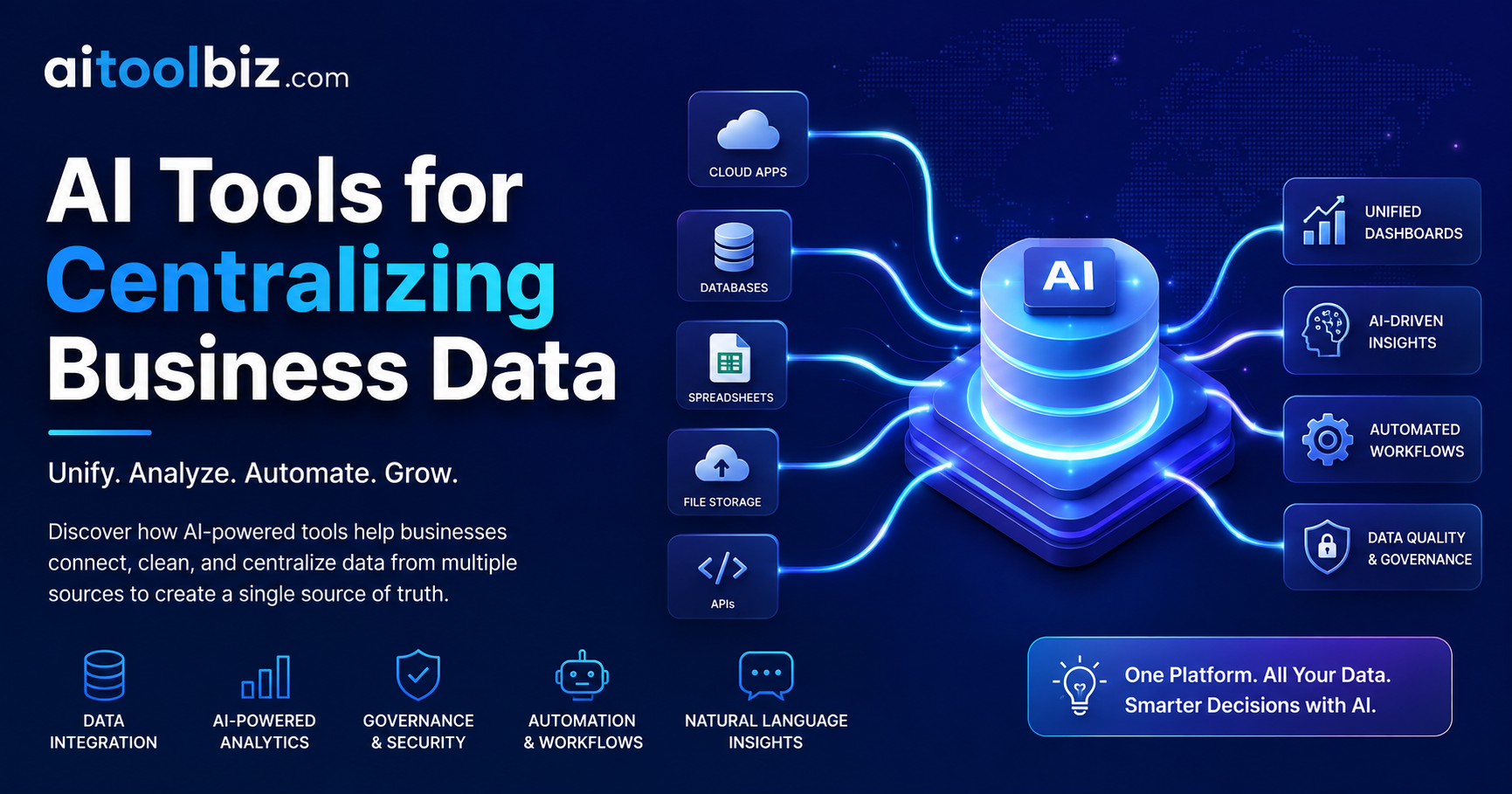
Tools that help to integrate and analyze data in businesses are rising, offering to solve these problems by linking data to business objects, building unified views, improving quality, and enabling natural language querying. Such tools aim to create a centralized repository of information that ordinary workers, analysts, executives, and artificial intelligence can use.
It does not necessarily mean that the data should be in one database or data warehouse. Instead, having a single source of truth that different applications, dashboards, and divisions can use is critical. In this guide, I will discuss the topic and share my knowledge about the tools and approaches to unify data in companies with artificial intelligence.
Table of Contents
What Does Centralizing Business Data Mean?
Business data centralization denotes the process of consolidating data from disparate sources in a unified repository for analysis, governance, and utilization in operations. For instance, an organization dealing in online trade may need to collate
- customer records from its CRM,
- website data,
- ecommerce sales,
- inventory data,
- accounting information,
- advertising platforms,
- customer-support data,
- email marketing,
- and product catalogues
- among other sources to form a complete dataset that supports informed business decision-making.
Typically, data integration tools employ such strategies as ETL, ELT, replication, and synchronization to integrate data from different sources.
However, artificial intelligence can enhance this process by facilitating such activities as identifying relationships between fields, resolving discrepancies, automating field reconciliation, and categorization to make data easy to comprehend and utilize. For instance, Salesforce explains that one can utilize AI to automate the data preparation process while detecting data-quality issues in the integration process.
Why Businesses Need to Centralize Their Data
The biggest problem with fragmented data is not just the fact that it is inconvenient. It influences decision-making.
Suppose a sales manager asks:
“Who were our most profitable customers in the past year, and do they have any unresolved support requests?”
To answer that question, you might need to consult both the CRM and billing database, as well as the customer-support one.
Without data integration, you would need to export some excel sheets, match customer IDs, count the amounts of money, remove duplicates, and so on.
With an integrated system, you might be able to perform a few clicks in a dashboard, use some analytical software, or even type a sql query or ask a chatbot.
There are numerous benefits to centralized data management.
1. A single source of truth
When departments work with different data sets, disagreements over basic metrics are common.
One team might use one definition of “active customer” and another department another. Finance and Sales may use different methods for calculating revenue.
A governed centralized data environment would govern data sets to make sure that there are common definitions that are available to all departments.
2. Faster decision-making
Employees waste less time searching for applications and reconciling spreadsheets.
Rather, they can access information from a central repository or business intelligence environment.
IBM points out that data integration can improve data access and provide a single view of the data that facilitates collaboration and decision-making.
3. Better AI performance
AI systems require trustworthy business context.
If an AI assistant is given outdated information about a customer or a contradicting definition of revenue, it’s going to provide wrong answers.
McKinsey’s 2026 research on the prerequisites for enterprise AI scale suggests that data readiness, specifically the harmonization of structured and unstructured information in a governed repository, is a key priority.
4. Less Manual Work
Automated pipelines can replace repetitive processes such as downloading reports, copying information between systems, and manually updating spreadsheets.
5. More effective analytics
Once data has been integrated, companies can investigate relationships between various departments that were previously unimportant.
For example, a company can examine the relationship between expenditure on advertising and sales, the amount of stock available and consumer satisfaction, or customer support problems and retention rates.
Types of AI Tools for Centralizing Business Data
There is no single category called an “AI data centralization tool.” Instead, businesses typically combine several technologies.
1. AI-Powered Data Integration Tools
Data integration platforms connect applications, databases, APIs, files, and more together.
Some examples are Fivetran, Airbyte, Boomi, Azure Data Factory, AWS Glue, Zapier, and many others — but they have varying degrees of capability and target audiences. A 2026 comparison from Zapier shows the ways in which they differ: custom connector management, open source extensibility, cloud-native features, and low-code automation, among others.
AI can be utilized to facilitate data integration by helping with
- field mapping,
- Data transformation,
- Schema discovery,
- Error detection,
- data classification,
- pipeline monitoring, and
- Anomaly detection
Essentially streamlining many of these processes and reducing the amount of human work involved.
2. AI Analytics Platforms
Now that we have the information in one place it is important for companies to have the tools to actually use it.
AIs around the world have started to offer ways for people to ask questions in natural language.
This eliminates the need for a person to be able to write a query in SQL, which is a programming language used strictly for querying databases.
An executive could ask,
“What were my five highest-selling products last quarter?”
This will bring up the relevant information in the database and could create a visualization based on that information. This is a critical tool in business intelligence, as it allows non-technical people to quickly see relevant information. As these programs grow, they are starting to break away from older dashboards, and are offering more natural language conversation. Tools like Tableau, ThoughtSpot, Power BI, Looker, Qlik, and many other AI powered data tools are leading this revolution.
3. Data Warehouses and Lakehouses
For many companies, the centralized data warehouse is a cloud data warehouse or lakehouse.
Such solutions allow collecting data from various systems into one place, which forms the basis for:
- business intelligence
- machine learning
- AI applications
- reporting
- data science
- operational analytics
AI tools and technologies can be superimposed on such a data warehouse or lakehouse and provide an even more convenient way to work with information.
However, it should be emphasized that AI does not replace the need for a correct data architecture.
On the contrary, AI makes such an architecture even more relevant, increasing its value and opening up new opportunities for use.
4. Data Catalog and Governance Tools
The issue with centralization without governance is that it can lead to nobody really knowing what the data means.
A data catalog can help organizations document:
- The source of a piece of data
- The ownerThe meaning of individual fields
- What data sets are trusted
- Who has access to the information
- How data should be used
This is especially important for AI.
Google Cloud’s current system, Knowledge Catalog, is aimed at combining data discovery, governance, and metadata, with an AI-focused business context that helps AI systems find more reliable enterprise information.
5. AI Automation Platforms
Automation platforms connect business applications and trigger actions based on data.
For example:
New customer → CRM → AI classification → customer segment → marketing platform → personalized campaign
Or:
New support ticket → support platform → AI categorization → priority assessment → notification to appropriate team
These workflows do not necessarily require a traditional centralized warehouse. Instead, AI automation can synchronize information and move it between operational systems.
This makes automation platforms particularly useful for smaller organizations that want to connect business applications without building a large data engineering infrastructure.
8 Best AI Tools and Platforms to Consider
The right platform depends on the organization’s size, technical capabilities, existing infrastructure, and use case.
Fivetran
Fivetran is primarily known for managed data movement and connectors. It can be a strong option for businesses that want to move data from SaaS applications and databases into analytical destinations without maintaining every pipeline manually.
Airbyte
Airbyte is particularly attractive for organizations that value flexibility and open-source extensibility. Its ecosystem supports a broad range of data connectors.
Zapier
Zapier is useful when the goal is connecting business applications and automating workflows with relatively little technical work. Its current platform combines application connectivity with automation and AI capabilities.
Microsoft Azure Data Factory
Organizations heavily invested in Microsoft’s cloud ecosystem may consider Azure Data Factory for data integration and pipeline management. It is particularly suited to organizations with more technical data engineering requirements.
AWS Glue
AWS Glue is designed for data integration and preparation within the AWS ecosystem. It can be useful for organizations already operating significant workloads on AWS.
Tableau
Tableau is primarily an analytics and visualization platform, but its AI capabilities make it relevant when the objective is turning centralized business data into accessible insights.
ThoughtSpot
ThoughtSpot focuses heavily on search-driven and natural-language analytics. It can be useful for organizations that want business users to interact with centralized data through questions rather than relying exclusively on traditional dashboards.
Boomi
Boomi provides integration and automation capabilities and can be appropriate for businesses that need to connect numerous applications and operational systems.
These platforms should not be viewed as interchangeable. Some are designed primarily to move data, others to analyze it, and others to automate actions across applications.
How AI Improves Data Centralization
Traditional data integration generally follows a predictable process:
Extract → Transform → Load → Analyze
AI can make several parts of this workflow more intelligent.
Automated data mapping
Suppose one system calls a field customer_id, another calls it client_number, and a third calls it account_reference.
AI can help identify that these fields may represent the same business concept.
Data Cleansing
AI can identify suspicious duplicates, inconsistent formats, missing information, and unusual records.
For example:
- “United States”
- “USA”
- “U.S.”
- “US”
Could potentially be standardized into a common representation.
Natural-language access
Business users can ask questions without necessarily understanding the underlying database structure.
Intelligent monitoring
AI can help identify unusual changes in data pipelines.
If a normally stable data source suddenly sends dramatically fewer records, an intelligent monitoring system can flag the anomaly.
Automated documentation
AI can assist with generating descriptions of datasets, columns, transformations, and business terminology.
This becomes increasingly valuable as organizations accumulate hundreds or thousands of datasets.
Centralizing Structured and Unstructured Data
One of the biggest changes in modern business data management is the growing importance of unstructured information.
Businesses do not only have rows and columns.
They also have:
- PDFs
- Contracts
- Emails
- Customer conversations
- Meeting transcripts
- Product documentation
- Images
- Presentations
- Internal policies
A modern AI data strategy needs to connect structured information with these sources.
For example, a sales analysis might combine CRM revenue data with customer meeting transcripts and contract information.
This can give decision-makers a much broader understanding of a customer than a CRM record alone.
Google Cloud describes this approach as combining structured and unstructured enterprise information to provide richer context for AI systems.
How to Choose an AI Data Centralization Tool
Before purchasing a platform, evaluate the following areas.
Data Sources
Determine whether the platform connects to the systems you already use.
Check support for:
- CRM platforms
- ERP systems
- Databases
- Spreadsheets
- Cloud storage
- APIs
- Marketing tools
- Financial applications
- Support systems
Data freshness
Ask how quickly information needs to be updated.
Some businesses only need daily reporting. Others need near-real-time information.
A financial dashboard might tolerate periodic updates, while fraud detection or inventory management may require much faster synchronization.
Scalability
A solution that works for 50,000 records may not be appropriate when the organization reaches billions of records.
Consider both current and projected data volume.
Security and governance
Look for appropriate:
- Access controls
- Encryption
- Audit logs
- Data lineage
- Role-based permissions
- Compliance capabilities
- Data retention controls
AI Accuracy
Natural-language interfaces are useful, but the system should be able to explain where its answers come from.
A trustworthy AI data platform should provide appropriate grounding, definitions, permissions, and governance rather than simply generating plausible-sounding answers.
The Future of Centralized Business Data
The emerging wave of next-generation business data platforms is centered around unifying data integration, analytics, governance, automation, and AI agents.
Beyond standard business intelligence dashboarding, AI can help analyze business information, uncover insights, answer queries, generate reports, suggest courses of action, and even execute pre-approved processes.
Consequently, the quality of data underpinning these analytics is paramount.
Enterprise research today is focused on how to scale AI, which means constructing standardized, governed, and reusable data assets that enhance the value of analytics as opposed to relying on disparate silos of information where AI is grafted on.
The future of enterprise therefore lies in unified, contextualized and trusted data analytics.
Also Read:
- 6 best research tools for AI Consulting for Small Businesses
- Benefits of AI-Powered RFP Tools for Small Business Proposal Writing
- 10 best AI Tools for Sales Teams in 2026
Frequently Asked Questions
What are AI tools for centralizing business data?
AI data-centralization tools help organizations connect information from multiple applications, databases, files, and other sources. They can assist with data integration, transformation, cleansing, governance, analytics, and natural-language access.
What is the best AI tool for centralizing business data?
There is no universally best tool. Fivetran and Airbyte can be strong choices for data movement, Zapier for application automation, cloud-native services for organizations already invested in AWS or Microsoft, and AI analytics platforms such as Tableau or ThoughtSpot for business intelligence.
Can AI combine data from multiple business applications?
Yes. AI-enabled data integration platforms can help connect information from CRMs, ERP systems, databases, spreadsheets, APIs, and other applications. AI can assist with tasks such as field mapping, cleansing, classification, and transformation.
Does centralizing business data mean using one database?
Not necessarily. Centralization can mean creating a unified data architecture where information from multiple systems is accessible through a governed layer. The underlying data may remain distributed across different technologies.
What is the difference between data integration and data centralization?
Data integration is the process of connecting, moving, transforming, and synchronizing data between systems. Data centralization is the broader objective of making information available through a unified and governed environment.


1 Comment