
Expert Comparison of AI Avatar Tools for Explainer Videos
AI avatar technology has moved far beyond novelty. In 2026, businesses can turn a written script into a polished explainer video without hiring an actor, booking a studio, recording voice-over, or spending hours in a traditional editing suite.
But that convenience has created a new problem: which AI avatar platform should you actually use?
The answer is not as simple as choosing the tool with the most avatars or the lowest monthly price. Explainer videos have different requirements from social-media clips, corporate training, product demonstrations, or sales outreach. A platform that produces impressive talking-head videos for marketing may not be the best choice for an enterprise training department. Likewise, a platform with excellent LMS functionality may be unnecessary for a startup that simply needs a convincing 60-second product explainer.
Our comparison focuses on the factors that matter most when creating professional explainer videos: avatar realism, lip-sync quality, voice performance, language support, script-to-video workflow, editing flexibility, localization, templates, collaboration, integrations, scalability, and overall value.
Current 2026 comparisons consistently place HeyGen, Synthesia, and Colossyan among the leading dedicated AI-avatar platforms, while D-ID and several newer tools target more specialized use cases.
Table of Contents
Quick Verdict
If you want the short answer:
- Best overall for most explainer-video creators: HeyGen
- Best for enterprise and corporate explainers: Synthesia
- Best for training and interactive explainers: Colossyan
- Best for developer/API and real-time applications: D-ID
- Best for high-volume short-form or UGC-style content: specialist tools such as Argil and Captions may be more appropriate than traditional enterprise avatar platforms.
However, there is no universal winner. Recent independent comparisons have found HeyGen particularly strong in avatar realism and multilingual marketing content, Synthesia strong in enterprise workflows and compliance-oriented use cases, and Colossyan particularly strong in learning and development.
What Makes an AI Avatar Tool Good for Explainer Videos?
Determining what constitutes a successful explainer-video generator is crucial before evaluating different services.
An explainer video must effectively convey a concept. The procedure involves more than just the avatar.
Ideally, a solid platform should enable you to:
- Start from a script.
- Select an appropriate presenter.
- Generate natural speech.
- Match lip movements accurately to the voice.
- Add text, graphics, screenshots, images, or B-roll.
- Control scenes and pacing.
- Produce consistent branding.
- Translate the video into other languages.
- Revise the script without rebuilding the entire video.
- Export a professional-quality final video.
The best platform is therefore the one that minimizes friction throughout this workflow.
Avatar realism matters, but workflow efficiency matters almost as much. A slightly more realistic avatar is not necessarily the better business choice if the platform makes localization, revisions, collaboration, or publishing difficult.
1. HeyGen: Best Overall for Modern Explainer Videos
For marketers, artists, sales teams, and companies looking for extremely lifelike AI presenters, HeyGen has emerged as one of the best options.
The quality of its presentation is its greatest benefit. HeyGen’s most recent avatar technology consistently ranks among the most convincing in the industry, especially when it comes to facial expressions, gestures, and natural-looking delivery, according to recent comparisons.
Why HeyGen Stand out:
When an explainer video needs to feel like it was delivered by a real person, the platform works very well.
Consider the creation of a 90-second video by a SaaS provider that explains its new analytics dashboard. The business can utilize an AI presenter to introduce the product, switch between sceneries, and outline the key advantages in place of a static screen recording with a robotic voice.
This format is particularly useful for:
- SaaS product explainers
- Sales videos
- Website videos
- Product launches
- Marketing campaigns
- Multilingual content
- Founder-style videos
- Customer education
- Social-media explainers
Multilingual content is one of HeyGen’s other key advantages. According to recent comparisons, depending on the functionality and plan, more than 175 languages or linguistic variants are supported.
Because of this, businesses who produce a single master explanation and then require localized copies for several regions find it very appealing.
Where HeyGen Wins
- Avatar realism: Excellent
- Voice and delivery: Excellent
- Localization: Excellent
- Marketing workflow: Excellent
- Ease of use: Excellent
- Developer/API potential: Strong
Where HeyGen may fall short
HeyGen is not necessarily the best choice for every corporate learning environment.
If your primary requirement is SCORM-based training, sophisticated learning management integration, or structured instructional design, another platform may be better suited.
Some independent comparisons also point out that enterprise collaboration and LMS functionality are areas where traditional corporate-focused platforms can have an advantage.
Expert verdict
If you want your explainer films to look contemporary, organic, captivating, and customer-facing, go with HeyGen.
It is perhaps the best all-around place to start for the majority of marketers and content teams.
Also Read: 10 top ai avatar tools for nonprofit fundraising videos
2. Synthesia: Best for Enterprise Explainer Videos
One of the most well-known AI avatar video systems, Synthesia has traditionally placed a strong emphasis on enterprise content, business, training, and internal communications.
Avatar generation is not its only strength. It is the larger ecology of business video production.
Synthesia’s enterprise capabilities, extensive avatar library, language compatibility, collaborative features, and connectors are highlighted as key advantages in recent comparisons.
Why Synthesia is different
Consider a large organization that needs to create:
- Employee onboarding videos
- Product training
- Compliance explainers
- HR announcements
- Software tutorials
- Internal communications
- Customer education
- Multilingual corporate content
The company may need dozens or hundreds of videos rather than one marketing clip.
In that environment, consistency becomes critical.
The same brand colors, presentation style, voice standards, avatars, templates, and review processes need to be maintained across a large library of content.
This is where Synthesia becomes particularly compelling.
Avatar and language capabilities
Synthesia offers a large selection of stock avatars and supports a broad range of languages. Current 2026 comparisons put its language coverage at 140+ languages, although exact capabilities vary by feature and plan.
For organizations with global teams, this can significantly reduce localization costs.
Instead of recording an English video and then hiring multiple voice actors and editors for Spanish, German, French, Japanese, or other versions, a team can use AI localization to create multiple versions from the same core content.
Where Synthesia wins
- Enterprise workflows: Excellent
- Training content: Excellent
- Avatar library: Excellent
- Brand consistency: Excellent
- Corporate communications: Excellent
- Localization: Excellent
- Compliance and enterprise controls: Strong
Where Synthesia may fall short
HeyGen might have an advantage if your main goal is to create the most realistic or emotive avatar for a marketing video.
HeyGen is superior to Synthesia in terms of avatar naturalness and emotive delivery, according to recent head-to-head testing, although Synthesia is still especially excellent for enterprise use cases.
Because AI video platforms utilize different billing structures, credit systems, annual commitments, and minute restrictions, it might be challenging to compare prices directly. A low headline price may not always translate into a cheaper cost of production.
Expert verdict
When the explainer film is a component of a wider corporate content or training initiative, select Synthesia.
Businesses that prioritize governance, consistency, integrations, and scalable content creation over merely having the most lifelike avatar may find it particularly appealing.
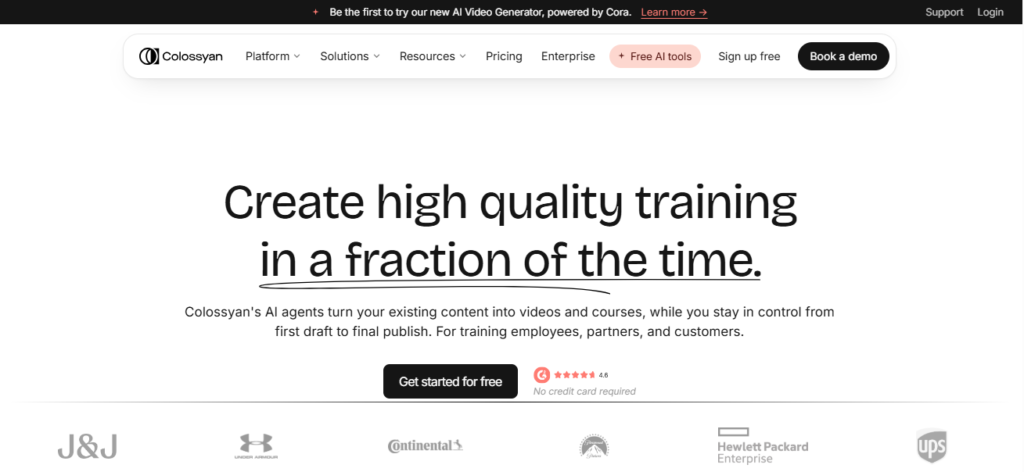
3. Colossyan: Best for Training and Interactive Explainers
Colossyan occupies an interesting position in the AI avatar market.
Rather than competing purely on avatar realism, it emphasizes learning, training, and interactive video.
That distinction is important.
A marketing explainer typically asks:
“How can we explain our product in an engaging way?”
A training explainer asks:
“How can we teach this concept and verify that the learner understood it?”
Those are different problems.
Colossyan is designed around the second one.
What makes Colossyan different?
Current comparisons highlight features such as quizzes, branching scenarios, interactive learning, and LMS-oriented workflows.
For example, imagine a company creating a cybersecurity awareness course.
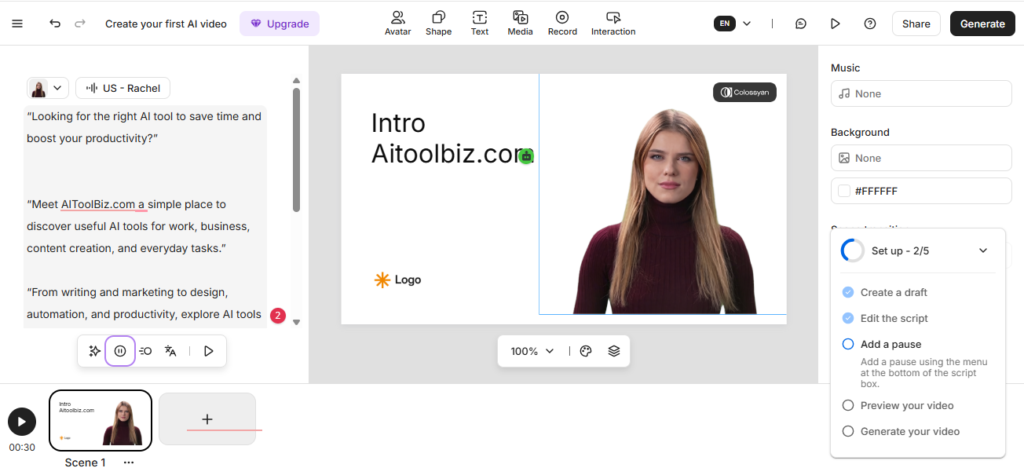
Instead of simply producing:
“Never click suspicious links.”
The video could explain the concept and then present an interactive scenario:
“You receive this email. What would you do?”
The learner chooses an answer, and the experience can branch accordingly.
That turns the AI avatar from a simple presenter into part of a learning experience.
Where Colossyan wins
- Training: Excellent
- Interactive learning: Excellent
- Quizzes: Excellent
- Scenario-based learning: Excellent
- L&D workflows: Excellent
- Corporate education: Strong
Where Colossyan may fall short
Interactive training functionality may not be as important for highly polished customer-facing marketing movies as avatar realism and visual sophistication.
According to recent comparisons, HeyGen and Synthesia perform better when presenter realism is the main requirement, whereas Colossyan performs best when instructional design is the top priority.
Expert Verdict
If your “explainer video” is truly educational, go with Colossyan.
It may be more appropriate than a general-purpose avatar platform for corporate training departments, educational teams, onboarding programs, and interactive instructional content.
4. D-ID: Best for Developer-Oriented and Real-Time Applications
Another important brand in AI avatar technology is D-ID.
D-ID has positioned itself on developer use cases, APIs, digital humans, and interactive applications, whereas systems like Synthesia and HeyGen have a strong emphasis on producing sophisticated commercial videos.
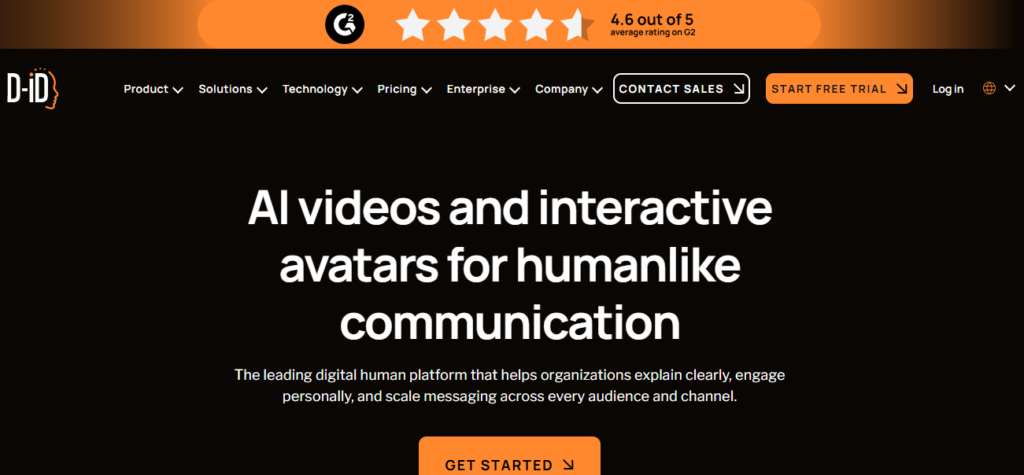
Because of this, businesses who wish to incorporate AI-generated presenters into their own software instead of just creating stand-alone videos find it appealing.
Potential use cases
D-ID can be relevant for:
- Interactive digital assistants
- AI-powered presenters
- Educational applications
- Customer-facing digital humans
- Developer projects
- Real-time avatar experiences
- Personalized communication
Current comparisons describe D-ID as particularly relevant for developer and real-time applications.
The trade-off
If your goal is simply:
“I have a script. Give me a beautiful 90-second explainer.”
then a platform such as HeyGen or Synthesia may provide a more straightforward workflow.
D-ID becomes more interesting when the avatar itself is part of a larger application.
Expert Verdict
Choose D-ID when your project involves APIs, interactive experiences, or digital humans rather than conventional marketing explainers alone.
AI Avatar Tools Comparison Table
| Criteria | HeyGen | Synthesia | Colossyan | D-ID |
|---|
| Avatar realism | Excellent | Very strong | Strong | Strong |
| Explainer videos | Excellent | Excellent | Very strong | Strong |
| Marketing | Excellent | Excellent | Good | Good |
| Corporate training | Strong | Excellent | Excellent | Good |
| Interactive learning | Limited | Stronger | Excellent | Limited |
| Language support | Excellent | Excellent | Strong | Good |
| Voice cloning | Strong | Strong | Strong | Strong |
| Custom avatars | Yes | Yes | Yes | Yes |
| API/developer use | Strong | Strong | More limited | Excellent |
| Enterprise workflows | Strong | Excellent | Strong | Good |
| Best audience | Marketers & creators | Enterprises | L&D teams | Developers |
Exact features, language counts, credits, video limits, and pricing can change by plan, so buyers should verify the current vendor plan before making a purchasing decision. Recent 2026 pricing comparisons show substantial differences in how these platforms charge for minutes, credits, seats, and premium generation models.
Avatar Realism: Which Tool Looks Most Human?
Avatar realism is one of the most visible differences between platforms.
Older AI avatars often had obvious problems:
- Frozen facial expressions
- Robotic eye movement
- Poor lip-sync
- Repetitive gestures
- Strange hand movements
- Artificial voice delivery
The technology has improved considerably.
Recent independent testing has repeatedly highlighted HeyGen’s latest avatar technology for particularly natural facial movement and expressive delivery.
Synthesia has also improved significantly, with newer avatar models designed to provide more natural expressions and movement.
The important point is that realism should be judged in context.
A 20-second promotional clip may require highly expressive movement.
A three-minute compliance training video may benefit more from consistent eye contact, clear pronunciation, and restrained gestures.
In other words, the “most realistic” avatar is not always the most effective avatar.
Voice Quality Can Matter More Than the Avatar
A common mistake is focusing almost entirely on the visual presenter.
For explainer videos, voice quality is arguably just as important.
A perfect-looking avatar with a monotonous voice can make an explanation feel artificial.
Look for:
- Natural pauses
- Appropriate emphasis
- Pronunciation accuracy
- Emotional range
- Consistent volume
- Natural pacing
- Language-specific pronunciation
Voice cloning is another important consideration.
If a founder, instructor, or sales representative wants to create many videos without recording every script manually, voice cloning can dramatically reduce production time.
However, organizations should establish clear consent and governance procedures before cloning someone’s voice or likeness.
Multilingual Explainer Videos
One of the biggest advantages of AI avatars is localization.
Traditionally, producing an explainer in five languages might require:
- Script translation
- Voice actors
- Recording sessions
- Video editing
- Lip-sync adjustments
- Quality assurance
- Multiple exports
AI can compress much of that process.
HeyGen, Synthesia, and Colossyan all offer multilingual workflows, although the number of supported languages and exact translation capabilities differ. Current comparisons place HeyGen at 175+ languages, Synthesia at 140+ and Colossyan at 70+ core languages, with some translation workflows extending further.
For global companies, this can be one of the strongest arguments for adopting an AI avatar platform.
Pricing: Don’t Compare Monthly Prices Alone
AI video pricing is unusually difficult to compare.
One platform may charge per minute.
Another may use credits.
Another may offer a number of videos.
Another may advertise an annual price while displaying a different monthly price.
This makes simple comparisons misleading.
For example, current 2026 pricing research shows that HeyGen, Synthesia, and Colossyan use different pricing structures and allowances.
Instead of asking:
“Which platform is cheapest?”
ask:
“What will it cost me to produce the amount and type of video content I actually need?”
Calculate:
Total annual cost ÷ usable finished video minutes
Then consider:
- Number of users
- Rendering limits
- Premium avatar credits
- Translation costs
- Voice cloning
- Export quality
- Watermarks
- Collaboration
- API access
- Enterprise requirements
A $20/month plan can become expensive if your team constantly exceeds its included credits.
How to Choose the Right AI Avatar Tool
| AI Avatar Tool | Best For | Choose This Tool If… | Key Strengths | Ideal Users / Use Cases |
|---|---|---|---|---|
| HeyGen | Marketing & customer-facing explainer videos | You prioritize realistic avatars, need multilingual content, and want to create videos quickly. | High avatar realism, natural presentation, multilingual content, fast production, easy workflow | Creators, marketers, agencies, startups, SaaS companies, sales teams |
| Synthesia | Enterprise & corporate training | You are an enterprise, produce large amounts of internal content, or require structured workflows and strong enterprise controls. | Enterprise features, professional avatars, brand consistency, structured video production, multilingual support | Large businesses, HR teams, corporate training departments, internal communications teams |
| Colossyan | Training & instructional content | Your audience is primarily employees or learners and you need quizzes, branching scenarios, or LMS integration. | Interactive learning, quizzes, branching scenarios, training-focused workflows, instructional content | L&D teams, educators, HR departments, trainers, corporate learning teams |
| D-ID | Interactive & developer-focused applications | You are a developer, need an API, or want to integrate an AI avatar into an application or interactive experience. | API capabilities, digital humans, interactive experiences, application integration | Developers, software companies, AI product teams, interactive application creators |
What Should You Use for a SaaS Product Explainer?
For a typical SaaS company, HeyGen is one of the strongest choices for creating a professional product explainer video. It is particularly useful when the goal is to present a software product in a clear, engaging, and visually appealing way. Its realistic AI avatars can introduce the product, explain key features, and guide viewers through the main benefits without requiring a professional presenter or traditional video-production setup.
A SaaS explainer video can be structured around the customer’s problem, followed by the introduction of the software solution. The AI avatar can explain the problem and introduce the product, while screen recordings, product screenshots, animations, and interface demonstrations show how the software actually works. This combination is generally more effective than keeping the avatar on screen for the entire video because viewers can see the product while they are hearing about it.
For example, a SaaS company could create a 60- to 120-second explainer that begins by identifying a common customer problem, introduces the software as the solution, demonstrates two or three important features, highlights the main benefits, and finishes with a clear call to action such as “Start your free trial” or “Book a demo.” An AI avatar can provide the narration and human-like presentation while the visuals demonstrate the actual product.
Synthesia is another strong option for SaaS companies, particularly larger businesses that need consistent branding, multilingual versions, employee or customer training, and a structured video-production workflow. It can be a good choice when the product explainer is part of a larger library of corporate or educational content.
Ultimately, the best AI avatar tool for a SaaS explainer depends on the company’s objectives. HeyGen is particularly suitable for modern, customer-facing product explainers, while Synthesia may be preferable for enterprise SaaS companies that need scalable and structured video production. Regardless of the platform, combining the AI presenter with product demonstrations, graphics, captions, and a strong script will usually produce a more effective SaaS explainer than relying on an avatar alone.
What Should You Use for Corporate Training?
For corporate training, Synthesia and Colossyan deserve particular attention.
Synthesia is attractive when the organization prioritizes enterprise-scale video production, localization, and governance.
Colossyan becomes particularly compelling when the course needs interactive scenarios, quizzes, and branching.
The best option therefore depends on whether the primary goal is content production or instructional interaction.
What Should You Use for Multilingual Explainers?
HeyGen’s extensive language and translation capabilities make it a particularly good option for multilingual marketing explainers.
For businesses that require extensive localization at an enterprise level, Synthesia is also a good choice.
The capacity to efficiently create localized versions of a single master film can have a greater financial impact than minor variations in avatar quality for businesses who produce the same product explanation in ten or twenty markets.
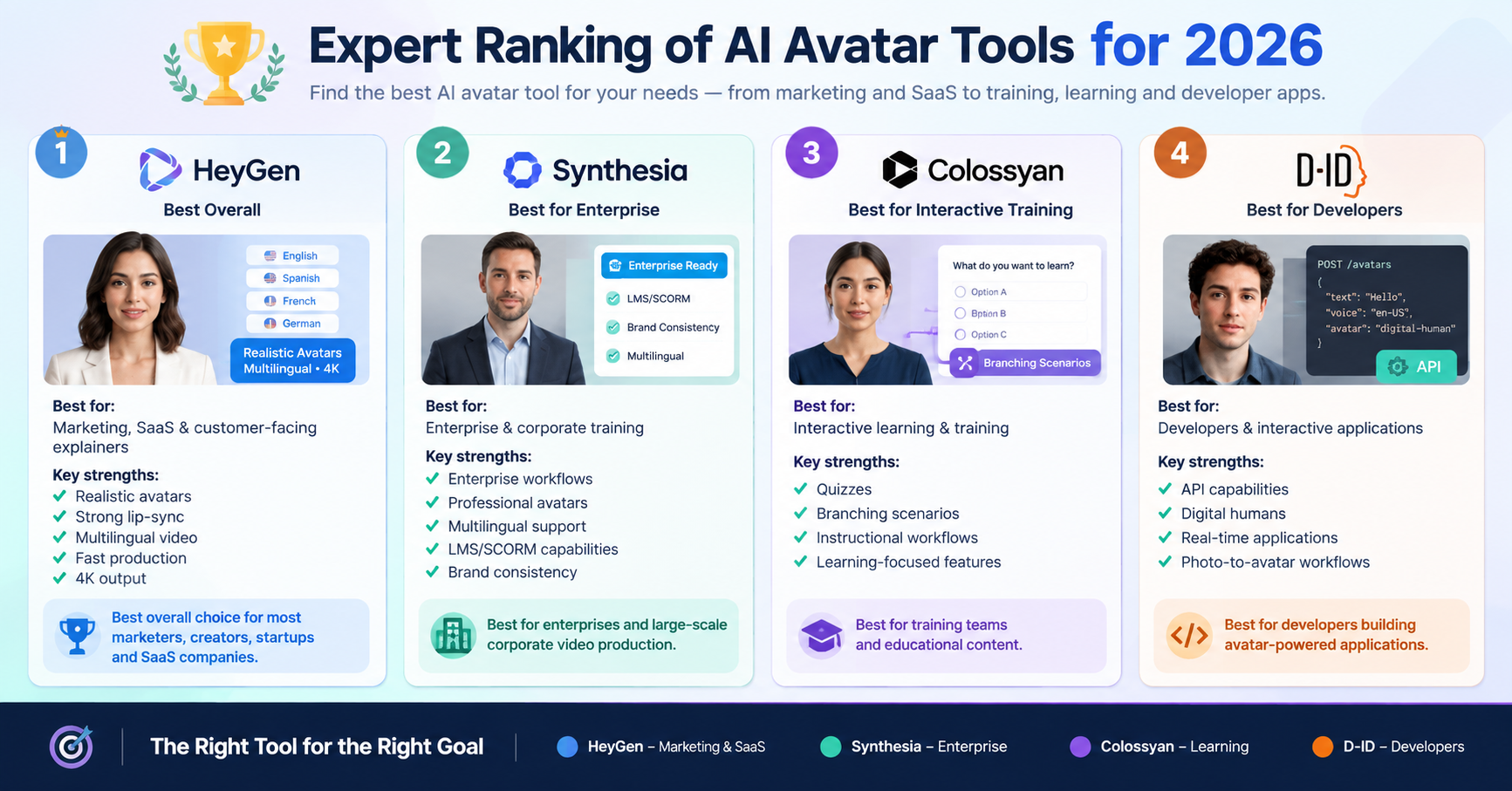
Expert Ranking for 2026
| Rank | AI Avatar Tool | Best For | Key Strengths | Expert Verdict |
|---|---|---|---|---|
| 1 | HeyGen | Marketing, SaaS & customer-facing explainers | Realistic avatars, strong lip-sync, multilingual video, fast production, 4K output | Best overall choice for most marketers, creators, startups, and SaaS companies |
| 2 | Synthesia | Enterprise & corporate training | Enterprise workflows, professional avatars, multilingual support, LMS/SCORM capabilities, brand consistency | Best for enterprises and large-scale corporate video production |
| 3 | Colossyan | Interactive learning & training | Quizzes, branching scenarios, instructional workflows, learning-focused features | Best for training teams and educational content |
| 4 | D-ID | Developers & interactive applications | API capabilities, digital humans, real-time applications, photo-to-avatar workflows | Best for developers building avatar-powered applications |
Conclusion
AI avatar tools have matured enough to become practical production systems for explainer videos.
HeyGen is our strongest all-round recommendation for marketers, creators, SaaS companies, and teams that prioritize realistic presenters and multilingual content.
Synthesia is the better strategic choice for many enterprises, particularly those producing corporate training, internal communications, and large volumes of structured content.
Colossyan is the specialist choice for learning and development, especially when interactive training features matter.
D-ID is worth considering for developers and interactive applications where the avatar needs to become part of a larger digital experience.
Ultimately, the right platform depends on the type of explainer video you are producing.
If the goal is a persuasive customer-facing product video, prioritize realism, voice quality, editing, and localization.
If the goal is employee education, prioritize instructional design, collaboration, LMS functionality, and consistency.
If the goal is an interactive AI experience, prioritize APIs, real-time capabilities, and integration flexibility.
The biggest mistake is choosing an AI avatar tool because its demo looks impressive.
The better approach is to create the same 60–90 second test script on two or three platforms, using similar avatars and voices, and compare the actual outputs. Evaluate lip-sync, pronunciation, gestures, editing time, rendering speed, localization, and total cost.
That practical test will tell you far more than a feature checklist.
Frequently Asked Questions
What is the best AI avatar tool for explainer videos?
For most customer-facing explainer videos, HeyGen is one of the strongest choices because of its combination of avatar realism, voice capabilities, multilingual support, and relatively streamlined production workflow. Synthesia is another excellent option, particularly for enterprise content.
Is HeyGen better than Synthesia for explainer videos?
It depends on the type of explainer. HeyGen generally has an advantage for highly realistic, expressive marketing and customer-facing videos, while Synthesia has strong advantages for enterprise training, corporate communications, and structured business workflows. Recent head-to-head testing has similarly found HeyGen ahead on avatar realism while Synthesia remains strong in enterprise functionality.
Is Synthesia good for product explainer videos?
Yes. Synthesia can create professional product explainers using AI presenters, scenes, scripts, graphics, and multilingual capabilities. It is particularly attractive when product videos are part of a larger corporate content strategy.
Is Colossyan good for explainer videos?
Yes, particularly for educational and training explainers. Its interactive features, quizzes, and branching scenarios make it especially useful when the viewer needs to learn and respond rather than simply watch.
Which AI avatar tool has the most realistic avatars?
There is no permanent winner because avatar models are updated frequently. However, 2026 comparisons frequently identify HeyGen’s latest avatar technology among the most realistic available, particularly for expressive facial movement and natural delivery.
Can AI avatar tools create multilingual explainer videos?
Yes. Leading platforms such as HeyGen, Synthesia, and Colossyan support multilingual video workflows. Language counts and translation features differ by platform and subscription level, so buyers should verify the current plan before purchasing.