
Benefits of AI-Powered RFP Tools for Small Business Proposal Writing
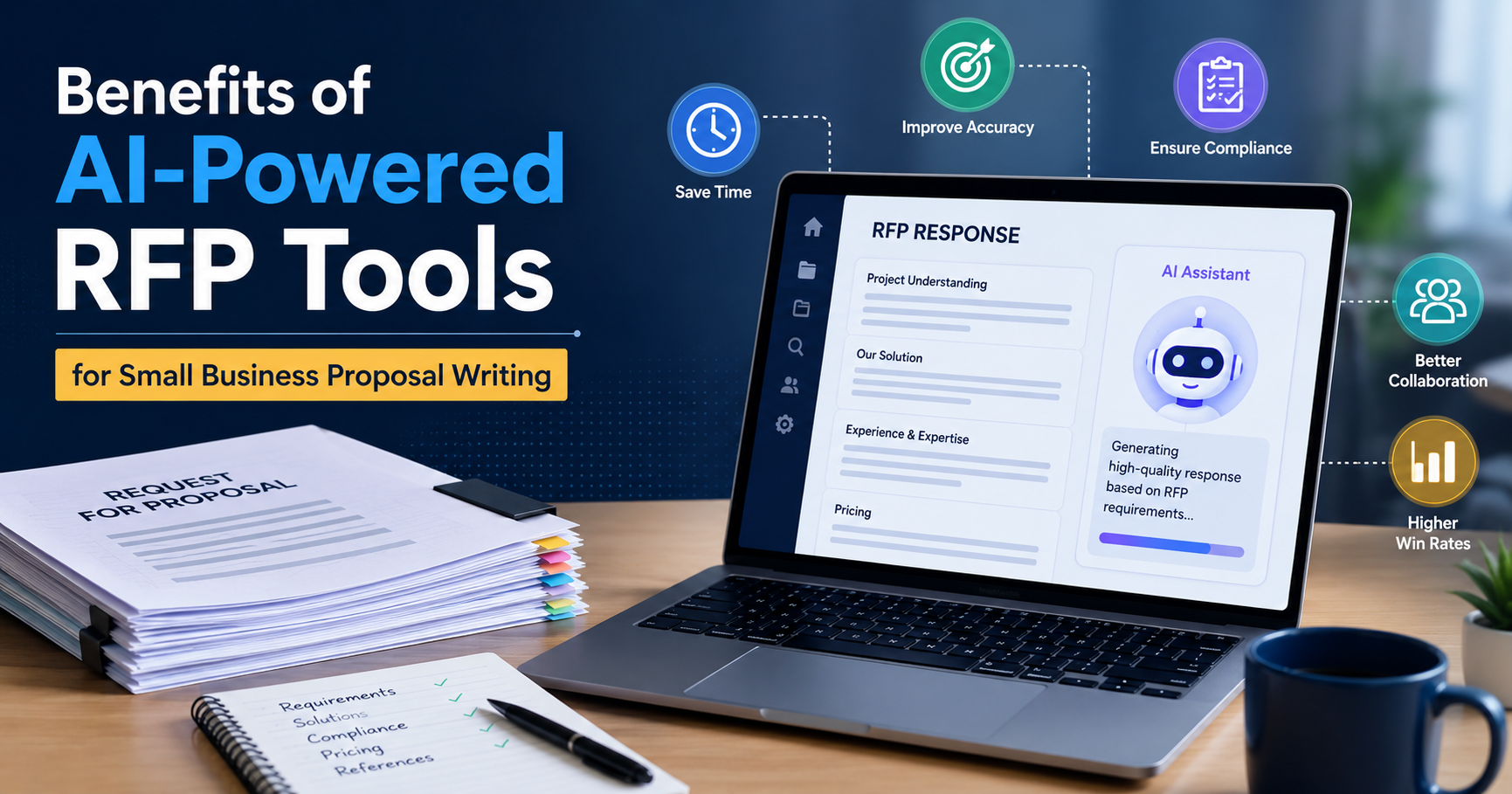
Contracts for small firms are frequently awarded based on the calibre of their proposals. Businesses must provide compelling, precise, and compliant proposals under strict timeframes, whether they are responding to corporate procurement requests, government tenders, or private-sector possibilities. Unfortunately, for small teams with few employees, creating proposals may be challenging, time-consuming, and resource-intensive.
Here, AI-driven RFP (Request for Proposal) technologies are revolutionising the field.
The way organisations develop, manage, and present proposals is being revolutionised by artificial intelligence. Small firms may now use AI to automate a large portion of the proposal-writing process rather than spending endless hours looking for information, creating repeated material, and verifying compliance by hand.
Organisations can produce better bids more quickly, enhance win rates, maintain consistency, and improve response accuracy using AI-powered RFP software. Startups and small businesses may now benefit from what was previously exclusive to giant corporations with specialised proposal teams.
The main advantages of AI-powered RFP tools for creating small company proposals will be discussed in this article, along with the reasons that implementing these technologies may provide you a big competitive edge.
Table of Contents
Understanding AI-Powered RFP Tools
It’s crucial to comprehend the true functions of AI-powered RFP tools before delving into the advantages.
Software that employs artificial intelligence, machine learning, natural language processing (NLP), and automation to support companies throughout the proposal generation process is known as an AI-powered RFP tool.
These tool can:
- Analyze RFP documents
- Extract requirements automatically
- Generate draft responses
- Suggest relevant content
- Reuse approved answers from previous proposals
- Check compliance requirements
- Improve writing quality
- Collaborate across teams
- Track proposal progress
Rather than replacing proposal writers, AI acts as an intelligent assistant that handles repetitive and administrative tasks, allowing teams to focus on strategy, customization, and client relationships.
1. Dramatically Reduces Proposal Writing Time
Time constraints are one of the main issues small businesses deal with.
Composing a thorough proposal frequently calls for:
- Reviewing lengthy RFP documents
- Identifying requirements
- Gathering information from multiple departments
- Writing responses
- Editing and proofreading
- Ensuring compliance
Dozens or even hundreds of hours may be needed for this procedure.
By automating several activities, AI-powered RFP solutions drastically lessen this effort.
AI, for instance, can:
- Scan and summarize RFP documents
- Identify mandatory requirements
- Recommend relevant responses
- Generate initial drafts
- Auto-fill repetitive sections
Proposal teams may start with a strong draft created in a matter of minutes rather than beginning from scratch.
Small firms may respond to more possibilities thanks to this acceleration without hiring more staff.
Key Benefit:
Businesses may chase more contracts and boost income potential by creating proposals more quickly.
2. Improves Proposal Quality and Consistency
Win rates are directly impacted by the quality of proposals.
Because numerous individuals contribute material, frequently using various writing styles and formats, many small firms suffer with inconsistent message.
AI-driven technologies support consistency by:
- Using approved response libraries
- Applying standardized language
- Following brand guidelines
- Recommending best-performing content
- Maintaining formatting standards
Maintaining consistency enhances brand trust and gives the look of professionalism.
AI may also evaluate proposals that have been successful and recommend content patterns that have worked effectively in the past.
Key Benefit:
Proposals that are professional and consistent provide a better first impression and boost buyer confidence.
Also Read:
- Zanus AI Automation Review 2026: Features, Pricing, Benefits & Alternatives
- Grammarly for Windows Download 2026: How to Install Grammarly on PC for Free
- 8 Best Free Grammarly Alternatives in 2026
- Grammarly Review 2026: Features, Pricing, Pros, Cons & Alternatives
- 6 Best Claude Alternatives in 2026 (Free & Paid AI Tools)
3. Enables Small Teams to Compete with Larger Organizations
Subject matter experts, bid teams, proposal managers, and compliance professionals are frequently found in large organisations.
Such resources are scarce for small enterprises.
AI contributes to fairness.
A small team may generate proposals that are on par with those of much bigger rivals by automating repetitive proposal chores.
Features like:
- Automated response generation
- Smart content recommendations
- Centralized knowledge management
- Workflow automation
make it possible for small firms to run more effectively.
Organisations may use AI to boost efficiency rather than recruiting more proposal workers.
Key Benefit:
AI provides enterprise-level proposal capabilities without enterprise-level costs.
4. Increases Response Accuracy
Errors in proposals can be expensive.
Typical errors consist of:
- Missing requirements
- Incorrect data
- Outdated information
- Inconsistent answers
- Compliance gaps
Disqualification may result from even little errors.
RFP systems with AI capabilities reduce these risks by:
- Cross-checking information
- Validating content
- Flagging inconsistencies
- Identifying missing responses
- Suggesting corrections
Certain sophisticated methods ensure that the most recent information is utilised by continually learning from organisational knowledge bases.
Key Benefit:
Increased precision lowers risk and raises the possibility that the idea will be accepted.
5. Enhances Compliance Management
Strict compliance criteria are seen in many RFPs.
Rejection can happen right away if you don’t fulfil even one criteria.
It can be challenging to manually monitor compliance, particularly when answering long government or business RFPs.
Tools with AI capabilities can:
- Extract compliance requirements automatically
- Create compliance matrices
- Track mandatory responses
- Flag missing sections
- Monitor submission requirements
These features lessen the possibility of missing important instructions.
Key Benefit:
Businesses may prevent expensive errors and disqualifications by improving compliance.
6. Creates a Centralized Knowledge Repository
Finding information is one of the largest inefficiencies in proposal writing.
Teams frequently squander time trying to find:
- Previous proposal responses
- Company credentials
- Product descriptions
- Security documentation
- Case studies
Centralised knowledge libraries, which store and arrange authorised material, are a common feature of AI-powered RFP tools.
When necessary, AI can swiftly retrieve pertinent data.
Users may obtain precise answers instantaneously rather than having to question coworkers repeatedly or go through outdated files.
Key Benefit:
Efficiency is increased and institutional knowledge is preserved using a centralised information base.
7. Supports Better Collaboration
Many parties are involved in the preparation of proposals.
Contributors might be:
- Sales teams
- Product managers
- Engineers
- Executives
- Legal teams
- Marketing departments
It can be difficult to coordinate these contributors.
Proposal platforms driven by AI enhance teamwork by offering:
- Shared workspaces
- Real-time editing
- Task assignments
- Workflow tracking
- Automated notifications
There is less misunderstanding and redundancy when everyone operates from a single source of truth.
Key benefit:
Faster completion and fewer communication obstacles are the results of improved teamwork.
8. Reduces Operational Costs
It might be costly to hire proposal experts.
It might not be financially possible for small enterprises to have a specialised proposal department.
RFP tools driven by AI lower expenses by:
- Automating repetitive work
- Reducing administrative tasks
- Eliminating redundant efforts
- Improving productivity
- Minimizing outsourcing needs
Even though software requires an investment, many businesses see a profit thanks to improved productivity and more proposals.
Key Benefit:
Proposal operations may be scaled by businesses without appreciably raising labour expenses.
9. Improves Win Rates
Writing proposals is ultimately about getting business.
AI helps businesses achieve higher win rates by assisting them:
- Respond faster
- Deliver higher-quality proposals
- Maintain consistency
- Improve compliance
- Personalize responses
Some AI platforms even analyze historical proposal performance to identify winning patterns.
By leveraging data-driven insights, businesses can continuously refine their proposal strategies.
Key Benefit:
More contract awards and higher income are frequently the results of better bids.
10. Enables Proposal Personalization at Scale
Customers today demand tailored replies.
Proposals that are generic frequently don’t stand out.
Personalisation, though, requires time.
AI-powered solutions facilitate proposal customisation by:
- Analyzing customer requirements
- Recommending relevant content
- Customizing messaging
- Aligning responses with buyer priorities
Businesses may produce more persuasive offers without compromising efficiency because to this harmony between automation and personalisation.
Key Benefit:
Personalised proposals increase customer satisfaction and set companies apart from rivals.
11. Improves Content Reusability
Recurring information may be found in many proposal answers.
Examples consist of:
- Company background
- Product features
- Security practices
- Certifications
- Customer success stories
AI systems can recognise and repurpose authorised information instead of constantly rewriting certain portions.
This guarantees precision and consistency while also saving time.
Certain platforms use context and past usage to automatically suggest the optimal answer.
Key Benefit:
Reusing content minimises work while upholding quality requirements.
12. Provides Data-Driven Insights
These days, RFP tools with AI capabilities do more than just create material.
They also offer insights and analytics.
Companies are able to monitor:
- Proposal completion times
- Contributor performance
- Response effectiveness
- Win/loss outcomes
- Content usage trends
Over time, these insights assist organisations in streamlining their proposal procedures.
Teams can prioritise and improve specific proposal elements, for instance, if they frequently show up in successful bids.
Key Benefit:
Long-term proposal performance is enhanced by data-driven decision-making.
13. Supports Business Growth
Demands for proposals frequently rise as a business expands.
Small teams may become overwhelmed by the amount of proposals if suitable procedures are not in place.
Scalability is supported by AI-powered RFP systems, which allow companies to:
- Handle more opportunities
- Maintain quality standards
- Manage larger knowledge bases
- Coordinate larger teams
- Standardize workflows
Businesses looking to expand into new areas or take on bigger contracts would particularly benefit from this scalability.
Key Benefit:
Proposal operations may expand with the company thanks to AI.
Also Read: 5 best AI SEO Tools for Local Businesses Minnesota
14. Enhances Competitive Advantage
Two important competitive considerations are speed and quality.
Businesses that submit better bids more quickly often have an edge.
AI allows companies to:
- Respond quickly to opportunities
- Improve proposal quality
- Reduce administrative delays
- Focus on strategic differentiation
Teams may devote more time to creating strong value propositions and meeting customer demands by automating repetitive operations.
Key Benefit:
Market competitiveness is strengthened via a quicker and more intelligent proposal procedure.
15. Reduces Burnout Among Proposal Teams
Deadlines for proposals may be daunting.
Employee tiredness is frequently caused by handling paperwork, writing identical replies repeatedly, and keeping track of requirements.
By automating low-value jobs, AI lessens this strain.
Rather of dedicating hours on creating repetitious material, staff members might concentrate on:
- Strategy
- Relationship building
- Solution design
- Customer engagement
Deadlines for proposals may be daunting.
Key Benefit:
Teams are better able to sustain morale and performance when they have less work to do.
Choosing the Right AI-Powered RFP Tool
Not every AI proposal platform has the same features.
Small firms should take into account the following while assessing solutions:
Ease of use
Select software that easily interacts with current workflows and requires little training.
Knowledge Management Features
Seek out strong content repositories and sophisticated search features.
AI Writing Assistance
Analyse how well the tool creates and enhances proposal material.
Complaince Tracking
Make sure the platform is able to recognise and track the requirements for proposals.
Collabration Tools
Choose solutions that facilitate the creation of team-based proposals.
Integration Option
Take into account compatibility with productivity platforms, document management software, and CRM systems.
Reporting and Analytics
Organisations can enhance proposal performance over time with the use of analytics tools.
The Future of AI in Proposal Writing
AI technology is still developing quickly.
Future RFP resources will probably consist of:
- Advanced predictive analytics
- Real-time competitive intelligence
- Automated proposal scoring
- More sophisticated content generation
- Personalized buyer insights
- Enhanced multilingual capabilities
Small firms will have increasingly more access to capabilities that were previously only available to huge corporations as AI develops.
Early adoption of AI-powered proposal solutions may provide businesses a long-term competitive edge.
Conclusion
For small firms, drafting proposals is one of the most crucial company growth tasks, but it frequently takes a significant amount of time and money.
This process is being revolutionised by AI-powered RFP solutions, which automate tedious activities, improve content quality, increase accuracy, improve compliance, and make it easier for small teams to compete with larger organisations.
AI-powered RFP software has several advantages, including shorter proposal creation times, higher win rates, and long-term growth support. Companies that use these technology may respond to more possibilities, make more compelling bids, and provide better commercial results.
AI-powered proposal automation is evolving from a luxury to a strategic need as industry competitiveness rises. In the coming years, small firms who make use of these technologies now will be in a better position to get contracts, expand operations, and promote sustainable growth.
FAQ
What is an AI-powered RFP tool?
An AI-powered RFP (Request for Proposal) tool is software that uses artificial intelligence, machine learning, and natural language processing to help businesses create, manage, and submit proposals more efficiently. These tools can automate content generation, identify proposal requirements, recommend responses, check compliance, and streamline collaboration among team members.
How do AI-powered RFP tools help small businesses?
AI-powered RFP tools help small businesses save time, improve proposal quality, reduce manual work, and increase efficiency. They allow small teams to respond to more opportunities without hiring additional proposal specialists, making it easier to compete with larger organizations.
Can AI write an entire proposal automatically?
AI can generate proposal drafts, suggest responses, and automate repetitive sections, but human review is still essential. The most effective approach combines AI-generated content with human expertise to ensure accuracy, personalization, compliance, and strategic messaging.
Do AI-powered RFP tools improve proposal win rates?
While no software can guarantee contract wins, AI-powered RFP tools can improve win rates by helping businesses create more accurate, consistent, compliant, and professionally written proposals. Faster response times and better content quality can significantly strengthen a company’s competitive position.
Are AI proposal writing tools suitable for startups?
Yes. AI proposal writing tools are particularly valuable for startups because they often operate with limited resources and smaller teams. These tools help startups create professional proposals, respond to more RFPs, and compete for contracts without the need for a dedicated proposal department.
What features should I look for in an AI-powered RFP solution?
When evaluating AI-powered RFP software, consider features such as:
AI-assisted content generation
Centralized content library
Compliance tracking
Automated requirement extraction
Collaboration and workflow management
CRM integrations
Analytics and reporting
Version control and document management
These capabilities can significantly improve proposal efficiency and quality.
Can AI-powered RFP tools help with government contract proposals?
Yes. Many AI-powered RFP platforms are designed to support government contracting requirements. They can help identify mandatory compliance criteria, manage extensive documentation, track submission requirements, and reduce the risk of missing critical instructions in complex government RFPs.
What is the future of AI in proposal writing?
The future of AI in proposal writing includes advanced content generation, predictive win-rate analysis, intelligent proposal scoring, automated compliance monitoring, personalized buyer insights, and deeper integrations with business development systems. As AI technology evolves, proposal creation will become even faster, smarter, and more strategic.